One Etherium whale has bought up about 300,000 ETH for $70 million in recent weeks
The prices of Bitcoin and other crypto coins seem to change as randomly and frequently as the wind direction. Even the available analytical tools do not allow us to reliably predict the future movement of prices in the crypto market.
However, it seems that someone can predict them and even influence them.
Owners of large volumes of cryptocurrencies - "whales" - have become active on several exchanges again. They place orders to buy and sell large batches of cryptocurrencies, which seems to have had a significant impact on recent cryptocurrency prices.
Suu Zhu, CEO of Three Arrows Capital, publicly noted on Twitter that one "Etherium whale" has been busy accumulating large amounts of ETH over the past few weeks.
Manipulation in progress?
Most recently, the whale has placed a purchase order for almost 20,000 ETHs on Binance, bringing the total number of coins it has purchased in recent weeks to almost 300,000 (about $70 million).
Perhaps, as a direct result of this order for 20,000 coins, the price of Etherium has risen above $200, and at the time of preparation of this post was $221.93.
Some traders say that this giant order is a prop bid, a manipulative maneuver to temporarily increase the price of the cryptocurrency. Whales use a large buy order to attract positive attention to the asset, and then can sharply cancel it.
However, the order began to be filled just a few minutes after the placement, and the "track record" of this whale as a buyer was normal:
"These are bearish steps. This is called prop bid, and these orders are often recalled when they start to be filled. The opposite is a loading wall - a huge sell order that frightens other retail investors and pushes them to sell.
"I would agree, but I don't agree here. Whoever it was, he already made a buy order for more than 350 BTC last night, and I saw the order executed. "There seems to be no bullish or bearish order here.
This buy order appeared a couple of days after the user of Chico Crypto stated that the order to sell 15,000 ETH at Bitstamp caused a decline in the crypto markets.
Concerns about market manipulation also influenced the SEC's decisions to approve Bitcoin-ETFs.
Earlier this year, Bitwise Asset Management stated loudly that market manipulation is a normal and active approach. The company also published a comprehensive report on fictitious trading on cryptocurrency exchanges, which has led to much debate in the cryptographic industry.
However, Bitwise's report does not recognize the role of the whales and their impact on prices, while a significant part of the cryptocurrency is owned by about 1% of the holders.
CRYPTO GREATNESS!
🎯 Author's articles about cryptocurrency
🎯 Profitable trading recommendations
🎯 Professional analytics from StansberryChurchouse Investment Fund
🎯 Qualitative reviews of cryptocurrencies
Recently I've been telling you what kind of coin will grow in 30 times and more in 3 years.
Subscribe and increase your crypto capital!
🍀 @Crypto_Great 🍀
Telegram
Crypto Greatness
Basic Attention Token (BAT)
In late April, the Brave desktop browser started rewarding users for viewing privacy-preserving Brave Ads. This allowed users to receive 70% of the ad revenue share as a reward in BAT.
From the beginning of 2019 to the end…
In late April, the Brave desktop browser started rewarding users for viewing privacy-preserving Brave Ads. This allowed users to receive 70% of the ad revenue share as a reward in BAT.
From the beginning of 2019 to the end…
US investors were able to purchase Bitfinex tokens with the help of third parties
American investors have successfully acquired LEO tokens issued by the Bitfinex exchange through third parties, CoinDesk writes.
According to the publication, Arrington XRP Capital and Arca, operating in the US, confirmed the fact of "legitimate investment" in LEO, while Bitfinex refused to sell tokens to similar members of the token sale following its own rules.
Arrington XRP Capital partner Michael Arrington explained that his company is registered in the Cayman Islands, but he has American citizenship, which is why he had to involve third parties in the LEO acquisition process.
“Although we are not an American foundation, I think that we would not be allowed to participate because of my citizenship,” he said.
A similar statement was made by representatives of Arca, registered in the British Virgin Islands.
In the course of the current proceedings with the prosecutor's office in New York, Bitfinex insists that it ceased to serve the residents of the jurisdictional regulator controlled in mid-2018. The plaintiff claims that New Yorkers used the services of the Bitfinex platform in early 2019. However, he does not say anything about selling LEO to residents, while the exchange pays attention to the absence of Americans in the list of investors in its token sale.
“LEO tokens were not available to the general public and were not offered to clients in the United States or US-based foreign eligible parties to the contract,” wrote Stuart Hegner, chief lawyer of the exchange this Monday. “Also, no one from the United States can trade LEO tokens on the Bitfinex platform.”
Twitter users will be able to receive donations in BAT tokens
The developers of the Brave Internet browser announced the completion of a beta test of the function of sending donations in various online services using the Basic Attention Token (BAT). From now on, BAT tokens can be sent to content creators on the popular microblogging service Twitter.
According to the developers, in this way, they intend to stimulate the creation of useful content and attract network participants to use a browser with advanced privacy features.
To support the launch of the new functionality, the creators of Brave promised to allocate 100,000 BAT as grants for users in regions where the Brave Ads program, which allows you to earn tokens while on the Internet, is currently unavailable.
Earlier, the donation sending function was also implemented for YouTube and Twitch. The following services on the Brave roadmap are Reddit, Vimeo, and GitHub.
A function was also added to send regular donations to user-created content creators at regular intervals.
The possibility of receiving awards in BAT tokens for viewing ads offered by the Brave browser was implemented in April of this year.
In New Zealand, the legality of the issuance of wages by cryptocurrency was recognized
The New Zealand Tax Authority recognized the payment of salaries in cryptocurrency as legal and provided detailed guidance on the taxation of related transactions, writes Cointelegraph.
In particular, cryptocurrency payments were legalized, which are part of the employee’s fixed salary, fixed by volume or rate, while, for example, dividend payments are not included in this scheme. Also, the permit applies only to settlements with employees - self-employed taxpayers were not included in it.
For the salary paid in cryptocurrency to be taxable, the assets transferred to the employee must not have restrictions associated with their immediate expenditure and be available for conversion into fiat.
“In the current environment, where cryptocurrency assets are not directly accepted for payment of goods and services, the commissioner believes that cryptocurrency assets that are not available for direct conversion into fiat currency on the exchange do not have sufficient signs of money to consider them to be waged,” it says in the document.
Thus, the manual covers cryptocurrencies used in peer-to-peer payment systems, including those tied to fiat currency rates, but not assets that operate on the principle of vouchers, stocks or debt securities.
In June, it became known that a resident of nearby Australia owed the state $ 100,000 of tax on cryptocurrency assets, the real value of which fell to $ 20,000.
Bitcoin dropped to $ 9,550, having experienced the largest collapse in one day in a month
The fall of the cryptocurrency market worsened on the night of Wednesday to Thursday. During the day, the rate of the largest cryptocurrency by capitalization fell by $ 900.
On August 14, bitcoin began to drop sharply from $ 10,862. At the time of publication, the price of bitcoin continues to decline and is at $ 9,550 on the Bitstamp exchange. The collapse occurred is the deepest recorded for one day, from July 16, that is, almost a month.
The movement is accompanied by a jump in bitcoin trading volume - after falling to $ 13.5 billion on Tuesday, the value rose again to $ 20 billion.
Large altcoins continued to follow bitcoin down. The fall of many of them is about 15%.
The segment's capitalization dropped to $ 254 billion. Bitcoin's dominance index is 68.4%.
Bank Santander will use Ripple technology to create payment corridors in Latin America
The largest bank in Spain is preparing to launch a new payment service in Latin America using the technology of the American fintech company Ripple. In particular, the xCurrent solution will be involved, working without the XRP cryptocurrency developed by the company.
According to CoinDesk, Santander Bank is creating a “payment corridor” that will allow Latin Americans to instantly and free to send payments to the United States through the One Pay FX application.
One Pay FX is currently being used for money transfers between the UK and Spain. In the future, it is planned to connect new countries to the payment corridors one at a time. Santander provides its services to residents of Brazil, Uruguay, Chile, and Mexico. Which of these countries will be the first to receive access to payments based on xCurrent is not reported.
“Customers who have not made international payments in the past now use this service; those who have used international translations now do this more often; those who have left to competitors in the field of fintech are returning to take advantage of the One Pay offer, ”said Cedric Méžiener, CEO of One Pay FX.
In March, Santander representatives said they were already using the XRP cryptocurrency “to make international payments in 18 EU countries and the US,” but they later called this information erroneous.
The planned update of the Ethereum main blockchain is postponed, Trustnodes writes.
Parity Tech developer Wei Tang said: “It will take us until September 6th to complete the implementation. This is due not only to the fact that we adopted EIP late but also to the fact that we are engaged in large-scale processing of the code structure. ”
It was assumed that the block number for starting the update in the test network should have been selected on Friday, August 23. Now, however, developers will have to wait for Parity to complete the necessary improvements on its part. According to Tan, it will take 2 weeks.
The main network update was to take place on October 4, before the Devcon conference. Under current conditions, it may be delayed until November, depending on how quickly Parity cope with the task.
However, the Geth client, curated by the Ethereum Foundation, has implemented all the necessary Ethereum Improvement Proposals (EIP). Currently, about 76% of nodes in the Ethereum network use the Geth client and 21% use the Parity client.
In addition, developers are discussing the issue of increasing gas consumption for certain actions or functions, since changing the settings can lead to the failure of some smart contracts that use fixed gas values in certain scenarios.
Ethereum Foundation developer Martin Svendé said: “We know that because of this, something will break, in theory. But breakdowns can be different. ”
Thus, developers discuss the admissibility of the rejection of some smart contracts. “The problem is that if we ruin some contracts and are asked to unfreeze them, a situation similar to what happened with Parity multi-signature wallets may arise,” Tan said.
In 2017, a bug in the smart contract code led to the freezing of 500,000 ETH on Parity wallets. In this case, the problem may arise not at the level of a separate smart contract, but at the level of the entire Ethereum protocol, if the bugs that the developers are afraid of really show themselves.
In particular, such bugs can be used to carry out attacks by filling blocks with operations with too low commissions, which will lead to an increase in the processing time of blocks.
The release of the Ethereum 2.0 genesis block is scheduled for January 2020, however, the transfer of Istanbul to November or, possibly, later will not affect the second network, as different teams work on these initiatives, and Ethereum 2.0 will become an independent blockchain, which so far will not be connected to a valid PoW chain, Trustnodes notes.
The largest crypto giveaway in history!
$1 000 000 and 500 prizes for traders & holders of PYN-37 on Binance DEX!
Yes, that's not a joke – Paycent is really giving away $1 000 000 in amazing prizes.
You can win a trip to Dubai or Vegas, a Mac, a 70-inch LED TV, a Rolex, and a A KILOGRAM OF PURE 24 KT GOLD. But best of all...
...You can win a Bentley. A gorgeous, $150 000+ Bentley.
It's an epic, monumental, monstrous event – nothing like this has ever happened before.
Are we crazy? Probably. But we're gonna do it anyway!
Paycent is the world's ONLY crypto-fiat card that actually works.
Our coin PYN is now listed on Binance DEX.
If you are on Binance DEX too, then join our giveaway ASAP!
It's very easy, really. You can trade PYN-37 (our token) or just HODL it.
Start: September 3
End: October 15
Full terms & conditions.
BitMEX caught Binance plagiarizing tool descriptions for the platform of the future
The largest BitMEX crypto-derivative exchange this morning drew the attention of its subscribers on Twitter to the fact that the descriptions of some of its trading mechanisms were copied without any changes by the Binance exchange.
“Congratulations on launching a futures test network, Binance. We are glad that you enjoyed reading our documentation no less than we should write it! ”Says BitMEX.
In particular, this concerns the descriptions of the auto-de-delivery option and the financing rate, which are 100 percent consistent.
CEO Binance Changpen Zhao commented on the situation: “Shame on us! I apologize. We missed this point in the DD process before the acquisition (we ourselves did not read the BitMEX documentation). We will correct ourselves as soon as possible. ”
As follows from the words of Zhao, BitMEX descriptions on Binance migrated along with the crypto-derivative platform JEX, the acquisition of which Binance announced last week. He also said that Binance has prepared its documentation for the futures exchange, the development of which it is engaged from scratch. Earlier, Binance opened a vote among its users for a platform that will subsequently become the official division of Binance under the Binance Futures brand.
Some of the participants in the discussion, meanwhile, note that BitMEX, while developing its platform, could also be inspired by the ideas of third-party companies. In particular, we are talking about the tools of the OKCoin exchange, which were created by her at the time when Zhao worked as its technical director until the founding of Binance.
Binance Exchange Launches USDD Stablecoin USDD
Binance cryptocurrency exchange launches a new stable coin, writes The Block. The Binance USD (BUSD) exchange rate will be pegged to the US dollar, and the instrument will be issued on the Ethereum blockchain, a spokesman said.
Paxos also takes part in the development of BUSD, having previously launched its own stable Paxos Standard Token (PAX) on the market. It is she who will deal with the issue of BUSD and the storage of fiat reserves, which will be used to provide it.
“Paxos is the leader in the digital trust space, and we are excited to develop our own stable coin with them,” said Binance CEO Changpen Zhao.
For the purchase and redemption of BUSD, the Paxos platform will be used. Trading using your own stable coin exchange on Binance.com will start this month. Initially, there will be three cryptocurrencies available for exchange on BUSD: Bitcoin, Binance Coin, and XRP.
Binance and Paxos claim they have already received permission from the New York State Department of Financial Services for BUSD. Thus, among others, access to the instrument will be able to get New Yorkers.
Earlier, Binance released the stable coin BGBP, the rate of which is tied to the British pound. In addition, the exchange intends to launch the stable coin Venus, which is positioned as a regional alternative to the Facebook-developed cryptocurrency Libra.
Brokerage giant Charles Schwab ruled out direct cryptocurrency trading
Charles Schwab, one of the largest US investment brokers, ruled out the possibility of providing his clients access to cryptocurrency trading. This was reported by the RIAbiz portal, citing Rob Farmer, Charles Schwab managing director of corporate affairs.
According to Farmer, direct cryptocurrency trading is not one of the company's current priorities. “Investors should only consider these currencies as a speculative tool,” he added.
However, some experts believe that over time Charles Schwab will have to join the cryptocurrency trade, possibly by acquiring a stake in a third-party company.
“Schwab will be forced to enter this space at some point, although it is likely that their participation will be small: the storage of client assets or a share on the exchange,” said William Trout, senior analyst at Celent research firm.
“Traditional companies now have a long-term advantage because they can buy cheaply,” added Lex Sokolin, co-head of financial technology at Ethereum Studios ConsenSys.
Competitor Charles Schwab Fidelity Investments already offers its customers the opportunity to trade bitcoin and custody services. Sources familiar with Fidelity's activities in this direction told RIAbiz that about 200 people, mainly developers, are involved in its cryptocurrency initiatives. They also mentioned the Ethereum wallet with ERC20 token support, which Fidelity has already developed, but has not yet launched. In addition, according to them, the company is preparing to provide its customers with margin trading opportunities and the opening of short positions.
Since 2015, Fidelity has received over $ 100 million in cryptocurrency donations.
DPRK legalizes cryptocurrencies and launches a first cryptocurrency exchange
In February 2020, the DPRK will hold the second “international conference on blockchain and cryptocurrencies,” while sources in Pyongyang report that from now on, citizens of the country are allowed to own cryptocurrencies, and local developers create crypto wallets.
One of the organizers of the conference is the Korean Friendship Association (KFA), an organization headquartered in Spain, working to establish international relations with the DPRK. The organization is recognized by the DPRK, unites its supporters in the world, cooperates with the authorities and receives official information from them.
According to KFA President, Spanish IT specialist Alejandro Cao de Benos de Les Peres, North Korean authorities have allowed citizens to own cryptocurrencies, and local developers are currently working on creating crypto wallets and “related applications”. Moreover, Cao de Benos made it clear that the country is in the process of creating a crypto exchange, although similar statements were made a year ago.
The blockchain and cryptocurrency conference will be held in the so-called Palace of Science and Technology in the DPRK capital from February 22 to 29, 2020. As the organizers promised, by its scale it will surpass a similar event in April this year. According to KFA, 100 foreign guests attended the April conference.
The organizers promise participants in the February summit the opportunity to meet with senior government officials and engineers. However, a conference ticket costs 3,400 euros - a fabulous price even by the standards of the decaying bourgeoisie - and participation is prohibited for citizens of South Korea, Japan, and Israel.
As coinspot.io wrote, on September 5, Glenn Gerstell, the chief legal adviser to the US National Security Agency (NSA) at the Pentagon, identified the main threats to US security. According to Gerstell, one of them is the DPRK, which "specializes in financial crimes, especially using cryptocurrency vulnerabilities."
In early August of this year, the UN Security Council accused the North Korean authorities of stealing about $ 2 billion from banks and cryptocurrency exchanges to finance programs for the creation of weapons of mass destruction. The authors of the UN report said that the DPRK hackers carry out cyber attacks under the leadership of the country's intelligence bureau.
Pyongyang has always rejected such allegations: North Korean media say the country has nothing to do with attacks on cryptocurrency exchanges, much fewer support hackers.
However, the US and Seoul believe that the DPRK’s army serves “from 20 to 30 elite cyber saboteurs” specializing in the theft of cryptocurrencies from crypto exchanges.
Cosmos token has been growing continuously since September 5 and has already risen in price by 70%
Cosmos token has risen 70% in the past week. Since September 5, the cost of altcoin has increased from $ 1.93 to $ 3.20. Coin trading volumes during this time doubled. About this writes RBC Crypto.
On Friday, September 13, the average market price of the Cosmos token reached $ 3.20. Over the past day alone, the cost of altcoin has increased by 19%, and since September 5, by almost 70%. At the same time, trading volumes increased by 105% and now amount to $ 234 million.
The asset is on the 21st place in the list of the largest digital money by capitalization with an indicator of $ 610 million. The coin is presented on many popular exchanges, such as Binance, OKEx, Huobi Global and others. However, most of the altcoin transactions currently take place on the Chinese trading platform Hotbit.
On September 12, Cosmos was added to the list of Canadian cryptocurrency broker Voyager Digital. However, this was unlike
Okex Korea delists anonymous cryptocurrencies
Today, the South Korean division of the Okex cryptocurrency exchange on its official website announced the massive delisting of trading pairs with anonymous cryptocurrencies from its platform due to their non-compliance with the requirements of the Financial Anti-Money Laundering Development Group (FATF).
“Under the article” includes:
-Monero
-Dash
-Zcash
-Horizen
-Super Bitcoin
Users are required to withdraw the aforementioned coins from their accounts on the exchange by December 10.
The main reason: the nature of private cryptocurrencies does not meet the FATF requirements for the transfer of user information in the interaction of cryptocurrency platforms, approved earlier.
Many analysts now do not rule out that soon many other cryptocurrency exchanges will follow the example of Okex Korea.
Ethereum takes the lead in the number of commissions collected
For the first time in history, the number of commissions collected on the Ethereum network over a 24-hour period exceeded the bitcoin indicator, Trustnodes draws attention.
According to the Messari portal, Ethereum miners raised $ 207,000 from user fees and bitcoin miners $ 180,000. The median commission was $ 0.16 and $ 0.20, respectively.
As you can see in the image above, other networks are many times inferior to the leaders. $ 915 commissions were paid on the Litecoin blockchain, and $ 156 on Bitcoin Cash. Their resources are not in great demand by users, while Bitcoin and Ethereum are close to the limit, processing on average 1 MB for 10 minutes each.
Ethereum is trying to increase its manufacturing capabilities by 25% by voting miners. One of the largest miners, Ethermine, says it focuses on 10 million units of gas, while now the value is 8.7 million compared to the recent 8 million.
The increase in the limit is slow in part due to the fact that some miners, for example, F2Pool, periodically vote either for an increase or for a decrease. “Most likely they are using the default settings in the Parity client,” said an Ethermine spokesperson. “Parity targets 8 million by default, but starts voting for 10 million when the blocks are full.”
Ethermine themselves admit that they used to use standard settings too until they were pressed by the public. Thus, smaller miners can use the same settings without worrying about changing them.
Along with the computing capabilities of the network, commissions are also growing. According to EthGasStation, the cost of an ordinary ETH transaction is now around $ 0.14. Token-based transactions cost twice as much, and interaction with a smart contract can cost $ 1-2 depending on the type.
The main culprit, however, is not Tether, which is actively transferring its USDT tokens from the Bitcoin blockchain to the Ethereum blockchain, but a kind of gambling application.
The upcoming hard fork Istanbul brings with it certain improvements in the calculation of gas and the necessary space per gas unit and will contribute to a further increase in the limit. The Ethereum test network is expected to be activated in October.
Gram wallet became available in test mode
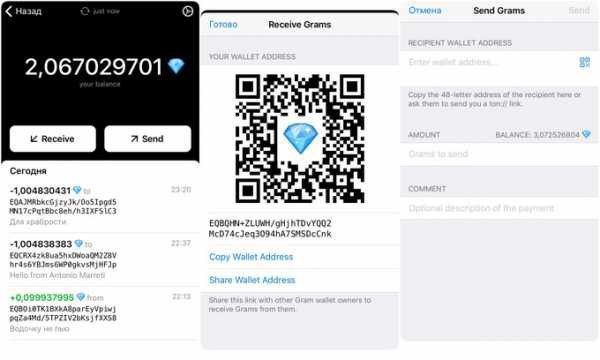
According to Telegram info, the Gram wallet appeared in the alpha version of Telegram for iOS for developers. Users shared wallet screenshots online:
When creating a wallet, you must provide 24 words that will be used to restore access to the wallet, even if you forget your password or lose access to your account.
So far, Telegram has functionality for creating and deleting a wallet, as well as the ability to receive and send tokens. The address of your wallet can be shared, including through a QR code.
In early September, Telegram posted an open-access test version of TON. Anyone could test the platform. By agreement with investors, the platform should earn in full mode by October 31, otherwise, Telegram will have to return the invested funds.
In March 2018, during the ICO, Pavel and Nikolai Durov raised $ 850 million for the development of TON. In total, investors invested $ 1.7 billion in the project. Among the investors are Qiwi co-founder Sergey Solonin and Wimm-Bill-Dann co-founder David Yakobashvili.
TON is an ecosystem on the blockchain with its own services, applications, and site analogs. An important part of TON should be the payment system for the Gram currency.
⚡️October launch is confirmed!
Original investors received emails from the Telegram core team.
Key items:
1. Following a successful initial testing period, TON is planned to be launched in late October.
2. Investors are provided with the TON Key Generation Software: https://generator.ton.org
3. Investors will have to provide Telegram with the public key to receive their Grams by October 16th. This key will be confirmed using credentials provided in the Token Purchase Agreement.
4. The entire source code of TON is available at https://github.com/ton-blockchain/ton.
5. Investors have to select validators. Neither Telegram nor the TON Foundation will serve as validators post-launch.
We will follow up with the additional analysis.
GitHub
GitHub - ton-blockchain/ton: Main TON monorepo
Main TON monorepo. Contribute to ton-blockchain/ton development by creating an account on GitHub.
Alipay promised to block all transactions related to Bitcoin trading
The payment unit of the Chinese e-commerce company Alibaba has promised to block all payments related to Bitcoin and other cryptocurrencies.
On Thursday, Alipay once again outlined its negative attitude to cryptocurrencies on Twitter, emphasizing that it closely monitors over-the-counter trading and will suppress activities carried out in violation of existing rules.
“If it is discovered that any transaction is related to Bitcoin or other virtual currency, Alipay will immediately suspend all relevant payment services,” the company said.
The day before, the Binance exchange confirmed that its users from China can make deposits through Alipay for peer-to-peer trading while noting that it does not have a direct agreement with the payment platform.
Binance launched its new service as part of a plan to increase competitiveness in the Chinese market. Currently, traders are invited to exchange yuan for Bitcoin, Ethereum and USDT. In the future, Binance intends to expand the service to other countries.
Last July, Alipay successfully tested a blockchain-based payment system.