
Digital RMB launch threatens Macau's gambling industry
The launch of the digital yuan threatens the Macau gambling industry, Bloomberg writes.
Although no official plans have been announced yet, intermediaries helping wealthy Chinese residents visit such establishments are beginning to wind down their businesses or move to other jurisdictions. They say the emergence of a government-tracked currency is tantamount to a death sentence for an industry that has already been hit by the coronavirus pandemic and tightening of regulations in recent years.
Several casino operators have reported that they have been contacted by the Macau Gaming Authority in recent months to discuss the possibility of selling chips for digital yuan. The regulator claims that this information is not true.
While the information remains unconfirmed, it has already stirred up the middlemen who provide private jets and organize lodging, but most importantly, supply players with chips. It is estimated that wealthy people in China account for half of Macau's revenue. Shares of related companies lost 3% on Wednesday.
Setting up settlements with the digital yuan in Macau would mean that Chinese gamblers will no longer be able to convert yuan into Hong Kong dollars for gambling. Beijing, on the other hand, will be able to keep track of all cash flows.
“If the water is too clean, there will be no fish left in it. Big players will leave if casinos become transparent, ”said one of the representatives of the intermediary business.
Chinese exchange CEO Global freezes withdrawals after the arrest of its co-founder
Hong Kong cryptocurrency exchange CEO Global announced the arrest of one of its founders. Withdrawals have been suspended.
Against the background of the development of a national cryptocurrency, the Chinese authorities continue to closely look at the cryptocurrency market. This time, the CEO Global exchange was not lucky. Chinese journalist Colin Wu told the readers of his Twitter that the bank card of the exchange co-founder has repeatedly received funds that were hiding from the tax authorities. Local authorities detained the CEO of Global for 15 days to conduct an investigation.
In an official statement, the exchange said that the detained manager kept most of the keys to the cold wallet. Therefore, it was decided to temporarily freeze the withdrawal of funds from the platform. In addition, the platform will restrict all services due to the risks associated with regulatory uncertainty in China.
The path from #CeFi to #DeFi in one chart.
The volume of funds spent on transactions in the #Ethereum network on #eth deposits of centralized exchanges fell from ~ 25% in 2017 to 1% today.
Almost all the commissions that were paid for transactions in the past months went to pay for the withdrawal of #eth from exchanges.
The volume of funds spent on transactions in the #Ethereum network on #eth deposits of centralized exchanges fell from ~ 25% in 2017 to 1% today.
Almost all the commissions that were paid for transactions in the past months went to pay for the withdrawal of #eth from exchanges.
The developers talked about the reasons for the first fines in the Ethereum 2.0 system and how to avoid them
Ethereum 2.0 update phase 0 was launched two weeks ago. ConsenSys researcher Ben Edgington said these were "wonderful boring days" as the system was fully functional and did not cause the unexpected bugs that community members feared.
However, some validators have already been slashed, that is, fined for allegedly malicious actions towards other network participants. Edgington gives five examples of such fines:
1. The first validator proposed conflicting blocks, thus for some time creating uncertainty in the system as to which block is considered correct. This happened due to the fact that the validator used two stations to start nodes with the same key.
2. After it, 10 validators were slashed at once, all of which belonged to the Stkr service from the Ankr startup and provided conflicting confirmations. As explained by Ankr, the problem was caused by their own anti-slashing mechanism. This mechanism carried out the restart of the node participating in the vote, which is prohibited by the rules. Edgington notes that clients have built-in protection against such actions from the outset, so it's not entirely clear what could go wrong or what was disabled in Ankr.
3. In the third case, another validator again proposed two conflicting blocks at the same height. Edgington admits that this validator used multiple nodes to increase its chances of earning non-fungible tokens (NFTs) used to reward early entrants to Ethereum 2.0 staking under the Proof of Attendance Protocol (POAP) program.
4. In the fourth case, the validator himself said that he used two nodes: one at home, the other at work. When it was his turn to offer a block, he was fined by the system for breaking the rules.
5. In the fifth example, the validator provided two confirmations for the same target checkpoint. The reasons for the incident were not specified.
As Edgington notes, in at least three cases, and possibly all, slashing is the result of prohibited practices that users have been repeatedly warned about. The researcher believes that out of fear of being fined for inactivity, stakers begin to unnecessarily complicate their configurations, which only aggravates the situation.
"It's a delusion! Please, do not do that. A small downtime (a day or two) will have little impact on overall reward over the long term. It's better than being slashed. As Vitalik says, “Don't try too hard,” Edgington explains.
In addition, developer Raul Jordan recommends that users always make sure they copy the activity history from the client when migrating the validator to a new device, which will allow them to avoid repeating the same actions and thus slashing.
Edgington also states that the amount of the fine in the first stages is small - 0.25 ETH from a deposit of 32 ETH. However, the main problem is that deposits of such stakers lose activity and remain blocked in the system until transfers are activated.
Overall, Edgington rates the validator participation rate as "very healthy" at 99%. To date, over 1.4 million ETH have been deposited into Ethereum 2.0 staking, 31,000 validators have been activated, and another 13,000 are in the queue.
Ether rate rose to a maximum since spring 2018
The largest altcoin ether (ETH) is updating highs along with bitcoin. ETH soared in value this week to its highest level since spring 2018.
On Friday, December 18, the altcoin went up to $ 647. Over the past 24 hours, ETH's capitalization has grown to $ 73.61 billion. Black Thursday, March 12, was a shock event for ether holders. On this day, the cryptocurrency crashed to $ 123.
However, this mark became a "bottom" for ETH, after which the ascent resumed. Ultimately, the winners were those ether holders who initially bet on long-term storage of the cryptocurrency.
The IntoTheBlock team draws attention to the surge in activity not only of bitcoin holders, but also of those players who prefer to keep funds in ETH.
According to analysts, now the number of Ethereum addresses with a non-zero balance exceeds 50 million. This is a record figure, indicating the growing investor confidence in the altcoin.
One of the drivers for strengthening the ETH rate was the information about the intention of the Chicago Exchange (CME) to launch Ethereum futures. The new product will be offered to investors on February 8 next year.
Many observers predict that altcoin will continue to rise in value after the launch of ETH futures.
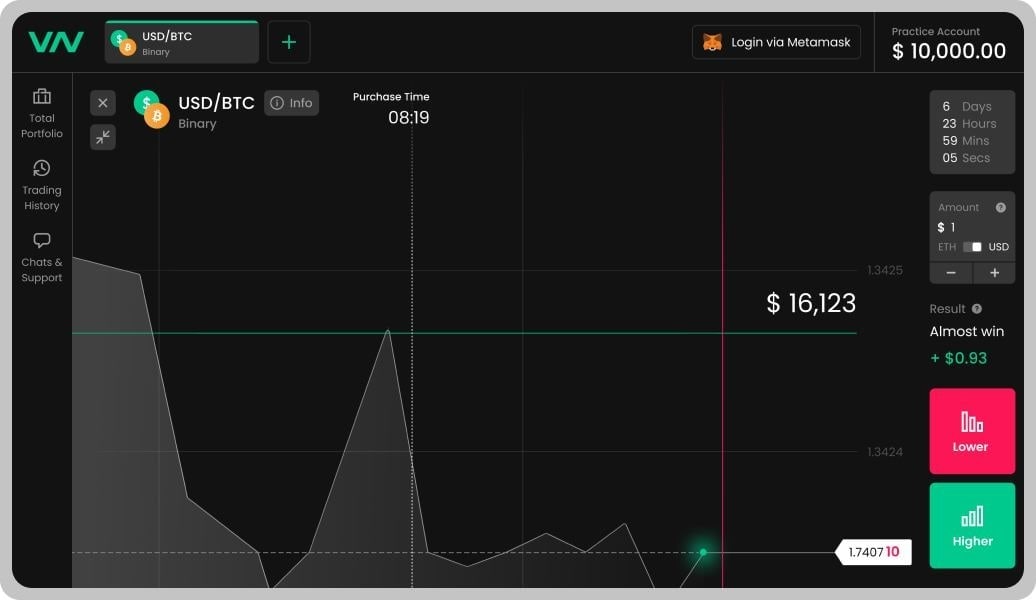
📈Value Network is a decentralized Binary options platform and exchange
🚀Started in 2018 by Artem Levin, the Value Network project has initially created the crypto-backed loans platform on Ethereum smart-contracts.
Re-started in September 2020, we've chosen the new vector of development - Binary options. We are solving the Binary options industry's main problems:
🔒By putting the bets against each other on the Ethereum blockchain, letting users compete against each other. There's no conflict of interest like on 99% of fiat platforms.
📱UI interfaces are made clear and engaging, differentiating us from current blockchain prediction markets' platforms.
🖍Also, users can see how their bet changes in price depending on the possibility of the outcome and replace their bets at any time for the additional fee.
❇️Whitelabel solution and blockchain-based referral system is in the pipeline in Q1 2021, boosting user adoption in the upcoming year.
📶 The VNTW token - the core of the Value Network platform plays a critical role in the ecosystem. Its utilities:
- Access to the exclusive markets
- Lowering of commissions on the trades
- Token is essential for creating of the new markets
- Staking
- Pre-timing escape of the deal
- Advertising possibilities on the platform
‼️ Listing will take place on Uniswap and Sushiswap on January 5th, allowing you to participate in 6 pairs, all with liquidity reward programs. 1% of the total supply will be destributed to liquidity providers in the first month. More details here.
✅Founder shares his ideas in Community daily - https://t.me/valuenetworkchat ✅
More detailed information is available on Medium (including roadmap) - https://valuenetworklive.medium.com/
Website - https://valuenetwork.live/
Crypto NEO pinned «📈Value Network is a decentralized Binary options platform and exchange 🚀Started in 2018 by Artem Levin, the Value Network project has initially created the crypto-backed loans platform on Ethereum smart-contracts. Re-started in September 2020, we've…»