
Over 40% of blockchain workers are employees of cryptocurrency exchanges
42% of employees in the blockchain sector work on cryptocurrency exchanges, according to a study by The Block portal.
A total of 158 companies were analyzed, including 30 exchanges. Mining with 11% of employees turned out to be the second-largest area, and cryptocurrency project management was the third. These included companies such as Ripple, TRON, Block.one, and IOHK.
The largest employers in the cryptocurrency industry are Bitmain, Huobi, Coinbase, and OKEx, with 1,500, 1,300, 1,000, and 950 employees. Binance and Ripple employ 650 and 450 people, respectively, according to The Block.
“It is not surprising that the three sectors where most people are employed are historically the only ones profitable. The vast majority of companies in other sectors are still at the promotion stage, ”said analyst Larry Chermak.
As noted earlier, Coinbase and Ripple this year were not able to enter the top ten leading startups according to LinkedIn.
In March, Good Place to Work recognized Ripple as one of San Francisco's top employers among technology companies. Then 91% of the employees surveyed rated their work experience in the company positively.
Earn 10% interest on your crypto deposits with StormGain! 🔥
We’re glad to announce an absolutely new era of making money on your crypto assets. Starting on 28 October, 2019, StormGain clients will receive guaranteed interest on their deposits equivalent or higher than 100 USDT.
➡️ How to earn interest with StormGain⬅️
Your investments are an driving factor in the StormGain investment lifecycle. To begin, your deposits allow StormGain clients to trade with a multiplier. For example, if a trader has 1000 USDT, our platform will permit them to open a deal for 5000 USDT using investors money. Of course, this opportunity is not free for traders - a fee is charged for the use of borrowed funds. On average, depending on the instrument and type of trade, the fee is 14% per annum, while 10% of it is given back to you, the investors, as the interest. The cycle is then closed with your return in interest on your investement.
Get guaranteed profit on your deposits in 4 simple steps:
▶️ Download the StormGain app for iOS or Android or register your account here.
▶️ Apply for the interest rate.
▶️ Deposit at least 100 USDT on your StormGain account.
▶️ Start making money with StormGain, official sleeve sponsor of Newcastle United FC.
Join now: http://bit.ly/2qZdxPF
Crypto NEO pinned «Earn 10% interest on your crypto deposits with StormGain! 🔥 We’re glad to announce an absolutely new era of making money on your crypto assets. Starting on 28 October, 2019, StormGain clients will receive guaranteed interest on their deposits equivalent…»
Bitfinex Added Support for SegWit Addresses for Outgoing Bitcoin Transactions
Bitfinex cryptocurrency exchange this Tuesday announced the addition of support for outputting bitcoins to Bech32 format addresses with support for Segregated Witness (SegWit) scaling technology.
According to Bitfinex, the addresses of the Bech32 form are peculiar only to the Bitcoin network and begin with “bc1”, which helps to avoid confusion between the chains when transferring funds. Also, customers using SegWit can rely on cheaper transactions when withdrawing funds from the exchange.
Previously, the ability to withdraw funds to Bech32 addresses was implemented, for example, by Gemini and Kraken. Also, add support SegWit plans exchange Binance.
According to the Transaction fee portal, the share of SegWit transactions in the Bitcoin blockchain currently stands at more than 50% after rising above this value at the end of September.
Bitfinex also today announced the addition of new visual instruments for derivatives trading, with which it will be easier for users to get market information, and the ability to connect Twitter accounts to an account on the exchange to display it in the list of most successful traders.
Cryptocurrency exchange DX.Exchange on NASDAQ technology suspended work
Estonian cryptocurrency exchange DX.Exchange, powered by the NASDAQ infrastructure, has announced the suspension of work.
According to the statement, the platform is not able to independently bear the costs of maintaining security and technology.
The board of directors of DX.Exchange said it would look for opportunities to merge or sell the company. The exchange management does not see other options for continuing work.
The platform has already stopped accepting deposits and trading. To withdraw funds, users must contact the exchange before November 15.
The launch of DX.Exchange took place earlier this year.
Recall that a few days after the start of work in the security system of the exchange, a vulnerability was discovered and eliminated, which opened access to authentication tokens.
Libra developers pre-launch the main project network
Representatives of the Libra Association reported details of the development of the project to create a digital currency of the social network Facebook, saying, among other things, about the successful launch of the Libra main network in preliminary mode.
According to the project’s blog, to this day this network, which is a copy of the future main network, has seven active nodes. Another 14 nodes, eight of which are not controlled by the Libra technical team, are preparing for launch.
As for the test network, since its restart in September, more than 51 thousand transactions have been registered in it.
To date, 34 different projects have been created in the Libra test network, including 10 wallets and 11 block browsers.
The publication also refers to the Libra Core Summit, which was held with the participation of members of the Libra Association technical team to attract more developers to the project. The organization plans to conduct such events on an ongoing basis, which will allow the development community to regularly discuss the problems and opportunities of the Libra ecosystem.
EXMR token went up by 412% in a few hours
The daily trading volume of a coin increased by more than 27,000%, its price rose 5 times after updating the project
The EXMR token exchange rate soared by 412%, to $ 0.11. Coin trading volumes increased by 27,000%, reaching $ 198 thousand, its capitalization is $ 1.28 million.
The increase in EXMR token value may be due to a recent upgrade. On November 18, the project team announced the introduction of stacking in their Twitter account. Now, asset holders will be able to earn coins for storing altcoins in their wallets.
The EXMR token is presented on three small trading floors. The increase in its price occurred on the Bitrabbit exchange. However, on the YoBit and IDEX platforms, the value of the coin has changed significantly less, on them, it still costs about $ 0.014.
A similar increase happened on November 14 with the Storeum token, it went up by 1500% in a few minutes. As in the case of EXMR, the coin rate rose only on one of the exchanges, while on the other it remained unchanged.
Sharp fluctuations in the value of low liquid assets may result from the use of the Pump & Dump scheme. It is widespread in the blockchain industry due to the lack of regulation.
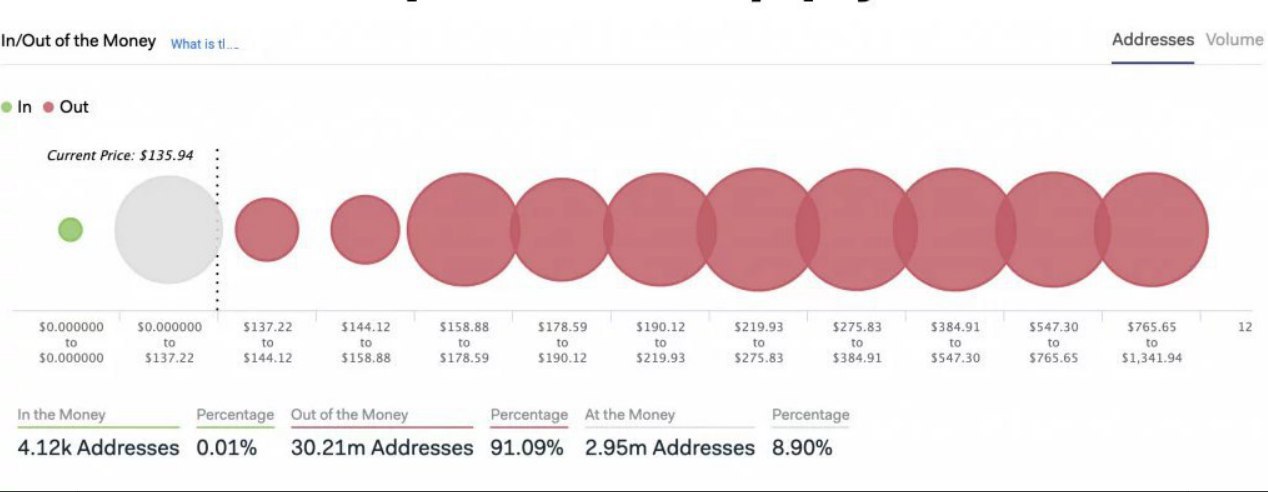
Over 90% of Bitcoin Hodlers is in the Red
As a result of a study by the IntoTheBlock portal, it turned out that 99.9% of the Ethereum holders after yesterday's fall of the coin to the level of $ 135 - in the red or on the verge of breaking even.
Only 4120 addresses (0.01%) can boast of a plus in their wallets.
At the same time, about 9% of ether holders can now go to zero, and more than 90% suffer losses.
During November, ETH fell 23% - at the beginning of the month, 27% of Hodler coins remained albeit in a small but positive (then the rate was $ 188).
At the same time, Bitcoin remains one of the most profitable tools of 2019 - in early November, 77% of BTC addresses remained in profit. And today this figure is 55%.
Profitable still remain: BCH (85%), BSV (94%), LINK (48%);
Unprofitable: ADA (87%), LTC (83%), ETC (81%), BAT (68%).
The Canadian authorities took control of the assets of the crypto exchange Einstein, owing customers $ 12.4 million
The Securities Commission of the Canadian Province of British Columbia (BCSC) has taken steps to gain control of the Einstein cryptocurrency exchange, which on October 31 announced its intention to close within 60 to 90 days.
According to court documents, Einstein owed its customers $ 12.4 million (16.3 million Canadian dollars). The British Columbia Supreme Court upheld the BCSC request and appointed Grant Thornton as the interim asset manager for the Vancouver cryptocurrency exchange.
According to BCSC, many complaints were sent to her from Einstein customers who were not able to access their assets on the exchange. The legal representative of the platform notified users that it was closing due to loss-making.
According to BCSC inspector Sammy Wu, at the end of last week he visited the Einstein office, where he found a locked elevator, after which he could not get through to any of the available phones, including the number of the founder of the exchange, Michael Gokturk. BCSC emphasized that it did not provide Einstein, like any other cryptocurrency exchange platform, with permissions to conduct such activities and urged investors to exercise caution when working with them.
This is the second case in the last year, when Canadian cryptocurrency exchanges are insolvent. At the beginning of the year after the death of its owner, QuadrigaCX closed, due to which up to 115 thousand of its customers suffered multimillion-dollar losses.
A court in New York sentenced the organizer of fraudulent ICOs to one and a half years in prison
Maxim Zaslavsky, who became the first person in the United States accused of organizing fraudulent campaigns for the initial placement of coins (ICO), was sentenced to one and a half years in prison, writes Cointelegraph.
An entrepreneur from Brooklyn was found guilty of organizing two fraudulent ICOs, which, he said, were provided with diamonds and real estate that did not exist. In November 2018, Zaslavsky pleaded guilty to conspiring to engage in securities fraud.
Zaslavsky claimed that his ICO was headed by professionals in the real estate market and the summer of 2017 attracted more than a thousand investors who invested at least $ 300,000.
“Zaslavsky committed an old-fashioned fraud disguised as advanced technology,” said Richard Donoghue, New York’s Eastern District Attorney. “The prosecutor’s office will continue to harass those who cheat on investors, whether they use traditional securities or virtual currencies.”
The defense claimed that Zaslavsky was trying to return money to investors, but his PayPal account was frozen due to suspicions that payments to ICOs were transferred from stolen credit cards.
“I was never a thief,” Zaslavsky said in court.
“You are a thief,” the judge answered. “You took what did not belong to you, using a false pretext.” This is a very unusual case for several reasons. It is associated with new technologies and new currencies. But there’s nothing new in lies or flagrant fraud. ”
BitPay adds support for stablecoins USDC, GUSD, and PAX
BitPay cryptocurrency operator added support for stablecoins USD Coin (USDC), Gemini Dollar (GUSD) and Paxos Standard Token (PAX).
Now users of the service, including such giants as Microsoft and Avnet, will be able to receive payments from their customers in the above stablecoins.
“Thanks to this decision, business representatives can not resort to the help of expensive and complex cross-border bank transfers, but instead invoice customers in stablecoins, which are free from volatility risks, and are also a more effective tool due to fast and cheap transactions,” commented the general BitPay Director Stephen Pair.
According to Joshua Rawlins, Managing Director of Financial Operations, Gemini, sellers will be interested in fast, cheap and secure payments from various fraudulent activities, and customers will be able to experience all the advantages of cryptocurrencies without fear for their volatility.
Before listing stablecoins, BitPay provided the ability to make payments using bitcoin, bitcoin, and ether. In addition to these cryptocurrencies, the company also plans to add rip. She announced these plans after agreeing with Ripple Xpring.
BitPay was founded back in 2011. Throughout its existence, it has attracted investments worth more than $ 70 million. Among the main investors are the Founders Fund, Nimble Ventures, and the Virgin Group. Over the past year, BitPay has processed payments totaling more than $ 1 billion.
CULedger tested blockchain platform with three US credit unions
The CULedger consortium, which includes representatives of US credit unions, has announced the successful completion of blockchain-based identification platform testing.
The test was attended by 3 American credit unions - Unify Financial Credit Union, Desert Financial Credit Union, and TruWest Credit Union. The platform was used in call centers of credit unions in order to identify telephone fraudsters who were trying to get loans.
The CULedger blockchain platform is used to increase security and reduce the risks of fraud in credit unions. It can also be used to optimize administrative and operational processes. CULedger releases special digital credentials called “MyCUID”, which are used to verify financial transactions.
“After the credit union has fully confirmed my identity and issued MyCUID credentials, they can be used in other organizations, for example, to receive medical or public services. You will no longer need logins and passwords. I have hundreds of different logins and passwords, but with MyCUID their number can be significantly reduced while increasing security, ”said Ron Amstutz, Executive Vice President of the Desert Financial Credit Union.
Brooklyn residents will be brought to court for the theft of $ 1 million in cryptocurrency using SIM swap
US authorities intend to prosecute 19-year-old Yousef Selassi on charges of stealing personal data of 75 residents of the country to misappropriate more than $ 1 million in cryptocurrency.
According to a statement from the Manhattan District Attorney’s Office, Selassi organized a sophisticated SIM swap scheme targeted at residents of 20 different states. This type of crime is associated with gaining access to the victim’s mobile phone number, which is then used to crack accounts connected to him in financial applications and social networks by intercepting automated messages or phone calls used in two-factor authentication.
Selassi is charged with nine episodes, including identity theft, large-scale theft of money, computer-assisted crime, and fraud.
According to the prosecutor, the attacker acted from his apartment in Brooklyn, "using only an iPhone and a computer." Selassi allegedly hacked accounts of potential victims in services such as Gmail, Yahoo and Dropbox to find out if they have cryptocurrency. In certain cases, he changed passwords to prevent their owners from accessing them, and “deliberately selected and attacked victims who were active participants in the cryptocurrency space”.
As a result of the search, various electronic devices were seized from Selassi, as well as custom-made jewelry, allegedly bought for bitcoins. Also, he found a handwritten record with a seed phrase from a cryptocurrency wallet, which, after recovery, allowed him to be associated with several victims and the theft of hundreds of thousands of dollars in cryptocurrency.
The prosecutor's office noted that this is the third major case of SIM swap, which the agency has to deal with in recent months.
⚡️2 great contests from SwapZilla — unique infrastructure solution that revolutionizes crypto trading.⚡️
🎬 Swapzilla Video Contest 🎬
Create a video and win up to $1500
How?
Create a creative video
Upload it to the YouTube and send us a link
Make your video popular and get up to 1500 USDT +
qualifying contestants will get a guaranteed 25 USDT!
Competition conditions
💰 Win up to 5 ETH every day💰
Each participant has an opportunity to receive up to 5 ETH daily and up to 10% of the total amount raised monthly.
How?
After purchasing SwapZilla tokens, you will be automatically added to the list of contest participants.
If you have bought at least 25 SWZL, then on this day, you will get an opportunity to win up to 5 ETH.
Competition conditions
Do not miss the opportunity to get up to 5 ETH every day or up to 1500$ for your video!
VeChain Foundation, whose wallet stolen 1.1 billion VET on December 13, reported on progress in resolving the consequences of this incident.
As promised in the first announcement, the VeChainStats service was used to organize a blacklist of addresses that received assets from an attacker's wallet, which avoided their direct sale through large exchanges such as Binance and Bittrex, which expressed their willingness to cooperate.
On December 18, an urgent client update was published, which allowed a vote among master node owners to block hacker wallets. In total, 469 addresses were blocked, on which 727 million VETs were frozen.
In the course of further voting, a decision will be made on what should be done with these tokens, including the possibility of their complete withdrawal from circulation. Limiting the distribution of assets that have been credited to exchange wallets up to this point will require further cooperation with trading platforms.
Also, sanctions were announced against employees whose actions entailed a violation of the organization’s wallet security. Jay Zhang will leave the post of CFO, refuse to participate in the elections to the steering committee of the VeChain Foundation in 2020 and lose half his salary for the next year. VeChain CEO Sunny Lou was found indirectly guilty of what happened and will also be held accountable. Like Zhang, he will not receive half of the payments due to him in 2020.
Hong Kong freezes $ 9 million donations for protesters, anti-banking sentiment rises
Hong Kong protesters have now turned their attention to financial censorship. This happened after last month the funds in the amount of $ 9 million received in support of the protesters were frozen.
Again, thousands of people took to the streets after the HSBC closed the Spark Alliance account associated with the protest movement.
“45,000 people protested outside HSBC headquarters in Hong Kong after closing a fundraising account in support of democracy. Organizers urge to boycott the bank. Although we are told that only criminals use bitcoin, it may turn out to be the most effective tool against them. ”
(However, according to Hong Kong authorities, there were no more than 3,300 such protesters).
People express dissatisfaction with the fact that the authorities will try to strangle the protest movement financially. One elderly woman stated:
“The money I donated came from hard work, and it’s not black money at all ... The police are just looking for any excuse to discourage young protesters.”
Promoters also say that HSBC’s actions are damaging Hong Kong’s reputation as a global financial center.
Events in this special administrative region of China serve as a reminder of the importance of a decentralized censorship-protected asset class, such as Bitcoin.
As you can see, people's discontent with financial censorship, which is global in nature, is becoming stronger. When existing systems no longer represent the most efficient or safest way to transfer value, it is only natural that more desperate people start looking for other options.
Earlier, we talked about the fact that the UN intends to use blockchain technology so that employment agencies in Hong Kong cannot hard exploit visiting workers in this region.
Developers announced a massive update of the NEM network on December 31
On the last day of the year, developers of the NEM altcoin (XEM) plan to upgrade the network to NEM 2.0. In parallel, the team promises to rebrand the project, the corresponding post she posted on Twitter.
The main difference between the updated version of the blockchain will be the release of a more advanced Catapult protocol. For the first time, the NEM Foundation startup together with Tech Bureau introduced this solution back in the spring of last year. Using this software, network users represented by various organizations have the opportunity to create their public or private ecosystem.
The startup blog also says that the NEM 2.0 blockchain will be high-performance and secure. Now the main users of the network are Japanese organizations, including agricultural and charitable organizations.
The announcement about the imminent release of the updated version of the platform had practically no effect on the current value of the XEM coin. At the time of publication of this material, altcoin was trading at $ 0.032, adding less than half a percent per day.
Note that during the so-called “bull race” at the end of 2017, the NEM rate exceeded $ 1. During peak trading periods, cryptocurrency capitalization reached $ 16.112 billion, but over the past two years, it has dropped to $ 289.795 million.
XRP does not respond to unlocking another portion of tokens
Ripple withdrew 200 million XRP from its Ripple Escrow Wallet, which is equivalent to approximately $ 38 million. The token is stably trading at around $ 0.19. Previously, the project unlocked 1 billion coins as part of a multi-stage defrosting process of 55 billion XRP.
As usual, some investors reacted negatively to this step, including Matum Greenspan, founder of Quantum Economics.
At the same time, unlike many other investors, Greenspan adheres to the bullish forecast for Ripple and XRP token. Meanwhile, entrepreneur Alistair Milne compared Ripple management control over XRP coins with the recent PlusToken scam.
Recent transactions with XRP
Recently, several notable transactions have been recorded in the Ripple blockchain after the transfer of 200 million tokens.
So, after unlocking 1 billion coins as part of a plan to defrost 55 billion tokens, 250 million XRP (for $ 48 million) was transferred to the so-called Funding Wallet 1, which supposedly relates to Ripple co-founder Chris Larsen.
What are the motives of Ripple
Recall that for the first time, Ripple announced a plan to gradually unfreeze its tokens in 2017. This plan involves unlocking 55 billion coins in 55 months. So, a recent operation was carried out as part of this program, which involves maintaining a stable supply level and increasing the use of coins. This decision was aimed at easing concern that Ripple could flood the market with a decent amount of XRP tokens.
At the same time, the project continues to face criticism from community members who talk about manipulating XRP coins. Opponents of the Ripple strategy cite the fact that the network is becoming centralized, and the phased unlocking of coins gives the project participants an unfair advantage.
The lawsuit against Tether and Bitfinex recalled
A lawsuit dated November 22, 2019 against the Bitfinex cryptocurrency exchange and the issuer Tether with charges of market manipulation was withdrawn on January 7. This is written by CoinDesk with reference to official documents.
Recall that at the end of last year, traders Eric Young and Adam Kurtz said that Bitfinex and Tether gave inaccurate information and "conspired to monopolize the bitcoin market."
“When bitcoin depreciated, defendants and their associates printed USDT and artificially increased the price of the leading cryptocurrency. After the rate went up, they converted back to USDT to replenish Tether’s reserves, ”the original application said.
Representatives of Bitfinex completely denied the allegations and promised to "fight to the end for the truth."
It is still unknown why the plaintiffs decided to “surrender”.
Liquid Exchange Cancels Gram Token Presale Results
Liquid Japanese cryptocurrency exchange canceled the results of the sale of not yet existing tokens of the Telegram blockchain project.
The sale was originally announced last June. Liquid offered investors a limited number of future tokens from Gram Asia, supposedly one of the largest investors in Telegram’s $ 1.7 billion ICO.
The funds raised from exchange users were in an escrow wallet awaiting the release of Gram, which was due to take place at the end of October. However, Telegram was forced to reconsider its plans because of the charges against it by the US Securities and Exchange Commission (SEC) in violation of the requirements for registering the campaign.
Liquid writes on its blog that the terms of sale of Gram on its platform provided that the launch of TON was due to take place before November 30, 2019. Since this did not happen, the results should be considered invalid.
In a conversation with CoinDesk, Liquid Development Commercial Director Seth Melamed said: “100% of client funds will be returned to participants. No commissions or fees. ”
Liquid has unveiled an escrow wallet address that currently does not contain assets.
It is expected that the SEC and Telegram will meet in court on February 18-19.