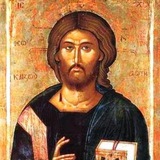
The virtuous life of the Venerable Anthony of the Kiev Far Caves (July 10/ July 23) illumined his homeland. At Mt Athos, his abbot gave the remarkably he zealous young ascetic Anthony obedience so that he would return to his beloved Russia to plant monasticism in the newly enlightened Christian country.
Anthony found none of the Greek monasteries there to his liking. He was accustomed to the more austere Athonite tradition. Anthony settled there as a hermit, subsisting almost exclusively on bread and water. Anthony's life of solitude was short-lived, as people began coming to ask his blessing and counsel. St Anthony's gifts of healing, of clairvoyance and spiritual discernment would become widely recognized.
"And having shown a multitude of monastics,
The pathway leading to the heavenly kingdom,
You led them to Christ,
Beseech Him, O Venerable Anthony,
That he may save our souls!"
We call the Most-Holy Theotokos “More Spacious Than The Heavens” because she held in Her womb Him who holds the whole universe.
The icon of the Mother of God, More Spacious Than the Heavens, is found on the wall above and behind the Altar in most Orthodox Churches.
Photo: Icon from the Altar of St. Mary's Romanian Orthodox Church, Calgary, Alberta
The icon of the Mother of God, More Spacious Than the Heavens, is found on the wall above and behind the Altar in most Orthodox Churches.
Photo: Icon from the Altar of St. Mary's Romanian Orthodox Church, Calgary, Alberta
My blessed children. Rejoice and be well. Sorry to bother you again with my illiteracy and unworthiness. Do not be shaken by the events of this present life. The struggle will continue with a variety of bad events in humanity in general. Our sins are great. What we sow we shall reap. Fight with faith and courage in the Lord Jesus. Do not despair. The struggle will be hard and dangerous. God's protection will save his true children. God's people will be covered with God's holy angels. Stay faithful to our Orthodox Church. For this I beseech you, that He may grant you His most gracious Name, which fills our dead hearts with Heavenly Life and Peace.
Persistently call out to God by crying out for help. Our Heavenly Father very much wants this annoyance because He is all ready to visit us, and give us His Golden Heart and unite it with our sinful one.
+Geronta Ephraim
Persistently call out to God by crying out for help. Our Heavenly Father very much wants this annoyance because He is all ready to visit us, and give us His Golden Heart and unite it with our sinful one.
+Geronta Ephraim
“Everything, both good and evil, comes from our thoughts. Our thoughts become reality. Even today we can see that all of creation, everything that exists on the earth and in the cosmos, is nothing but Divine thought made material in time and space. We humans were created in the image of God. Mankind was given a great gift, but we hardly understand that. God’s energy and life is in us, but we do not realize it. Neither do we understand that we greatly influence others with our thoughts. We can be very good or very evil, depending on the kind of thoughts and desires we breed. If our thoughts are kind, peaceful, and quiet, turned only toward good, then we also influence ourselves and radiate peace all around us—in our family, in the whole country, everywhere. This is true not only here on earth, but in the cosmos as well. When we labor in the fields of the Lord, we create harmony. Divine harmony, peace, and quiet spread everywhere.
However, when we breed negative thoughts, that is a great evil. When there is evil in us, we radiate it among our family members and wherever we go. So you see, we can be very good or very evil. If that’s the way it is, it is certainly better to choose good! Destructive thoughts destroy the stillness within, and then we have no peace.”
—Elder Thaddeus of Vitovnica
—Elder Thaddeus of Vitovnica
“If we continue to be plagued by guilt, even after we have received the absolution of Christ, through His agent the priest, we compound the very sin we've confessed, for in clinging to our guilt, we act as thought there is no forgiveness. Clinging to guilt is not a sign of humility, but rather a sign of unbelief, for we turn a cold shoulder to the very forgiveness that has been pronounced, as though it were not true.
Christ's absolution is a two way street, for having confessed our sin, and receiving Christ's forgiveness, we must receive that forgiveness with great joy, for we, like the woman at the well, must go, and sin no more.”
—Abbot Tryphon
Christ's absolution is a two way street, for having confessed our sin, and receiving Christ's forgiveness, we must receive that forgiveness with great joy, for we, like the woman at the well, must go, and sin no more.”
—Abbot Tryphon
Though his grandmother, had been a Christian, Holy Prince Vladimir (July 15/28) inherited the paganism of his father. Yet, he sought for something more. The prince sent emissaries to investigate the faiths of the Jews, the Muslims, the Western Christians and the Orthodox.
After experiencing services at Agia Sophia in Constantinople, the emissaries told him, “We knew not whether we were on earth or in heaven… We only know that God dwells there among the people, and their service is fairer than the ceremonies of other nations." Prince Vladimir, moved by their description, was baptized in Cherson in 988, receiving the name Basil. "He came forth from the font not only healed of a blindness lately afflicting him, but also from being passionate and warlike, he became meek, peaceable, and exceedingly godly." (Great Horologion)
After experiencing services at Agia Sophia in Constantinople, the emissaries told him, “We knew not whether we were on earth or in heaven… We only know that God dwells there among the people, and their service is fairer than the ceremonies of other nations." Prince Vladimir, moved by their description, was baptized in Cherson in 988, receiving the name Basil. "He came forth from the font not only healed of a blindness lately afflicting him, but also from being passionate and warlike, he became meek, peaceable, and exceedingly godly." (Great Horologion)
He immediately set about building a Christian nation: casting down the idols, baptizing the people, and creating legislation modelled on the Gospel of Christ and His commandments. He left behind as the largest Orthodox kingdom in the world.
“Holy Prince Vladimir, you were like a merchant in search of fine pearls. By sending servants to Constantinople for the Orthodox Faith, you found Christ, the priceless pearl. He appointed you to be another Paul, washing away in baptism your physical and spiritual blindness. We celebrate your memory, asking you to pray for all Orthodox Christians and for us, your spiritual children.”
—Troparion, Tone 4
“The preaching of the Apostles and the dogmas of the Fathers sealed the one Faith of the Church; and clad in the garment of truth woven of theology from on high, it teaches aright and glorifies the great mystery of piety.” —Kontakion to the Fathers of the First Six Councils, Tone 8
"By virtue of the catholic nature of the Church, an Ecumenical Council is the Church’s supreme authority, and possesses the competence to resolve major questions of church life. An Ecumenical Council is comprised of archpastors and pastors of the Church, and representatives of all the local Churches, from every land of the “oikumene” (i.e. from all the whole inhabited world)."
(oca.org/.../15/50-fathers-of-the-first-six-councils)
The First Ecumenical Council (Nicea I) (May 29, 325 and also on seventh Sunday after Pascha) was convened against the heresy of Arius, in the city of Nicea in Bithynia under St Constantine the Great, Equal of the Apostles.
The Second Ecumenical Council (Constantinople I) (May 22. 381) was convened against the heresy of Macedonias, by the emperor Theodosius the Great.
The Third Ecumenical Council (Ephesus) (September 9, 431) was convened against the heresy of Nestorius, in the city of Ephesus by the emperor Theodosius the Younger.
The Third Ecumenical Council (Ephesus) (September 9, 431) was convened against the heresy of Nestorius, in the city of Ephesus by the emperor Theodosius the Younger.
The Fourth Ecumenical Council (Chalcedon) (July 16, 451) was convened against the Monophysite heresy, in the city of Chalcedon under the emperor Marcian.
The Fifth Ecumenical Council (Constnatinople II) (July 25, 553) "Concerning the Three Chapters," was convened under the emperor Justinian the Great.
The Fifth Ecumenical Council (Constnatinople II) (July 25, 553) "Concerning the Three Chapters," was convened under the emperor Justinian the Great.
The Sixth Ecumenical Council (Constantinople III) (January 23) met during the years 680-681, to fight the Monothelite heresy, under the emperor Constantine Pogonatos.
The Seventh Ecumenical Council (October, 787) was convened against the iconoclasts, who considered it idolatry to depict God or humans artistically. The council declared Icons as necessary as and essential in protecting the full and proper doctrine of the Incarnation.
Since there are Seven Holy Ecumenical Councils, why do we commemorate only the first six on the 5th Sunday After Pentecost ? The Seventh Ecumenical Council occurred after the yearly commemoration of the first six had begun.
“Everyday I can see before my eyes the ongoing corruption of our clergy…. The last remaining believers are trembling with repugnance over the condition of their clergy. And there is no one to finally realize just what brink of destruction the Church is standing on, or what is happening.”
☦️ New Hieromartyr Seraphim (Chichagov) of Petrograd, in a prophetic letter written in 1910, seven years before the Bolshevik Revolution
☦️ New Hieromartyr Seraphim (Chichagov) of Petrograd, in a prophetic letter written in 1910, seven years before the Bolshevik Revolution