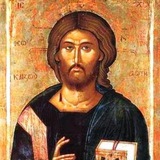
"We must try to purify ourselves both externally and internally, especially our mind— because all the evil that takes place in our heart and with our body originates from the mind. Evil is externalized through the bodily members once the mind and intellect have succumbed to sin. Bees do not land on flowers lacking nectar. Rather, they fly to flora containing nectar, which they convert into sweet honey. Similarly, the Holy Spirit races around the earth in search of a pure mind and serene intellect, where He comes to rest and bears fruit. Therefore, in order for us to receive the Holy Spirit, Who will strengthen us and render us worthy of confessing the Divinity of our Christ, we must first struggle to purify ourselves spiritually and physically, and then be crowned."
☦️ Geronda Ephraim of Arizona (1928-2019), “Art of Salvation”
☦️ Geronda Ephraim of Arizona (1928-2019), “Art of Salvation”
In 2011, the discovery of the tomb of the Holy, All-Praised Apostle Philip (Nov 14/27) left archaeologists breathless. The heavy wear of the marble of steps to the tomb, discovered with the help of satellite technology, indicates that the tomb received an extraordinary amount of veneration.
The holy apostle was crucified upside-down by the superstitious pagans of Hierapolis (in present-day Turkey) in about 80 AD but his relics were not contained at the discovery site. They were initially brought to Constantinople and in the sixth century taken to Rome and buried, next to the Apostle James, in the Church of Sts. James and Philip.
A portion of St Philip’s skull was taken to the village of Arsos, in Paphos, following the fall of Constantinople to the Crusaders in 1204. The skull was transferred to Cyprus that year. The skull is now kept in a silver reliquary at the ancient Monastery of the Holy Cross in Omodos, and is the source of many miracles.
From pain to dancing: a modern miracle of Holy Wonderworkers and Unmercenaries Cosmas and Damian of Mesopotamia (Nov 1/ Nov 13) The following miracle happened to one of the well-known present-day Greek elders, Father Ambrose Lazaris (1912-2006) in 1937, when he pursued asceticism in the Koutloumousiou Monastery on Mount Athos under the name of Chariton (as a Ryassophore monk). On a hot August day, Monk Chariton decided to go to the monastery garden to collect figs but he did it without the abbot’s blessing. He climbed a fig tree and started picking figs. The tree branch broke down, the monk fell to the ground and hit the ground so hard that his leg broke in half. Father Chariton cried out in terrible pain. Monks fled to the garden and carried their brother to the monastery hospital, where there was a small church in the name of Holy Unmercenaries Cosmas and Damian.
Because Athos was occupied by the Nazis in those years, there was devastation everywhere; there were no doctors in the monastery hospital, so Chariton’s situation was hopeless. Where you can’t rely on people, the Heavenly Hosts rush to help. Remembering that terrible night when he was lying in pain, the elder said: “So what happened at 12:00 in the morning? I saw St. Cosmas and St. Damian come down from the dome in person and approach me. The room was flooded with light.”
“Poor guy, how did he break his leg so badly?” St. Damian said. Saint Cosmas came up to my head and told St. Damian: “Go to the leg, take it and pull it out!” St. Damian stepped up to the leg and pulled it out. It was so painful that I cannot describe it!“ “We are here to help you. Do not be afraid, everything will be all right,” St. Cosmas said. “So what happened? When he pulled out the leg, it merged together! Bones, muscles, everything else: they were not visible anymore! After that, the pain disappeared. I immediately jumped up, started dancing and singing, unaware of what I was doing. Other monks woke up.””Monk Chariton must have gone mad from pain, he sings at such a late hour…”
The monks ran to the hospital. “Why did you get up? Sit down so you don’t break your other leg!” “Look!” I said. We had the Church of the Holy Unmercenaries in front of us. “The two who sit on their thrones came here an hour ago. One of them stood at my head and the other at my feet. They pulled out my leg, put it back in place, and now I can walk again!” “The monks did not fall asleep that night, and celebrated the Divine Liturgy the next morning. I also went to it. They celebrated the Divine Liturgy three days in a row.” Translated by The Catalogue of Good Deeds
Baptism by Rain
The martyrdom of Saints Akindinos, Pegasias, Anempodist and those with them (Nov 2/ Nov 15) is one of the fire of zeal and baptism by rain.
The martyrs miraculously escaped the pain of a series of attempted executions under the sadistic and enraged Persian emperor Sapor II (310-381). As each execution attempt failed, the fury of the emperor grew— and so did the number of new Christians.
At one point, the saints were put on an iron grate and a fire was lit. As they prayed, rain fell and extinguished the fire. In response, many came to believe and confess faith in Christ. The saints called on the new believers to accept Holy Baptism by the rain sent down upon them. Among the newly baptized was the emperor’s own mother, and one of the executioners, who had publicly repented.
The day of execution was a day of bloodshed as the emperor ordered the slaughter of every Christian in the crowd. Elpidiphoros, the repentant executioner, was among them.
Later, Akindinos, Pegasias, and Anempodist together with the emperor’s mother were set ablaze but when Christians came secretly by night to the place of the execution, they found the bodies of the holy martyrs unharmed. With reverence they buried them.
Troparion, Tone II “O athletes of the Lord,/ blessed is the earth/ which drank in your blood,/ and holy the habitations which have received your bodies,/ for ye vanquished the enemy in the arena/ and preached Christ with boldness.// Entreat Him, in that He is good, we pray, that our souls be saved.”
Troparion, Tone II “O athletes of the Lord,/ blessed is the earth/ which drank in your blood,/ and holy the habitations which have received your bodies,/ for ye vanquished the enemy in the arena/ and preached Christ with boldness.// Entreat Him, in that He is good, we pray, that our souls be saved.”
Elder Paisie Olaru on setting a prayer rule
"Each one does what he can, just as the bee does not take all the nectar from the flower. But it’s very good if you do a little rule. I know this myself, if I get up and do a little of my rule, it seems as if I’m a different man all day long. But if you get up in the morning and you whirl around the house because you have this and that to do, then your whole day goes poorly. So do a little of your rule every day, like the righteous Job, who offered sacrifice every day for his children in case they had sinned in their thoughts (cf Job 1:5)."
"Each one does what he can, just as the bee does not take all the nectar from the flower. But it’s very good if you do a little rule. I know this myself, if I get up and do a little of my rule, it seems as if I’m a different man all day long. But if you get up in the morning and you whirl around the house because you have this and that to do, then your whole day goes poorly. So do a little of your rule every day, like the righteous Job, who offered sacrifice every day for his children in case they had sinned in their thoughts (cf Job 1:5)."
Priests have huge shoes to fill. Through many temptations and trials, they walk in the path of the Holy Apostles of Christ. What an affront to the ancient enemy of Christ! Let us not take the enemy’s side when our priests do not meet our expectations. They struggle with even greater temptations than we do— and more cleverly devised. Pray! Lord have mercy!
Consider the lilies, how they grow: they neither toil nor spin; and yet I say to you, even Solomon in all his glory was not arrayed like one of these. If then God so clothes the grass, which today is in the field and tomorrow is thrown into the oven, how much more will He clothe you, O you of little faith?And do not seek what you should eat or what you should drink, nor have an anxious mind. For all these things the nations of the world seek after, and your Father knows that you need these things. But seek the kingdom of God, and all these things shall be added to you.
☦️ Luke 12:27-31
☦️ Luke 12:27-31
"Commanders of God’s armies and ministers of the divine glory, princes of the bodiless angels and guides of mankind, ask for what is good for us, and for great mercy, supreme commanders of the Bodiless Hosts."
—Kontakion, Synaxis of the Archangel Michael and the other Bodiless Powers: Gabriel, Raphael, Uriel, Salaphiel, Jegudiel, and Barachiel (Nov 8/ Nov 21)
—Kontakion, Synaxis of the Archangel Michael and the other Bodiless Powers: Gabriel, Raphael, Uriel, Salaphiel, Jegudiel, and Barachiel (Nov 8/ Nov 21)
Where does the idea of prayers to angels and to saints come from? Actually it’s more than an idea. It’s a reality found in Holy Scripture.
Abbot Tryphon notes that “the Bible indeed directs us to invoke those in heaven and ask them to pray with us. In Psalms 103, we pray, ‘Bless the Lord, O you his angels, you mighty ones who do his word, hearkening to the voice of his word! Bless the Lord, all his hosts, his ministers that do his will!’ (Psalms 103:20-21). And in Psalms 148 we pray, ‘Praise the Lord! Praise the Lord from the heavens, praise him in the heights! Praise him, all his angels, praise him, all his host!’ (Psalms 148:1-2).
Abbot Tryphon notes that “the Bible indeed directs us to invoke those in heaven and ask them to pray with us. In Psalms 103, we pray, ‘Bless the Lord, O you his angels, you mighty ones who do his word, hearkening to the voice of his word! Bless the Lord, all his hosts, his ministers that do his will!’ (Psalms 103:20-21). And in Psalms 148 we pray, ‘Praise the Lord! Praise the Lord from the heavens, praise him in the heights! Praise him, all his angels, praise him, all his host!’ (Psalms 148:1-2).
Not only do those in heaven pray with us, they also pray for us. In the book of Revelation, we read: ‘[An] angel came and stood at the altar [in heaven] with a golden censer; and he was given much incense to mingle with the prayers of all the saints upon the golden altar before the throne; and the smoke of the incense rose with the prayers of the saints from the hand of the angel before God’ (Rev. 8:3-4).
Those in heaven who offer to God our prayers aren’t just angels, but humans as well. John sees that ‘the twenty-four elders [the leaders of the people of God in heaven] fell down before the Lamb, each holding a harp, and with golden bowls full of incense, which are the prayers of the saints’ (Rev. 5:8). The simple fact is, as this passage shows: The saints in heaven offer to God the prayers of the saints on earth.
If Christ is the only intercessor before the Throne why do our Protestant friends ask fellow believers from praying for them? We all ask our friends to pray for us all the time. Why, then, would we not want to ask for the prayers of those who have already won their place in Paradise, and are already standing before the Throne of God, worshiping the Holy Trinity?”