St. Dorotheos of Gaza on the Holy Lenten Fast: “Everyone who wants to purify himself of the sins of the whole year during these days must first of all restrain himself from the pleasure of eating. For the pleasure of eating, as the Fathers say, caused all men's evil. Likewise he must take care not to break the fast without great necessity or to look for pleasurable things to eat, or weigh himself down by eating and drinking until he is full."
The gentle, charitable St. Cuthbert, Wonderworker of Lindisfarne (Mar 20) could not perform the Holy Liturgy without tears. Likewise, he wept at hearing confessions. His compassion extended to all creatures.
When the saint would stand along the frigid coastline to pray, otters would come around him and lay along his feet to keep them dry and warm.
St. Cuthbert was known to surround himself with a species of duck and gave a rule which prohibited them from being eaten or disturbed. To this day, the species is known as the “Cuddy duck” in St. Cuthbert’s honour.
“Having surpassed thy brethren in prayers, fasting, and vigils, thou wast found worthy to entertain a pilgrim-angel; and having shone forth with humility as a bright lamp set on high, thou didst receive the gift of wonderworking. And now as thou dwellest in the heavenly Kingdom, O our righteous Father Cuthbert, intercede with Christ God that our souls be saved.”
"Come, see a Man who told me all things that I ever did. Could this be the Christ?" (John 4:29)
According to the tradition of the Church, the name of the Samaritan Woman by Jacob's well (Mar 20 and the 5th Sunday of Pascha) is Photini (or Photine, Photina, Svetlana), which means “light" (Φωτεινός). She is sometimes called the first evangelist since after her encounter with Christ at the well, she told her townspeople that she had met the Christ.
"Now if a woman of Samaria is so eager to learn something profitable; if she stays with Christ though not yet knowing Him, what pardon shall we obtain? ... We know Him ... yet are unable to endure anything that is said, but are jaded in our knowledge. ☦️ St John Chrysostom
Great-Martyr Photini, Equal-to-the-Apostles, pray to Christ for the salvation of our souls!
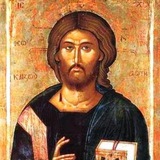
On the 1st Sunday of Great Lent, the Sunday of Orthodoxy, we commemorate the “Triumph of Orthodoxy,” the restoration of the holy icons in the reign of the holy Empress Theodora
St John of Damascus on Holy Images: "I do not worship matter, I worship the God of matter, who became matter for my sake, and deigned to inhabit matter, who worked out my salvation through matter. I will not cease from honouring that matter which works my salvation."
Photo: Holy Trinity Greek Orthodox Church, Orlando, Florida
“Behold the maidservant of the Lord! Let it be to me according to your word.”
The Annunciation to the Most-Holy Theotokos (Mar 25) "is the beginning of our salvation, the revelation of the eternal mystery! The Son of God becomes the Son of the Virgin as Gabriel announces the coming of Grace. Together with him let us cry to the Theotokos: Rejoice, O Full of Grace, the Lord is with you!" (Troparion of the Feast, Tone 4)
The Annunciation to the Most-Holy Theotokos (Mar 25) "is the beginning of our salvation, the revelation of the eternal mystery! The Son of God becomes the Son of the Virgin as Gabriel announces the coming of Grace. Together with him let us cry to the Theotokos: Rejoice, O Full of Grace, the Lord is with you!" (Troparion of the Feast, Tone 4)
If you fill your soul with news, what will it be fragrant with?
‘Our mind is wandering all the time as it is, our thoughts are constantly far away and we are unable to focus on anything. It’s the wandering of the mind. We receive some news willy-nilly. Then we begin to turn it over in our minds. And next the well-known scheme works:
‘Provocation—coupling—assent—captivity—sin.'
All the points of the development of sin are present in us. Someone hears some news, begins to think about it, gets annoyed, angry, and starts to judge others. As a result, we find ourselves in a state when we are unable to pray. How can we pray if we are annoyed, angry and condemn others?
—Father Sergei Ermolaev, Church of St. John the Baptist, Vologda
"How mistaken are those people who seek happiness outside of themselves, in foreign lands and journeys, in riches and glory, in great possessions and pleasures, in diversions and vain things, which have a bitter end! In the same way, to construct the tower of happiness outside of ourselves as it is to build a house in a place that is consistently shaken by earthquakes. Happiness is found within ourselves, and blessed is the man who has understood this. Happiness is a pure heart, for such a heart becomes the throne of God. Thus says Christ of those who have pure hearts: 'I will visit them and will walk in them, and I will be a God to them, and they will be my people.' (2 Cor. 6:16) What can be lacking to them? Nothing, nothing at all! For they have the greatest good in their hearts: God Himself!"
✝️ St. Nektarios of Aegina, “Path to Happiness”
✝️ St. Nektarios of Aegina, “Path to Happiness”
While it is impossible to know God in His essence (God in Himself), it is possible to know God in his energies— that is, to know what God does, and who He is in relation to the creation and to man. This is the teaching of St. Gregory Palamas, Archbishop of Thessalonica. This is the Orthodox Faith. “Anyone fortunate enough to attain to the divine energy, and to undergo divine transformation, himself becomes completely like the light. He is with the light, and by means of it sees clearly things which, were it not for this great and inexpressible grace, would be invisible to all.” St. Gregory taught that when the Apostles Peter, James and John witnessed the Transfiguration of Jesus Christ on Mount Tabor, they were in fact seeing the uncreated light of God-- a light that can be seen by others with repentance, spiritual discipline and contemplative prayer.
"God both is and is said to be the nature of all things, in so far as all things partake of Him and subsist by means of this participation... In this sense He is the Being of all beings, the Form that is in all forms as the Author of form, the Wisdom of the wise and, simply, the All of all things. Yet He is not nature, because He transcends every nature; He is not a being because he transcends every being; and He is not nor does He possess a form, because He transcends every form...He is everywhere and nowhere; He has many names and He cannot be named; He is ever-moving and He is unmoved and, in short, He is everything and no-thing." ✝️ St. Gregory Palamas