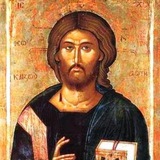
They shall go from strength to strength; the God of gods shall be seen in Zion. O Lord God of hosts, hear my prayer; give ear, O God of Jacob. O God, our protector, behold, and look upon the face of Your anointed. For one day in Your courts is better than a thousand; I chose to be an outcast in the house of my God, rather than to dwell in the tents of sinners. For the Lord God loves mercy and truth; He will give grace and glory; the Lord’s hand will not remove good things from those who walk in innocence. O Lord of hosts, blessed is the man who hopes in You. #Psalm83
“Whoever reads the Psalms imitates the angels and sings together with them.” ✝️ Elder Paisie Olaru of Sihla, from “A Little Corner of Paradise”
“Whoever reads the Psalms imitates the angels and sings together with them.” ✝️ Elder Paisie Olaru of Sihla, from “A Little Corner of Paradise”
By raising Lazarus from the dead before Thy Passion, Thou didst confirm the universal resurrection, O Christ God!
“Lazarus Saturday is a paschal celebration. It is the only time in the entire Church Year that the Resurrectional service of Sunday is celebrated on another day. At the liturgy of Lazarus Saturday, the Church glorifies Christ as ‘the Resurrection and the Life’ who, by raising Lazarus, has confirmed the universal resurrection of mankind even before His own suffering and death.”
— Fr Thomas Hopko, Orthodox Worship
Prayer ropes save the departed from Hell
While St. Joseph the Hesychast was praying for a departed soul who had been condemned, he had the following vision: “As I was praying, I saw the late Fr (Saint) George (Karslidis) in front of me… I managed to meet him because he was still alive when I was in the world. Every day, he served the Liturgy and commemorated thousands of names. Afterwards, he would go to the graves and read trisagion prayers and memorial services for the departed, all day long. I saw him in a vision and heard him saying to me in great amazement: ‘Wow! Until today, I thought that the deceased were only saved with Liturgies and memorial services. But today I saw and realized that people in Hell are also saved with prayer ropes.’ Again he repeated with admiration: ‘Yes, people are also saved with prayer ropes.’”
While St. Joseph the Hesychast was praying for a departed soul who had been condemned, he had the following vision: “As I was praying, I saw the late Fr (Saint) George (Karslidis) in front of me… I managed to meet him because he was still alive when I was in the world. Every day, he served the Liturgy and commemorated thousands of names. Afterwards, he would go to the graves and read trisagion prayers and memorial services for the departed, all day long. I saw him in a vision and heard him saying to me in great amazement: ‘Wow! Until today, I thought that the deceased were only saved with Liturgies and memorial services. But today I saw and realized that people in Hell are also saved with prayer ropes.’ Again he repeated with admiration: ‘Yes, people are also saved with prayer ropes.’”
Since Saint Joseph the Hesychast wasn’t a priest, he would commemorate the souls of the departed by fervently praying for them on his prayer rope, and through the prayers of Saint Joseph, souls were saved from Hell.
—Elder Haralambos Dionysiatis
—Elder Haralambos Dionysiatis
St. George (April 23/May 6) at his martyrdom, addressed the Emperor: “I am saved only by calling upon Christ and His Power. Whoever believes in Him has no regard for tortures and is able to do the things that Christ did” (John 14:12).
His own torturers were among those converted on witnessing the saint’s courage while being tormented for his faith un Christ.
His own torturers were among those converted on witnessing the saint’s courage while being tormented for his faith un Christ.
Then Jesus said to them, “Most assuredly, I say to you, Moses did not give you the bread from heaven, but My Father gives you the true bread from heaven. For the bread of God is He who comes down from heaven and gives life to the world.” + John 6:32-33
Mandylion (Not-made-by-hands) icon courtesy of www.eikonografos.com. Used with permission
Mandylion (Not-made-by-hands) icon courtesy of www.eikonografos.com. Used with permission
Slaying serpents (or dragons) isn't just a man's work. One day after the commemoration of St George who famously put a serpent in its place, we honour St Elizabeth the Wonderworker of Constantinople (Apr 24/ May 7), who famously put a serpent in its place. St Elizabeth, who was Abbess of the Saints Cosmas and Damian Monastery, lived centuries after St George. St Elizabeth did it not slay the creature with the aid of a sword, but simply by her prayer.
St Elizabeth, who practiced an ascetic life from her youth, also healed a woman with an issue of blood who had been ill for many years and cast out unclean spirits. At her tomb, many were healed of various illnesses, and the blind received their sight.
Portions of St Elizabeth’s relics can be found at the Monastery of Saint Anna in Lygaria, Crete and the Monastery of Ntaou Penteli in Athens, Greece.
"I am a Taliban of the Church, and I consider death as nothing. Whoever fears death cannot do a good deed..." Papa-George Chiotakas, military priest (reposed Feb. 21, 2016) in Crete, father of 12 children.
http://www.johnsanidopoulos.com/2016/02/the-beloved-priest-of-saint-porphyrios.html
http://www.johnsanidopoulos.com/2016/02/the-beloved-priest-of-saint-porphyrios.html
You became man, O Christ.
You took human nature from the Virgin!
As a man, you asked where Lazarus was buried,
Though as God, you know all things!
You have given us a pledge of your own resurrection
By raising your friend as if from sleep, O Word of God,
Though his flesh had tasted corruption from four days in the tomb.
#LazarusSaturday
“When you received the grace of the Spirit from on high, O Apostle, you broke the snares of the philosophers and gathered all nations into your net, bringing them to your Lord...'' Kontakion, Tone 2
The Holy Apostle and Evangelist Mark (May 8/Apr 25), who wrote the holy Gospel (ca. 62-63) bearing his name, is in iconography represented by a lion, symbolizing the might and royal dignity of Christ (Rev 5:5).
One of the central themes in the Gospel of St Mark is the power of God achieving what is humanly impossible. By the power of the Holy Spirit, St Mark indeed did what was humanly impossible, again and again throughout his vast missionary travels— preaching, teaching, and healing.
The school he established in Alexandria would produce such Fathers and teachers as Clement of Alexandria and many others. The pagans, whom he had so often confronted, seized St Mark when he was serving the Liturgy at Alexandria and he received his glorious martyrdom there.
"Christianity is either fire or it is nothing." ☦️ St Maria of Paris
It would be a great lie to tell searching souls: "Go to church, because there you will find peace. The opposite is true. The Church tells those who are at peace and asleep: 'Go to church, because there you will feel real anguish for your sins, for your perdition, for the world's sins and perdition. There you will feel an unappeasable hunger for Christ's truth. There, instead of becoming lukewarm, you will be set on fire; instead of pacified, you will becone alarmed; instead of learning the wisdom of this world you will become fools for Christ.
It would be a great lie to tell searching souls: "Go to church, because there you will find peace. The opposite is true. The Church tells those who are at peace and asleep: 'Go to church, because there you will feel real anguish for your sins, for your perdition, for the world's sins and perdition. There you will feel an unappeasable hunger for Christ's truth. There, instead of becoming lukewarm, you will be set on fire; instead of pacified, you will becone alarmed; instead of learning the wisdom of this world you will become fools for Christ.
Pascha at Dachau concentration camp
“In the entire history of the Orthodox Church there has probably never been an Easter service like the one at Dachau in 1945.”
April 29, 1945:
“After the electric power is turned off, the gates open and the American GIs make their entrance. As they stare wide-eyed at our lot, half-starved and suffering from typhus and dysentery, they appear more like fifteen-year-old boys than battle-weary soldiers...
An international committee of prisoners is formed to take over the administration of the camp. Food from SS-stores is put at the disposal of the camp kitchen. A US military unit also contributes provisions – my first taste of American corn. By order of an American officer, radio receivers are confiscated from ‘prominent Nazis’ in the town and distributed to the prisoners. The news comes in: Hitler has committed suicide, the Russians have taken Berlin, and German troops have surrendered in the South and in the North…
A fellow prisoner and chief interpreter of the international prisoner's committee, Boris F., paid a visit to my typhus-infested barracks, Block 27 to inform me that efforts were underway, in conjunction with the Yugoslav and Greek National Prisoner's Committees, to arrange an Orthodox service for Easter, May 6th.
Among the prisoners there were Orthodox priests, deacons and monks from Mount Athos. But there were no vestments, no books, no icons, no candles, no prosphoras, no wine. Efforts to acquire all these items from the Russian parish in Munich failed, as the Americans could not locate anyone from that parish in the devastated city.
Nevertheless, some of the problems could be solved. The approximately 400 Catholic priests detained in Dachau had been allowed to remain together in one barrack and say mass every morning before going to work. They offered us Orthodox the use of their prayer room in Block 26. The chapel was bare, save for a wooden table and an icon of the Theotokos hanging above the table.
A creative solution to the problem of the vestments was also found. New linen towels were taken from the hospital of our former SS-guards. When sewn together lengthwise, two towels formed an epitrachilion and when sewn together at the ends they became an orarion. Red crosses, originally intended to be worn by the medical personnel of the SS-guards, were put on the towel-vestments.
On Easter Sunday, May 6, Serbs, Greeks and Russians gathered at the Catholic priests' barrack. Although Russians comprised about 40 percent of the Dachau inmates, only a few managed to attend the service. By then ‘repatriation officers’ of the special ‘Smersh’ units had arrived in Dachau by American military planes, and began the process of erecting new lines of barbed wire for the purpose of isolating Soviet citizens from the rest of the prisoners – the first step in preparing them for their eventual forced repatriation.
In the entire history of the Orthodox Church there has probably never been an Easter service like the one at Dachau in 1945. Greek and Serbian priests together with a Serbian deacon wore the make-shift vestments over their blue and gray-striped prisoners uniforms. Then they began to chant, changing from Greek to Slavonic, then back to Greek. The Easter Canon, the Easter Sticheras – everything was recited from memory. The Gospel – ‘In the beginning was the Word’ —also from memory. The Homily of St. John Chrysostom also from memory. A young Greek monk from the Holy Mountain stood up in front of us and recited it with such infectious enthusiasm that we shall never forget him as long as we live. St. John Chrysostomos himself seemed to speak through him to us and to the rest of the world as well!
In the entire history of the Orthodox Church there has probably never been an Easter service like the one at Dachau in 1945. Greek and Serbian priests together with a Serbian deacon wore the make-shift vestments over their blue and gray-striped prisoners uniforms. Then they began to chant, changing from Greek to Slavonic, then back to Greek. The Easter Canon, the Easter Sticheras – everything was recited from memory. The Gospel – ‘In the beginning was the Word’ —also from memory. The Homily of St. John Chrysostom also from memory. A young Greek monk from the Holy Mountain stood up in front of us and recited it with such infectious enthusiasm that we shall never forget him as long as we live. St. John Chrysostomos himself seemed to speak through him to us and to the rest of the world as well!
Eighteen Orthodox priests and a deacon, most of them Serbs, participated in this unforgettable service. Like the sick man who had been lowered through the roof of a house and placed in front of the feet of Christ the Savior, the Greek Archimandrite Meletios was carried on a stretcher into the chapel, where he remained prostrate throughout the service.
The priests who participated in the 1945 Dachau Easter service are commemorated at every Divine Service held in the Dachau Russian Orthodox Memorial Chapel, along with all Orthodox Christians who lost their lives ‘at this place, or at another place of torture.’
Within the Dachau Resurrection Chapel is a large icon depicting angels opening the gates of the Dachau concentration camp and Christ Himself leading the prisoners to freedom.
Should you ever come to Germany, be sure to visit our Russian chapel at Dachau and pray for all those who died ‘at this place, or at another place of torture.’”
— from “In Communion”, Pascha/ Spring 2011 (Issue 60)
Watch live streams of the Holy Fire service at the Church of the Holy Sepulchre at 1pm Jerusalem/ 6am ET in N. America on Holy Saturday: www.tv4e.gr/livestreaming.php and at facebook.com/JerusalemPatriarchate/
"God never abandons a soul that puts its trust in Him, even though it is overpowered by temptations, for He is aware of all weaknesses. A man knows the weight that can be placed on the back of an ass, a mule or a camel, and burdens each beast with as much as it can carry; the potter knows how long he must keep his clay in the fire, for if he exposes it too long to the flames, the pot will crack, and if he does not bake it long enough, it will not be fit for use. Now if a man has judgment as precise as this, how infinitely greater is the wisdom of God in judging the degree of temptation which a soul is able to bear?"
☦️ St. Nilus of Sora
☦️ St. Nilus of Sora