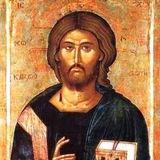
"Be joyful, brothers and sisters, keep the holy faith and do your little good works"
"Always rejoice and be in the faith. Do the same little deeds that I did: you yourselves saw them and heard of them. I am following the path which our fathers walked before us."
+Our father among the saints, David of Wales (Mar 1/ Mar 14)
The glory of St. David as a wonderworker spread throughout Britain and Ireland both during his life and after his repose. On hearing his zealous preaching, many rulers and princes gave away their riches to the poor and in some instances abdicated their thrones and took up monastic life.
The relics of St. David have survived and are located at St. David's Cathedral (12th-14th centuries), on the site of the original monastery established by David. His shrine was ravaged and desecrated during the Reformation but his holy relics survived and continue to be venerated.
[2/3] A tragedy of the reign of Henry VIII British Isles was the desecration and destruction monasteries and holy relics. Subjected to this destruction, on King Henry’s orders, were the holy relics of St. Chad, Evangelizer of Mercia, Bishop of Lichfield, faithful disciple of St. Aidan.
As a priest, and later bishop, St. Chad was known for his humility, prayerfulness and gentleness. In Mercia, there was fighting between neighbouring kingdoms. There was also division between the Romans and Celts in the Church. St. Chad, belonging to the Celtic group, took up the task of mediation of these conflicts.
As a priest, and later bishop, St. Chad was known for his humility, prayerfulness and gentleness. In Mercia, there was fighting between neighbouring kingdoms. There was also division between the Romans and Celts in the Church. St. Chad, belonging to the Celtic group, took up the task of mediation of these conflicts.
[3/3] St. Chad established monasteries and is said to have dug wells for travellers. The water from these wells sometimes brought healings.
St. Chad’s relics had been venerated by pilgrims for centuries at the Shrine of St Chad in Lichfield. In 1538 the Shrine was dismantled under the orders of King Henry. Some relics were destroyed. Others were recovered and hidden. Some later came into King Henry’s possession.
After the king’s death the holy relics were kept by the Jesuit from whom he had received the Last Rites, and eventually enshrined at a small chapel at Aston by Stone and later moved to a newly-built cathedral in Birmingham, consecrated in 1841. In 2022, a portion of the relics were returned to the original shrine in Lichfield Cathedral.
"The Fast has come, the mother of chastity" What was the time before this day? A time of fornication. The soul has fornicated with all that struck its eye as pleasant—both with people and with things and, more fully, with sinful passions. Everyone has his own passion which he pleases in every way. It is time to put an end to this. May each of you comprehend your Delilah, who binds you and hands you over to evil enemies, and abandon her. Then you will be given more than Samson was given: Not only shall your hair grow but so also shall good thoughts; and not only shall your strength return but so also your strength of will. Your eyes shall also open, your mind shall have sight, and it shall see the Lord, yourself, and everything around you in the proper light. Behold, now is the favorable time! Behold, now is the day of salvation!
☦️St. Theophan the Recluse
☦️St. Theophan the Recluse
The Uncovering of the Venerable Cross and Nails by the Holy Empress Helen at Jerusalem (6/19 March, 326)
✝️Tropar of the Holy Cross
O Lord, save Your people and bless Your inheritance. Grant victory to the Orthodox Christians over their adversaries and by virtue of Your Cross preserve Your habitation.
✝️Tropar of the Holy Cross
O Lord, save Your people and bless Your inheritance. Grant victory to the Orthodox Christians over their adversaries and by virtue of Your Cross preserve Your habitation.
The first Sunday of Lent is the Sunday of Orthodoxy. In many parishes, the faithful bring icons from home and carry them in a procession around the church.
On the veneration of icons:
"I worship the God who has saved me, who became material for my sake. And I do not cease to venerate the matter through which I have been saved and which is filled with divine grace".
☦️St. John Damascene
On the veneration of icons:
"I worship the God who has saved me, who became material for my sake. And I do not cease to venerate the matter through which I have been saved and which is filled with divine grace".
☦️St. John Damascene
[1/2] heard a beautiful story last week. True story. A parish priest had a man come to him, wanting to join the parish. He had been a criminal and spent time in prison, but was repentant and determined to redeem the remainder of his life.
But he had a hard time keeping a prayer rule. The priest kept reducing it: “Can you say fifty Jesus Prayers?" (the ancient prayer that goes "Lord Jesus Christ, have mercy on me.") "Well, can you at least say Twenty-five? How about ten?”
Then the man came down with cancer, and the priest visited him in the hospital in his closing days. He asked him, “Well, were you able to say those ten Jesus Prayers?”
The man looked sad and said, “No, Father, I didn’t.”
“Did you say five?”
“No, not even five.”
“Well, did you at least say one?”
“No, Father.”
“Why not?”
“I can’t get past ‘Jesus.’”
The man said that, when he began with “Lord,” he was overwhelmed with the majesty and glory of God, how he created all the universe, from the largest star to the smallest detail. Then, when he said “Jesus,” he was again seized with wonder, to think that this Lord of Creation became a human being, a man with the name “Jesus.”
And those two words were enough to ponder for a lifetime. He just couldn’t get any further.
—Presvetera Frederica Mathewes-Green
And those two words were enough to ponder for a lifetime. He just couldn’t get any further.
—Presvetera Frederica Mathewes-Green
[1/2] Come and see!
At that time Jesus was about to leave for Galilee, and he found Philip. And Jesus said to him, “Follow me.” Now Philip was from Bethsaida, the town of Andrew and Peter. Philip found Nathanael and said to him, “We have found the one of whom Moses in the Law and the Prophets wrote, Jesus the son of Joseph of Nazareth.” And Nathanael said to him, “Can anything good come out of Nazareth?” Philip said to him, “Come and see.” Jesus saw Nathanael coming to him and said of him, “Look, a true Israelite in whom there is no guile!” Nathanael said to him, “Where do you know me from?” Jesus answered him and said to him, “Before Philip called you, when you were under the fig tree, I saw you.” Nathanael answered him and said,
At that time Jesus was about to leave for Galilee, and he found Philip. And Jesus said to him, “Follow me.” Now Philip was from Bethsaida, the town of Andrew and Peter. Philip found Nathanael and said to him, “We have found the one of whom Moses in the Law and the Prophets wrote, Jesus the son of Joseph of Nazareth.” And Nathanael said to him, “Can anything good come out of Nazareth?” Philip said to him, “Come and see.” Jesus saw Nathanael coming to him and said of him, “Look, a true Israelite in whom there is no guile!” Nathanael said to him, “Where do you know me from?” Jesus answered him and said to him, “Before Philip called you, when you were under the fig tree, I saw you.” Nathanael answered him and said,
[1/2] “Rabbi, you are the Son of God, you are King of Israel.” Answering, Jesus said to him, “Because I said to you that I saw you under the fig tree, you believe. Greater things than these shall you see.” And he said to him, “Amen, amen, I say to you, you shall see heaven opened, and the angels of God ascending and descending upon the Son of Man.”
✝️John 1:43-51, Gospel reading for the Sunday of Orthodoxy, first Sunday of Lent
Photo: Sunday of Orthodoxy 2017, Holy Trinity Greek Orthodox Church, Orlando, Florida
✝️John 1:43-51, Gospel reading for the Sunday of Orthodoxy, first Sunday of Lent
Photo: Sunday of Orthodoxy 2017, Holy Trinity Greek Orthodox Church, Orlando, Florida