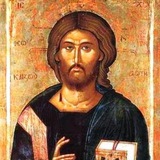
[2/2] New linen towels were taken from the hospital of our former SS-guards. When sewn together lengthwise, two towels formed an epitrachilion and when sewn together at the ends they became an orarion. Red crosses, originally intended to be worn by the medical personnel of the SS-guards, were put on the towel-vestments.
On Easter Sunday, May 6, Serbs, Greeks and Russians gathered at the Catholic priests' barrack. Although Russians comprised about 40 percent of the Dachau inmates, only a few managed to attend the service. By then ‘repatriation officers’ of the special ‘Smersh’ units had arrived in Dachau by American military planes, and began the process of erecting new lines of barbed wire for the purpose of isolating Soviet citizens from the rest of the prisoners – the first step in preparing them for their eventual forced repatriation.
In the entire history of the Orthodox Church there has probably never been an Easter service like the one at Dachau in 1945. Greek and Serbian priests together with a Serbian deacon wore the make-shift vestments over their blue and gray-striped prisoners uniforms. Then they began to chant, changing from Greek to Slavonic, then back to Greek. The Easter Canon, the Easter Sticheras – everything was recited from memory. The Gospel – ‘In the beginning was the Word’ —also from memory. The Homily of St. John Chrysostom also from memory. A young Greek monk from the Holy Mountain stood up in front of us and recited it with such infectious enthusiasm that we shall never forget him as long as we live. St. John Chrysostomos himself seemed to speak through him to us and to the rest of the world as well!
Eighteen Orthodox priests and a deacon, most of them Serbs, participated in this unforgettable service. Like the sick man who had been lowered through the roof of a house and placed in front of the feet of Christ the Savior, the Greek Archimandrite Meletios was carried on a stretcher into the chapel, where he remained prostrate throughout the service.
The priests who participated in the 1945 Dachau Easter service are commemorated at every Divine Service held in the Dachau Russian Orthodox Memorial Chapel, along with all Orthodox Christians who lost their lives ‘at this place, or at another place of torture.’
— from “In Communion”, Pascha/ Spring 2011 (Issue 60)
St Simeon, the Kinsman of the Lord (April 27/ May 10), one of the Apostles of the 70 and second Bishop of Jerusalem, is hymned as one who guided his flock "to the heavenly sheepfold" and for the sake of Christ, "crucified, imitating His passion."
The Apostle and Hieromartyr Simeon (Symeon) was a first cousin of our Lord Jesus Christ. He was the son of Clopas (or Cleopas, also called Alphaeus), the brother of Joseph the Betrothed. At 100 years of age, he was seized by pagans and, after prolonged torture, crucified.
The Apostle and Hieromartyr Simeon (Symeon) was a first cousin of our Lord Jesus Christ. He was the son of Clopas (or Cleopas, also called Alphaeus), the brother of Joseph the Betrothed. At 100 years of age, he was seized by pagans and, after prolonged torture, crucified.
Antipascha: St Thomas Sunday
Then [Christ] said to Thomas, “Reach your finger here, and look at My hands; and reach your hand here, and put it into My side. Do not be unbelieving, but believing.” And Thomas answered and said to Him, “My Lord and my God!” + John 20:27-28
The Holy and Glorious Apostle Thomas did not want to be found guilty of careless belief. He did not want to believe an apparition, and our Lord understood this. When St Thomas touched the Life-giving side of the Lord, he no longer had any doubts.
Icons named “The Doubting Thomas” are incorrectly titled. The correct inscription is “The Touching of Thomas” or “The Belief of Thomas.”
By the intercessions of Thine Holy Apostle Thomas, O Christ our Lord and our God, have mercy on us. Amen.
He is sold, and very cheap, for it is only for thirty pieces of silver; but He redeems the world, and that at a great price, for the price was His own blood. As a sheep He is led to the slaughter, but He is the shepherd of Israel, and now of the whole world also. As a lamb He is silent, yet He is the is bruised and wounded, but He heals every discase and every infirmity. He is lifted up and nailed to the tree, but by the tree of ife He restores us; indeed, He saves even the robber crucified with Him, indeed He wrapped the visible world in darkness. He is given vinegar to drink mingled with gall. Who? He who turned water into wine, who is the destroyer of the bitter Word, and is proclaimed by the voice of one crying in the wilderness. He is bruised and wounded, but He heals every disease and every infirmity. [1/2]
[2/2] He is lifted up and nailed to the tree, but by the tree of ife He restores us; indeed, He saves even the robber crucified with Him, indeed He wrapped the visible world in darkness. He is given vinegar to drink mingled with gall. Who? He who turned water into wine, who is the destroyer of the bitter Word, and is proclaimed by the voice of one crying in the wilderness. He is bruised and wounded, but He heals every disease and every infirmity. He is lifted up and nailed to the tree, but by the tree of life He restores us; indeed, He saves even the robber crucified with Him, indeed He wrapped the visible world in darkness. He is given vinegar to drink mingled with gall. Who? He who turned water into wine, who is the destroyer of the bitter taste, Who is sweetness and altogether desired. He lays down His life, but He has power to take it again ...He dies, but He gives life, and by His death destroys death. He is buried but He rises again; He goes down into hell, but He brings up the souls.
☦️ St. Gregory of Nazianzus. Third Theological Oration, 20. B#7.
☦️ St. Gregory of Nazianzus. Third Theological Oration, 20. B#7.
"Armed with the power of the Spirit" the Holy Apostle James (April 30/May 13) brother of St John the Theologian, "preached Christ to all" (from the Troparion). James, the brother St John the Theologian, was the first of the Apostles to receive the crown of martyrdom. His beheading at Jerusalem in the year 44 was based on the false witness of his accusers.
With the Apostle Peter and John, his brother, the Apostle James witnessed the Raising of the Daughter of Jairus, the Lord’s Transfiguration on Mount Tabor, and His agony in the Garden of Gethsemane.
Most praised James, ask remission of sins and great mercy for those who sing hymns to you.
With the Apostle Peter and John, his brother, the Apostle James witnessed the Raising of the Daughter of Jairus, the Lord’s Transfiguration on Mount Tabor, and His agony in the Garden of Gethsemane.
Most praised James, ask remission of sins and great mercy for those who sing hymns to you.
Once St. Matrona of Moscow (May 2) asked her mother to tell a certain priest about a book in his library with a picture of the Seeker of the Lost icon.
To the priest’s surprise, the picture was found. Matrona blessed the village women to collect money for it. One man unwillingly donated a ruble. Another man gave a kopeck for a laugh. When all the money raised was brought to Matrona, she found the ruble and the kopeck and removed them saying: “Give them their money back. It spoils the rest.”
An icon painter was found and Matrona asked him to have confession and receive Holy Communion before he started work. After awhile he came to Matrona and said that he could not do it. Matrona knew that he had one serious sin, which he had not confessed and she told him to repent. [1/2]
[2/2] The icon painter went to a priest, made confession, received Holy Communion again and asked Matrona to forgive him. She answered: “Go and paint the icon of the Heavenly Queen. Now you will do it.”
With the money left over, another copy of the Seeker of the Lost icon was painted in the town of Bogoroditsk.
With the money left over, another copy of the Seeker of the Lost icon was painted in the town of Bogoroditsk.
St John of Kronstadt called the Blessed Matrona of Moscow (April 19/ May 2) his "replacement, the eighth pillar of Russia."
"Once a militiaman came to arrest Matrona but she said: 'Go home quickly! It’s an emergency. I am blind and can’t walk and won’t escape from you.' He believed her and rushed for home. There he found his wife who was accidentally severely burned. He was just in time to take her to hospital. The next day they asked him at work: Have you arrested the blind one?” He answered: 'I’ll never arrest her. But for her, I would have lost my wife.'"
"Matronushka", as she was affectionately called, "was a warrior angel, as if she had a sword of fire in her hands to fight the evil power." - Zinaida Zhdanova
Source: orthochristian.com/79033.html
St. Anastasius of Sinai teaches: if you see someone sinning, do not condemn him, for you do not know how he will finish his life. That thief crucified with Christ was a murderer, and Judas was an apostle of Christ's, but the thief entered paradise and Judas went to perdition.
lf you see someone sin, you do not know his good works For many sin in public and repent in private, and we see their sin but do not know of their repentance. Therefore, my brothers, let us condemn no man, that we be not condemned.
☦️ Bishop Nikolai Velimirovic. Prolog, 22 March, B#80, p. 219
Image: Andreas Pavias’s Icon of the Crucifixion. A pelican is nested at top of the cross. The pelican is often associated with Christ in medieval imagery. When food was scarce, the pelican was thought to feed her own blood to her young to keep them alive. The pelican then dies. With this understanding in mind, angels are shown catching the blood of Jesus in communion chalices for the Eucharist.
The Myrrhbearing Women “were the first to see Jesus; and the sex that was most condemned first enjoys the sight of the blessings; this sex shows its courage the most. And when the disciples had fled, these were present... Do you see the women's courage? Do you see their affection? Do you see their noble spirit in matters of money? their noble spirit even unto death? Let the men imitate the women”
St. John Chrysostom, Homily LXXXVIII on Matthew XXVII
St. John Chrysostom, Homily LXXXVIII on Matthew XXVII
Faithful, Generous and Fearless: The Holy Myrrhbearing Women
✝️Mary Magdalene
✝️Mary the wife of Cleopas
✝️Joanna
✝️Salome, mother of the sons of Zebedee
✝️Martha and Mary, sisters of Lazarus
✝️The Most Holy Theotokos and Ever-Virgin Mary
They ministered unto Christ out of their own possessions, hearing His teaching and witnessing His miracles. They continued in their ministry even after Christ’s crucifixion— neither wavering in their faith in Him after His death, nor fearing the wrath of the Jewish rulers.
☦️The Sunday of the Holy Myrrhbearing Women with the Noble Joseph of Arimathea is commemorated on the Second Sunday after Pascha
ქრისტე აღსდგა! Christ is Risen!
On the Sunday of the Myrrhbearing Women, Georgian and Russian Orthodox Churches also commemorate the Holy Blessed Queen of Georgia, Tamara, who is also commemorated on her own feast day, May 1. Tamara called herself "the father of orphans and the judge of widows."
After her coronation, she convoked a local Church council, honouring the bishops if she were a commoner, and they Angels of God. She exhorted them in humility, "Do away with every wickedness, beginning with me, for the prerogative of the throne is in no wise that of making war against God."
The Kingdom of Georgia expanded under her leadership, and lands were reclaimed from Muslim dynasts. Queen Tamara used her influence to shelter vulnerable Middle Eastern Christians and pilgrims. She also enabled the sending of missionaries all around the Caucasus and supported monasteries, churches, and hospitals as far as Sinai, Athos, Cyprus, Thrace and Petritsoni.