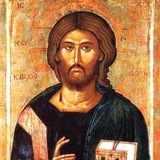
“All the sects are truly ‘gates of hell,’ but ‘They will not prevail against the rock’, that is, the truth.” ☦️ Our father among the saints Epiphanius of Cyprus (May 12)
St Epiphanius was Bishop of Salamis on the island of Cyprus and later, Bishop of Cyprus during the latter part of the fourth century. He was known for his great zeal for the faith, his love and charity toward the poor, and simplicity of character.
After his baptism, Epiphanius became a member of a monastery in Egypt under the guidance of the elder St. Hilarion the Great. Seeking to avoid human glory, he set out to the desert where robbers fell upon him and held him for three months. By his talk about repentance, Epiphanius brought one of the gang of robbers to the faith in the True God. When he was set free, the robber joined him. Epiphanius took him to his monastery and baptized him with the name John. John became a faithful disciple of Epiphanius and carefully recorded the Epiphanius’ life and miracles.
Epiphanius’ book, the Panarion which means "medicine-chest" offers antidotes for those bitten by the serpent of heresy. It lists 80 heresies, some of which are not described in any other surviving documents from his time. Epiphanius often let his zeal come before facts. He wrote against the Origenists based only on hearsay.
In 402 or 403 he was induced by Archbishop Theophilus of Alexandria to travel to Constantinople as part of the prelate's campaign against Archbishop John Chrysostom, who stood in defence of a group of monks whom Theophilus had falsely accused of Origenism. It is unclear what happened, but it appears that Epiphanius was made aware of Theophilus political motives, he reconciled with Archbishop John and abruptly began a journey home to Cyprus. On the way there, he died at sea.
“O relatives and close ones of the dead! Do for them what is needful for them and within your power. Use your money not for outward adornment of the coffin and grave, but in order to help those in need, in memory of your close ones who have died, for churches, where prayers for them are offered. Show mercy to the dead, take care of their souls. Before us all stands the same path, and how we shall then wish that we would be remembered in prayer! Let us therefore be ourselves merciful to the dead.”
+St John Maximovitch
+St John Maximovitch
Prayer of the Optina Elders
O Lord, grant that I may meet all that his coming day brings to me with spiritual tranquility. Grant that I may fully surrender myself to thy holy will. At every hour of this day, direct and support me in all things. Whatever news may reach me in the course of the day, teach me to accept it with a calm soul and the firm conviction that all is subject to thy holy will. Guide my thoughts and feelings in all my words and actions. In all unexpected occurrences, let me not forget that all is sent down from thee. Grant me to deal in a straightforward and wise manner with every member of my family, neither embarrassing nor saddening anyone. O Lord, grant me power to endure the fatigue of the coming day and all the events that will take place during it. Guide my will and teach me to prayer, to believe, to hope, to be patient, to forgive, and to love. Amen.
O Lord, grant that I may meet all that his coming day brings to me with spiritual tranquility. Grant that I may fully surrender myself to thy holy will. At every hour of this day, direct and support me in all things. Whatever news may reach me in the course of the day, teach me to accept it with a calm soul and the firm conviction that all is subject to thy holy will. Guide my thoughts and feelings in all my words and actions. In all unexpected occurrences, let me not forget that all is sent down from thee. Grant me to deal in a straightforward and wise manner with every member of my family, neither embarrassing nor saddening anyone. O Lord, grant me power to endure the fatigue of the coming day and all the events that will take place during it. Guide my will and teach me to prayer, to believe, to hope, to be patient, to forgive, and to love. Amen.
“Do away with every wickedness, beginning with me”
The Right-believing Saint Queen Tamara (May 1/ May 14), who called herself "the father of orphans and the judge of widows," ruled Georgia with such wisdom and godliness that her reign is known as the Golden Age of Georgia.
When she convoked a council of bishops from across her kingdom to correct disorders in church life, she honoured the assembled bishops as if she were a commoner, and they Angels of God. Queen Tamara exhorted them to establish righteousness and redress abuses. In her humility, she declared, “Do away with every wickedness, beginning with me, for the prerogative of the throne is in no wise that of making war against God."
“Desiring heavenly sweetness, you drove base carnal pleasures far from yourself and, during your reign, you lived an angelic life; O blessed Queen Tamara, pray to Christ God for the salvation of our souls.”—Troparion, Tone 1
Our venerable and God-bearing father Brendan the Navigator also called the Voyager (May 16) was a 6th-century Irish monastic and missionary who may have been the first Orthodox Christian to set foot on what is now Canadian soil.
The historic account of a possible trans-Atlantic voyage is disputed, based on doubts about the ability of a curragh, the sea craft on which Brendan is said to have sailed, to make such a journey. However, in 1976, Irish explorer Tim Severin built an ox leather curragh, a replica of the sort Brendan would have used. Over two summers he sailed from Ireland via the Hebrides, Faroe Islands and Iceland to Newfoundland to demonstrate that the such a voyage was feasible.
The historic account of a possible trans-Atlantic voyage is disputed, based on doubts about the ability of a curragh, the sea craft on which Brendan is said to have sailed, to make such a journey. However, in 1976, Irish explorer Tim Severin built an ox leather curragh, a replica of the sort Brendan would have used. Over two summers he sailed from Ireland via the Hebrides, Faroe Islands and Iceland to Newfoundland to demonstrate that the such a voyage was feasible.
Regardless of what was the actual extent of St Brendan’s journeys were, he is the patron saint of sailors and traveller. He is considered one of the "Twelve Apostles of Ireland", said to have been tutored by the great teacher, Finnian of Clonard. At the age of twenty-six, Brendan was ordained a priest and afterwards founded a number of monasteries— the first one was on the Aran Islands. He also travelled to Hinba (Argyll), an island off of Scotland, as well as Wales and finally to Brittany, on the northern coast of France.
St Brendan is a also a patron for
boatmen, divers, mariner’s, whales, and portaging canoeists.
“The Divine Likeness has been perfected in thee, O holy Father Brendan,
For taking up the Cross thou hast followed Christ,
And by thy deeds thou hast taught us to disdain the flesh for it passes away,
But to cultivate the soul for it is immortal:
Wherefore, O holy father, thy spirit rejoices with the Angels.”
Among the 318 bishops who gathered at the First Ecumenical Council (5th Sunday of Pascha) were many confessors who bore the marks of torture upon their bodies. At Nicea, they would confront not the instruments of physical torture, but the heresy of Arianism which was spreading across the Empire and infecting the Church.
Arius, a priest, denied the divine nature of Jesus Christ and His equality with God the Father. He falsely taught that the Saviour is not consubstantial with the Father. Arius' Christ was a creature, a most honourable one, but a creature nonetheless. Arius' Christ was not the true Saviour for Whom the martyrs gave their lives. Arius' clever teachings received their "walking papers" at Nicea.
Arius, a priest, denied the divine nature of Jesus Christ and His equality with God the Father. He falsely taught that the Saviour is not consubstantial with the Father. Arius' Christ was a creature, a most honourable one, but a creature nonetheless. Arius' Christ was not the true Saviour for Whom the martyrs gave their lives. Arius' clever teachings received their "walking papers" at Nicea.
At Nicea, the Church stood victorious in unity against the gates of hell and its disguises. She proved herself bigger than the pernicious beliefs that individual members, even priests and bishops, might promote.
Our Lord's promise, “I will build My Church, and the gates of hell shall not prevail against it” (Mt. 16:18), was fulfilled at Nicea and continues to be fulfilled until His coming again.
Our Lord's promise, “I will build My Church, and the gates of hell shall not prevail against it” (Mt. 16:18), was fulfilled at Nicea and continues to be fulfilled until His coming again.
Through a mother's prayers, an empire was defended and heresy conquered.
The Feast of Equal of the Apostles and Emperor Constantine with his Mother Helen is commemorated on May 21/ June 3. "Having seen the figure of the Cross in the heavens, and like Paul not having received his call from men," Constantine, 4th century emperor of the Roman Empire -- through the influential life and prayers of his mother, St Helen-- ended three hundred years of persecution. Christians could finally practice their faith without fear.
The emperor renounced paganism and moved the capital from ancient Rome, the former center of paganism to the city of Byzantium, which was renamed Constantinople.
Christian confessors came out of banishment and churches were built. Yet, various heresies raged during his reign-- the most ruinous being the Arian heresy, which denied the Divine Nature of the Son of God, and taught that Jesus Christ was a mere creature. By order of the emperor, the First Ecumenical Council was convened in the city of Nicea in 325. There the heresy of Arius was condemned.
At the same council, a Symbol of Faith (Creed) was composed. At the emperor's insistence, the term “consubstantial with the Father” was included in confirming the truth of the divinity of Jesus Christ, Who assumed human nature for the redemption of all the human race.
"Having seen the figure of the Cross in the heavens,
and like Paul not having received his call from men, O Lord,
Your apostle among rulers, the Emperor Constantine,
has been set by Your hand as ruler over the Imperial City
that he preserved in peace for many years,
through the prayers of the Theotokos, O only lover of mankind."
"В начале бе Слово, и Слово бе к Богу, и Бог бе [Слово]
V nachalye bye Slovo i Slovo bye k Bogu i Bog bye [Slovo]"
“In the beginning was the Word, and the Word was with God, and God was [the Word].” (Jn 1:1)
This is the Gospel text St Methodius holds in the icon on which he is represented with his brother, Cyril. St Kirill and St Mefodiy, commonly known in the West as St Cyril and St Methodius (May 11/ May 24) are venerated throughout the Slavic lands as the divinely-wise Equal-to-the-Apostles and Enlighteners of the Slavs (869, 885)
The brothers began their mission to the Slavs in Moravia at the request of Prince Rastislav (later St Rastislav). In an attempt to curtail the political influence of Franco-German Carolingians, the prince at first appealed to Rome for teachers for the Christian faith for Moravia. Rome refused. Determined to find teachers to properly instruct his people in the Christian faith, he then turned to Constantinople, which resulted in the arrival of Cyril and Methodius.
Forms of the alphabet devised by St Cyril are still used. The Cyrillic alphabet, now commonly called Glagolitic, was the first alphabet used to transcribe Old Church Slavonic.
Forms of the alphabet devised by St Cyril are still used. The Cyrillic alphabet, now commonly called Glagolitic, was the first alphabet used to transcribe Old Church Slavonic.
"As a divine treasure hidden in the ground was your head revealed to us by Christ, O prophet and Forerunner." Pray to the Lord that He may grant mercy to us all!
The Venerable Head of the Holy Prophet, Forerunner and Baptist John was first found on the Mount of Olives, where it had been hidden by Joanna, wife of Chusa, after the Saint's beheading. The second finding was at the city of Emesia during a time of unrest at Constantinople. The third finding came during a period of iconoclastic persecution. In around the year 850, after the veneration of icons was restored, Patriarch Ignatius saw in a vision the place at Komana where the head was buried in the ground. He revealed his vision to the emperor, who sent a delegation to Komana. There the head was found and transferred to Constantinople on May 25/ June 7.
The Venerable Head of the Holy Prophet, Forerunner and Baptist John was first found on the Mount of Olives, where it had been hidden by Joanna, wife of Chusa, after the Saint's beheading. The second finding was at the city of Emesia during a time of unrest at Constantinople. The third finding came during a period of iconoclastic persecution. In around the year 850, after the veneration of icons was restored, Patriarch Ignatius saw in a vision the place at Komana where the head was buried in the ground. He revealed his vision to the emperor, who sent a delegation to Komana. There the head was found and transferred to Constantinople on May 25/ June 7.