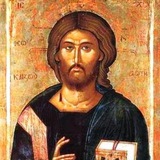
Though his grandmother, had been a Christian, Holy Prince Vladimir (July 15/28) inherited the paganism of his father. Yet, he sought for something more. The prince sent emissaries to investigate the faiths of the Jews, the Muslims, the Western Christians and the Orthodox.
After experiencing services at Agia Sophia in Constantinople, the emissaries told him, “We knew not whether we were on earth or in heaven… We only know that God dwells there among the people, and their service is fairer than the ceremonies of other nations." Prince Vladimir, moved by their description, was baptized in Cherson in 988, receiving the name Basil. "He came forth from the font not only healed of a blindness lately afflicting him, but also from being passionate and warlike, he became meek, peaceable, and exceedingly godly." (Great Horologion)
After experiencing services at Agia Sophia in Constantinople, the emissaries told him, “We knew not whether we were on earth or in heaven… We only know that God dwells there among the people, and their service is fairer than the ceremonies of other nations." Prince Vladimir, moved by their description, was baptized in Cherson in 988, receiving the name Basil. "He came forth from the font not only healed of a blindness lately afflicting him, but also from being passionate and warlike, he became meek, peaceable, and exceedingly godly." (Great Horologion)
He immediately set about building a Christian nation: casting down the idols, baptizing the people, and creating legislation modelled on the Gospel of Christ and His commandments. He left behind as the largest Orthodox kingdom in the world.
“Holy Prince Vladimir, you were like a merchant in search of fine pearls. By sending servants to Constantinople for the Orthodox Faith, you found Christ, the priceless pearl. He appointed you to be another Paul, washing away in baptism your physical and spiritual blindness. We celebrate your memory, asking you to pray for all Orthodox Christians and for us, your spiritual children.”
—Troparion, Tone 4
“The preaching of the Apostles and the dogmas of the Fathers sealed the one Faith of the Church; and clad in the garment of truth woven of theology from on high, it teaches aright and glorifies the great mystery of piety.” —Kontakion to the Fathers of the First Six Councils, Tone 8
"By virtue of the catholic nature of the Church, an Ecumenical Council is the Church’s supreme authority, and possesses the competence to resolve major questions of church life. An Ecumenical Council is comprised of archpastors and pastors of the Church, and representatives of all the local Churches, from every land of the “oikumene” (i.e. from all the whole inhabited world)."
(oca.org/.../15/50-fathers-of-the-first-six-councils)
The First Ecumenical Council (Nicea I) (May 29, 325 and also on seventh Sunday after Pascha) was convened against the heresy of Arius, in the city of Nicea in Bithynia under St Constantine the Great, Equal of the Apostles.
The Second Ecumenical Council (Constantinople I) (May 22. 381) was convened against the heresy of Macedonias, by the emperor Theodosius the Great.
The Third Ecumenical Council (Ephesus) (September 9, 431) was convened against the heresy of Nestorius, in the city of Ephesus by the emperor Theodosius the Younger.
The Third Ecumenical Council (Ephesus) (September 9, 431) was convened against the heresy of Nestorius, in the city of Ephesus by the emperor Theodosius the Younger.
The Fourth Ecumenical Council (Chalcedon) (July 16, 451) was convened against the Monophysite heresy, in the city of Chalcedon under the emperor Marcian.
The Fifth Ecumenical Council (Constnatinople II) (July 25, 553) "Concerning the Three Chapters," was convened under the emperor Justinian the Great.
The Fifth Ecumenical Council (Constnatinople II) (July 25, 553) "Concerning the Three Chapters," was convened under the emperor Justinian the Great.
The Sixth Ecumenical Council (Constantinople III) (January 23) met during the years 680-681, to fight the Monothelite heresy, under the emperor Constantine Pogonatos.
The Seventh Ecumenical Council (October, 787) was convened against the iconoclasts, who considered it idolatry to depict God or humans artistically. The council declared Icons as necessary as and essential in protecting the full and proper doctrine of the Incarnation.
Since there are Seven Holy Ecumenical Councils, why do we commemorate only the first six on the 5th Sunday After Pentecost ? The Seventh Ecumenical Council occurred after the yearly commemoration of the first six had begun.
“Everyday I can see before my eyes the ongoing corruption of our clergy…. The last remaining believers are trembling with repugnance over the condition of their clergy. And there is no one to finally realize just what brink of destruction the Church is standing on, or what is happening.”
☦️ New Hieromartyr Seraphim (Chichagov) of Petrograd, in a prophetic letter written in 1910, seven years before the Bolshevik Revolution
☦️ New Hieromartyr Seraphim (Chichagov) of Petrograd, in a prophetic letter written in 1910, seven years before the Bolshevik Revolution
"The image of God was truly preserved in you, O Mother," Macrina. Saint Macrina (July 19) was the sister of the holy hierarchs Basil the Great and Gregory of Nyssa. Like her brothers, she was well educated, especially in the Scriptures.
Macrina convinced her mother, St Emilia, once her children had grown up, to leave the world, to set their slaves free, and take up a monastic life. Some of their servants chose to join them in a life of communal prayer and work, possessing everything in common.
St Macrina was granted the gift of wonderworking. There was an instance she healed a girl of an eye-affliction. Through her prayers there was no shortage of wheat at her monastery in times of famine.
Among the few personal effects of the royal family of St Nicholas Alexandrovich Romanov (July 17) that remained behind at the Ipatiev House, the place of their martyrdom, was a notebook of the Holy Martyr Olga. On one of its pages, written in the hand of the young girl, was the following prayer:
Grant us Thy patience, Lord,
In these our woeful days,
The mob's wrath to endure,
The torturer's ire;
Thy unction to forgive
Our neighbors' persecution,
And mild, like Thee, to bear
A bloodstained Cross.
And when the mob prevails,
And foes come to despoil us,
To suffer humbly shame,
O Saviour, aid us!
Master of the world, universal God,
Bless us in prayer
And grant rest to our humble soul
In this unbearable, dreadful hour.
And when the hour comes
To pass the last dread gate,
Breathe strength in us to pray,
"Father, forgive them."
—from “The Romanov Royal Martyrs: What silence could not conceal”
From left to right: Saints Olga, Nikolai, Anastasia, Alexandra, Tatiana, and in the front row Alexei and Maria.
When receiving praised by others, St Seraphim, Wonderworker of Sarov referred to himself as "the poor wretch Seraphim." St Seraphim was healed thrice by the Mother of God. When he fell ill at the age of 10, the miracle-working Kursk icon of Theotokos passed by his family home. After Seraphim's mother took him to kiss the icon, he recovered quickly.
The Uncovering of St Seraphim's relics took place in 1903, seventy years after his repose and is commemorated on July 19/ August 1. In 1991, St Seraphim’s relics were rediscovered after being hidden in a Soviet anti-religious museum for seventy years.
Save us by your prayers, venerable Seraphim, our father.
"We Christians of the latter times are still called to work persistently on ourselves, to be obedient to spiritual fathers and authorities, to lead an orderly life with at least a minimum of spiritual discipline and with regular reading of the Orthodox spiritual literature... to watch over our own sins and failings and not judge others." ☦️Blessed Seraphim Rose
“We fall many times during our life, and it is absolutely necessary to reveal everything [in Confession] to a priest who is a witness to our repentance.
Repentance is the renewal of life. This means we must free ourselves from all our negative traits and turn toward absolute good. No sin is unforgivable except the sin of unrepentance."
—Thaddeus of Vitovnic
Repentance is the renewal of life. This means we must free ourselves from all our negative traits and turn toward absolute good. No sin is unforgivable except the sin of unrepentance."
—Thaddeus of Vitovnic
And Elijah was taken up in a whirlwind, as it were, into heaven. And Elisha saw it, and he cried, “Father! Father! The chariot of Israel and its horsemen!” And he saw him no more.
In iconography the Prophet Elijah (Elias) is depicted ascending to Heaven in a fiery chariot, surrounded with flames, and harnessed to four winged horses. The Holy, Glorious Prophet Elijah (July 20) did not experience physical death. Instead, he was, as we read in the Second Book of kings, taken up to heaven in a fiery chariot.
The life of the holy Prophet is recorded in 3 Kings; 4 Kings; Sirach/Ecclesiastes 48: 1-15; 1 Maccabees 2: 58. At the time of the Transfiguration, the Prophet Elijah conversed with the Saviour upon Mount Tabor (Mt. 17: 3; Mark 9: 4; Luke. 9: 30
According to the Tradition of Church, St Elijah will be the Forerunner of the Dread Second Coming of Christ. He will proclaim the truth of Christ, urge all to repentance, and will be slain by the Antichrist. This will be a sign of the end of the world.
She stayed when the others fled in fear
At the Lord’s Crucifixion, Holy Myrrhbearer Mary Magdalene (July 22 / August 4) remained at the cross with the Mother of God and the Apostle John. She was a witness to Christ's burial and first to see the risen Lord (Mark 16:1-10) and is thus honoured as the "Apostle to the Apostles."
"Holy Myrrhbearer and Apostle to the Apostles, now that you have passed into heaven, never cease to intercede for the world!"
"Who shall separate us from the love of Christ? Shall tribulation, or distress, or persecution, or famine, or nakedness, or peril, or sword?" Romans 8:35
Holy Martyrs and Passionbearers Boris and Gleb (July 24 / Aug 6), in baptism Roman (Romanus) and David (1015) were the sons of the great Prince Vladimir, the baptizer of the Russian people.
After their father's death, their jealous and power-hungry brother, Sviatopolk, the Prince of Kiev sent assassins to kill them. Boris already knew of Sviatopolk's intentions but vowed not to lift a hand against his own brother. He prayed to the Lord to strengthen him for the suffering to come, and that God would not count Sviatopolk's sin against him. Before stabbing him, St Boris' assassins found him chanting psalms and praying before an icon of Christ.
St Gleb was lamenting the deaths of his father and brother when his assassins arrived. However, it was Gleb's cook who killed him with a knife.