Not too many years ago the Abbess of a convent of the Russian Orthodox Church Outside of Russia, a woman of righteous life, was delivering a sermon in the convent church on the feast of the Dormition of the Most Holy Mother of God. With tears she entreated her nuns and the pilgrims who had come for the feast to accept entirely and wholeheartedly what the Church hands down to us, taking such pains to preserve this tradition sacredly all these centuries—and not to choose for oneself what is “important” and what is “dispensable”; for by thinking oneself wiser than the tradition, one may end by losing the tradition.
Thus, when the Church tells us in her hymns and icons that the Apostles were miraculously gathered from the ends of the earth in order to be present at the repose and burial of the Mother of God, we as Orthodox Christians are not free to deny this or reinterpret it, but must believe as the Church hands it down to us, with simplicity of heart.
☦️ Fr. Seraphim Rose, introduction to The Orthodox veneration of the Theotokos by St. John Maximovitch
☦️ Fr. Seraphim Rose, introduction to The Orthodox veneration of the Theotokos by St. John Maximovitch
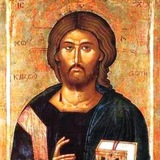
“We venerate your most pure image, O Good One.”
The icon of the Holy Face of Jesus Christ, "The Saviour Not Made by Hands" (Mandylion) was made by the Lord Himself, who pressed His Holy Face on a cloth and gave it to an artist commissioned by Abgar, who ruled at Edessa, in Syria. The commemoration of its translation to Constantinople is commemorated on Aug 16/ Aug 29.
Abgar, who was stricken with leprosy, had sent the artist, Ananias, to Jerusalem to paint a likeness of the Divine Teacher. When Ananias returned to Edessa with the cloth, it brought miraculous healing to Abgar. The ruler put the Holy Napkin in a gold frame adorned with pearls and placed it in a niche over the city gates. On the gateway above the icon he inscribed the words, “O Christ God, let no one who hopes on Thee be put to shame.”
Arabs, who later seized the city, did not prevent the veneration of the icon, which by that time had wrought countless miracles. In 944, emperor Constantine Porphyrogenitos paid a ransom for the icon, The icon was then brought to Constantinople.
Christ our God, as we behold the victorious image or Your true incarnation, we honor it with veneration!
Iconographer: Ira Zholobenko
Christ our God, as we behold the victorious image or Your true incarnation, we honor it with veneration!
Iconographer: Ira Zholobenko
1/2
St Arsenios of Paros (1800-1877) confessor, spiritual guide, teacher, ascetic, miracle-worker and healer (Aug 18)
After years of counseling the nuns at the Convent of the Transfiguration ("Christ of the Forest") to stop their constant fighting and discord, Fr. Arsenios left the monastery one day in despair. He decided he would no longer be their spiritual father.
On his way back to the Monastery of Saint George, Fr. Arsenios encountered a radiantly handsome young man who insisted on knowing why Fr. Arsenios had abandoned the nuns. Father Arsenios replied that he could not endure their misbehavior, whereupon the man responded: "And why did you not reflect that our Lord endures the misbehavior of millions of men, even those who do not believe in Him, but insult Him, blaspheme Him, and despise him. He endured even those who crucified him, and while on the Cross He prayed for them saying, 'Father forgive them, for they know not what they do'.
St Arsenios 2/2
Why is it that you cannot endure the wrong acts of forty monastics, who are women, weak natures, and who did truly grieve you through their sins, but have now repented?" Then the young man showed both the light of heaven, and the stench and darkness of hell. He told Fr. Arsenios that if he did not return as the nuns' spiritual father, he would never see heaven. The young man's face flashed like lightning and he disappeared. At that very moment, Fr. Arsenios realized he had been talking to St George himself, and returned to the monastery. There he found the whole sisterhood on their knees in church, praying and crying to God that Elder Arsenios might return and forgive them.
Why is it that you cannot endure the wrong acts of forty monastics, who are women, weak natures, and who did truly grieve you through their sins, but have now repented?" Then the young man showed both the light of heaven, and the stench and darkness of hell. He told Fr. Arsenios that if he did not return as the nuns' spiritual father, he would never see heaven. The young man's face flashed like lightning and he disappeared. At that very moment, Fr. Arsenios realized he had been talking to St George himself, and returned to the monastery. There he found the whole sisterhood on their knees in church, praying and crying to God that Elder Arsenios might return and forgive them.
O Heavenly Father, make me a better parent. Teach me to to listen patiently to my children. Keep me from interrupting them or contradicting them. Forbid that I should laugh at their mistakes or ridicule them when they displease me. Help me, O Lord, to hold my tongue and keep me from being mean. Let me not tempt my children to lie or steal or break Your commandments. May I demonstrate humility and fairness to them granting them their reasonable requests and having the courage to deny them the things that I know will do them harm. Amen.
Orthodox Faith pinned «An annual miracle occurs on the Feast of the Transfiguration at Mt Tabor, where our Lord, God and Saviour Jesus Christ appeared in His divine glory before the Apostles Peter, James, and John (Mt 17:1-9, Mk 9:2-8, Lk 9:28-36). After the all night vigil, at…»
"Eve was seduced by the word of the [fallen] angel and transgressed God's word, so that she fled from him. In the same way, [Mary] was evangelized by the word of an angel and obeyed God's word, so that she carried him [within her].
And while the former was seduced into disobeying God, the latter was persuaded to obey God, so that the Virgin Mary became the advocate (advocata) of the virgin Eve." + St Irenaeus of Lyons (Aug 23)
And while the former was seduced into disobeying God, the latter was persuaded to obey God, so that the Virgin Mary became the advocate (advocata) of the virgin Eve." + St Irenaeus of Lyons (Aug 23)
Saint Gregory of Tours credits the preaching of St Irenaeus (130-202) (Aug 23), Bishop of Lugdunum, for transforming all of Lugdunum (Lyons) into a Christian city. Holy Hieromartyr St Irenaeus is the third link in an unbroken chain of the grace of succession which links, in backward order, to Saint Polycarp of Smyrna, to the Apostle and Evangelist John the Theologian, to the Original Pastor, our Lord Jesus Christ Himself. Thus, he received his schooling from the best.
St Irenaeus recalled conversations that took place at the blessed Polycarp's house, where St Polycarp "spoke of the conversations which he had with John and others who had seen the Lord, how he remembered their words, and what he heard from them about the Lord ... I listened eagerly to these things, by the mercy of God, and wrote them, not on paper, but in my heart.”
St Irenaeus recalled conversations that took place at the blessed Polycarp's house, where St Polycarp "spoke of the conversations which he had with John and others who had seen the Lord, how he remembered their words, and what he heard from them about the Lord ... I listened eagerly to these things, by the mercy of God, and wrote them, not on paper, but in my heart.”
St Irenaeus (Aug 23) was a lion in his refutations of the gnostic heresy which was influencing the Church during his time. In doing so, he leaves us with the Orthodox teaching of salvation through the Incarnation. “Jesus Christ the Son of God, through exceedingly great love for His creation, condescended to be born of a Virgin, having united mankind with God in His own Self.” Through the Incarnation of God, creation becomes co-imaged and co-bodied to the Son of God. Salvation consists in the “Sonship” and “Theosis” (“Divinization”) of mankind. "By sharing in the ways of the Apostles, you became a successor to their throne. Through the practice of virtue, you found the way to divine contemplation, O inspired one of God; by teaching the word of truth without error, you defended the Faith, even to the shedding of your blood. Hieromartyr Irenaeus, entreat Christ God to save our souls.”