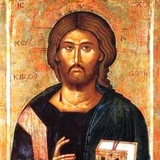
Among the 318 bishops who gathered at the First Ecumenical Council (5th Sunday of Pascha) were many confessors who bore the marks of torture upon their bodies. At Nicea, they would confront not the instruments of physical torture, but the heresy of Arianism which was spreading across the Empire and infecting the Church.
Arius, a priest, denied the divine nature of Jesus Christ and His equality with God the Father. He falsely taught that the Saviour is not consubstantial with the Father. Arius' Christ was a creature, a most honourable one, but a creature nonetheless. Arius' Christ was not the true Saviour for Whom the martyrs gave their lives. Arius' clever teachings received their "walking papers" at Nicea.
Christ’s declaration, “I will build My Church, and the gates of hell shall not prevail against it” (Mt. 16:18), was fulfilled at Nicea and continues to be fulfilled until His coming again.
St. Theodore the Sanctified (May 16/ May 29) disciple of St. Pachomius the Great (368), at the age of twelve, looked upon a festive meal of delicacies prepared by his family for the feast of Theophany. He told them, “If you enjoy this food, you will not enter into eternal life.”
At Tabenissi monastery, any penance he assigned to his brethren, he also completed the same for himself.
At Tabenissi monastery, any penance he assigned to his brethren, he also completed the same for himself.
“O God, the nations have invaded your inheritance; they have defiled your holy temple.” Within 24 hours of the Fall of Constantinople (May 29, 1453) almost all residents had been raped, despoiled, or enslaved, some inside Hagia Sophia.
Constantine XII, the last Byzantine Emperor, died defending the city. However, he accepted (and never publicly renounced) the false "union" of Florence, and so is counted by some as a heretic. Many Orthodox Christians, including many of the people of Constantinople, saw the city's fall as divine retribution for the Empire's acceptance of the union.
Constantine XII, the last Byzantine Emperor, died defending the city. However, he accepted (and never publicly renounced) the false "union" of Florence, and so is counted by some as a heretic. Many Orthodox Christians, including many of the people of Constantinople, saw the city's fall as divine retribution for the Empire's acceptance of the union.
Holy Pentecost is the celebration of "the end, "the day of the coming of the Holy Spirit --the achievement and fulfillment-- of the entire history of salvation. But for the same reason, it is also the celebration of "the beginning," the “birthday” of the Church.
Pentecost took "cowards, who throughout the duration of the Passion and Crucifixion of Christ were hidden in the Upper Room 'for fear of the Jews'"-- and turned them into "lions." When the Apostles received the Holy Spirit, they "set their fear aside, gained strength and spiritual courage, braved all the difficulties, even unto death." - John Sanidopolous, "The Holy Twelve Apostles as Models for our Lives" johnsanidopoulos.com
Pentecost took "cowards, who throughout the duration of the Passion and Crucifixion of Christ were hidden in the Upper Room 'for fear of the Jews'"-- and turned them into "lions." When the Apostles received the Holy Spirit, they "set their fear aside, gained strength and spiritual courage, braved all the difficulties, even unto death." - John Sanidopolous, "The Holy Twelve Apostles as Models for our Lives" johnsanidopoulos.com
At Pentecost, the fullness of the Godhead is manifested with the Spirit’s coming to man, thus Pentecost is also called Trinity Day. The Holy Trinity icon, depicting the three angelic figures who appeared to Abraham, is often placed in the middle of the church, alongside the traditional Pentecost icon.
An orchid species called "Flower of the Holy Spirit" (Peristeria elata) starts blooming during Pentecost each year.
Before it blooms, it looks like monks praying. When the flower blooms, it resembles a flying dove.
Before it blooms, it looks like monks praying. When the flower blooms, it resembles a flying dove.
The Old Testament feast of Pentecost occurred 50 days after Passover-- the commemoration of the Exodus of the Israelites from captivity and slavery in Egypt. For Christians, the Passover is the celebration of Christ’s "passing over" from death to life and from earth to heaven in His Glorious Resurrection. It is also our "exodus" as God’s People from this sinful world to the eternal Kingdom.
Pentecost is the day the promised Holy Spirit came "like the rush of a mighty wind," filling "all the house where Christ's disciples were sitting. And there appeared to them tongues as of fire, distributed as resting upon each one of them. And they were all filled with the Holy Spirit.” (Acts of the Apostles 2:1-4)
Pentecost is the day the promised Holy Spirit came "like the rush of a mighty wind," filling "all the house where Christ's disciples were sitting. And there appeared to them tongues as of fire, distributed as resting upon each one of them. And they were all filled with the Holy Spirit.” (Acts of the Apostles 2:1-4)
St Athanasius saw in the season of Pentecost an icon of eternity. For the Pascha of 332 he wrote: "Let us celebrate also the days of holy Pentecost, demonstrating through them the world to come."
Pentecost and Holy Spirit Day (Monday after Pentecost) are celebrated in green vestments of all shades and green branches adorn churches.
Pentecost and Holy Spirit Day (Monday after Pentecost) are celebrated in green vestments of all shades and green branches adorn churches.
For many consecutive years, a miracle has occurred at Pentecost at the Church of the Krasnogorsky (“of red hill”) Monastery in Ukraine’s Transcarpathia region.
The lilies are kept inside the icon case of the “Joy of All Who Sorrow” icon of Holy Theotokos. Although withered prior to Pentecost, they blossom when Pentecost again arrives, filling the temple with their fragrance.
The lilies are kept inside the icon case of the “Joy of All Who Sorrow” icon of Holy Theotokos. Although withered prior to Pentecost, they blossom when Pentecost again arrives, filling the temple with their fragrance.
With one voice, we glorify the All-holy Spirit!
The Monday following the Sunday of Pentecost is the Day of the Holy Spirit., honouring the all-Holy, good, and life-creating Spirit, Who descended upon the Apostles at Pentecost. He remains within the Church throughout the ages, guiding her into all truth” (+ John 16:13).
Icon: The Synaxis of the Twelve Apostles and the Holy Trinity, 18th century, Petrovskoe (Rybinsk uyezd).
When the Iconoclast heretic Leo the Armenian began to expel Orthodox hierarchs from their cathedrae-seats at the Seventh Ecumenical Council at Nicea, Saint Michael the Confessor, Bishop of Synnada (May 24), fearlessly defended the Orthodox Faith.
When Leo brought Saint Michael to trial, he declared: "I venerate the holy icons of my Saviour Jesus Christ and the All-Pure Virgin, His Mother, and all the saints, and it is to them I bow down. Thine decrees about the removal of icons from churches I shall not fulfill".
Leo the Armenian then banished Saint Michael to imprisonment in the city of Eudokiada, where the confessor died in about the year 821. The saint’s head is preserved in the Lavra of Saint Athanasias on Mt. Athos. Another portion part of his relics are at the Iversk monastery.
Holy Hierarch Michael, pray for our salvation!
The 7th chapter of the Epistle to the Hebrews reveals that centuries before the Law was given to Moses or Christ became incarnate, the Righteous Melchisedec the Priest-King (May 22), a “priest of the most high God" (Genesis 14:18-20) appeared. As a type of Christ, he blessed our Forefather Abraham and "brought forth bread and wine," prefiguring the Holy Eucharist.
When you get angry, you're not possessed by the Spirit of God, but are enslaved by the spirit of revenge, pride, and vainglory, which urges you not to repent, not to forgive, and not to humble yourself. Let us flee from anger and revenge, and let us follow our Lord Jesus Christ.
- Elder Paisius of Sihla Skate, Sihastria Monastery (Romania)
Photo: Sihastria Monastery Entrance Arch
Elder Paisius Olaru of Sihla (L) and Elder Cleopa (R)
- Elder Paisius of Sihla Skate, Sihastria Monastery (Romania)
Photo: Sihastria Monastery Entrance Arch
Elder Paisius Olaru of Sihla (L) and Elder Cleopa (R)
Forwarded from OrthoChristian
Prayers for those in Kherson flood zone before wonderworking icon of Mother of God (+VIDEO)
https://orthochristian.com/154108.html
The local hierarch of the Ukrainian Orthodox Church carried a wonderworking icon of the Mother of God to the banks of the Dnieper River in Kherson yesterday to pray for all those who are in danger of flooding after an explosion at the Kakhovskaya hydroelectric power station.
From "A Little Corner of Paradise: The Life and Teachings of Elder Paisius of Sihla"
A sorrowful Christian asked the elder for a word of comfort. and he said: "Listen, brother. Without temptations and sorrows we cannot be saved. But we shouldn't be disturbed or grow weak in faith, because now the devil attacks more cruelly than at other times, for he sees that he has very little time. Let us pray, let us endure, and let us remember the words of the Lord that promise us that He will be with us until the end of the ages (cf. Matt. 28:20). We should not despair at the time of ages our trials, for God has not abandoned us.
A sorrowful Christian asked the elder for a word of comfort. and he said: "Listen, brother. Without temptations and sorrows we cannot be saved. But we shouldn't be disturbed or grow weak in faith, because now the devil attacks more cruelly than at other times, for he sees that he has very little time. Let us pray, let us endure, and let us remember the words of the Lord that promise us that He will be with us until the end of the ages (cf. Matt. 28:20). We should not despair at the time of ages our trials, for God has not abandoned us.