The 7th chapter of the Epistle to the Hebrews reveals that centuries before the Law was given to Moses or Christ became incarnate, the Righteous Melchisedec the Priest-King (May 22), a “priest of the most high God" (Genesis 14:18-20) appeared. As a type of Christ, he blessed our Forefather Abraham and "brought forth bread and wine," prefiguring the Holy Eucharist.
When you get angry, you're not possessed by the Spirit of God, but are enslaved by the spirit of revenge, pride, and vainglory, which urges you not to repent, not to forgive, and not to humble yourself. Let us flee from anger and revenge, and let us follow our Lord Jesus Christ.
- Elder Paisius of Sihla Skate, Sihastria Monastery (Romania)
Photo: Sihastria Monastery Entrance Arch
Elder Paisius Olaru of Sihla (L) and Elder Cleopa (R)
- Elder Paisius of Sihla Skate, Sihastria Monastery (Romania)
Photo: Sihastria Monastery Entrance Arch
Elder Paisius Olaru of Sihla (L) and Elder Cleopa (R)
Forwarded from OrthoChristian
Prayers for those in Kherson flood zone before wonderworking icon of Mother of God (+VIDEO)
https://orthochristian.com/154108.html
The local hierarch of the Ukrainian Orthodox Church carried a wonderworking icon of the Mother of God to the banks of the Dnieper River in Kherson yesterday to pray for all those who are in danger of flooding after an explosion at the Kakhovskaya hydroelectric power station.
From "A Little Corner of Paradise: The Life and Teachings of Elder Paisius of Sihla"
A sorrowful Christian asked the elder for a word of comfort. and he said: "Listen, brother. Without temptations and sorrows we cannot be saved. But we shouldn't be disturbed or grow weak in faith, because now the devil attacks more cruelly than at other times, for he sees that he has very little time. Let us pray, let us endure, and let us remember the words of the Lord that promise us that He will be with us until the end of the ages (cf. Matt. 28:20). We should not despair at the time of ages our trials, for God has not abandoned us.
A sorrowful Christian asked the elder for a word of comfort. and he said: "Listen, brother. Without temptations and sorrows we cannot be saved. But we shouldn't be disturbed or grow weak in faith, because now the devil attacks more cruelly than at other times, for he sees that he has very little time. Let us pray, let us endure, and let us remember the words of the Lord that promise us that He will be with us until the end of the ages (cf. Matt. 28:20). We should not despair at the time of ages our trials, for God has not abandoned us.
As in the time of the Holy Prophet Elias the Tishbite, when God still had seven thousand of His elect who had not bent the knee to Baal, so also in our days, the Lord still has many elect Christians who are strong in faith and haven't bent their souls in slavery to the passions. God has His righteous ones in the villages and in the cities, who glorify Him day and night, who live in virginity and temperarnce, showing mercy to the poor and widows. But God alone knows their names and their number."
"Our aim should not be to have spiritual experiences or to feel 'peaceful,' for that aim is only anther egotistic ambition and another way of escaping from ourselves. Nor should our aim be to be enlightened by profound insights. Watchfulness is not a means of getting what we want; it is a means of knowing what is right. It is not in order to feel better; it is in order to be better.“
—Hieromonk Damascene, “Christ the Eternal Tau”
—Hieromonk Damascene, “Christ the Eternal Tau”
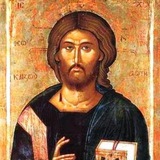
Christ the Pantocrator is one of the most widespread icons of Christ.
The word “Pantocrator” is translated from Greek as “the one who governs everything, the one who can do everything.”
Let us praise Him thus: “The very elements of nature obey You. Nothing happens by chance. What happens to us does not happen at random. Not a single hair from our heads falls to the ground without Your powerful will. We are in Your hands. What we are, whatever good we have in us, comes from You, the source of every goodness.”
—Father Emmanuel Hatzidakis
The Holy Confessor John the Russian (May 27/ June 8) steadfastly refused attempts by his Muslim master to convert him. "Neither by threats, nor with promises of riches and delights wilt thou be able to turn me away from my holy faith. I was born a Christian, and a Christian I shalt die". Eventually, the brutal heart of the master was tempered.
Confined to a cot in the corner of a horse-stable, he prayed compassionately for his fellow suffering Christians, even those who mocked him for his resolve in the midst of adversity. After his repose, Christian believers from various places came to Prokopia in Asia Minor to venerate his incorrupt and miracle-working holy relics. Saint John came to be venerated not only by Orthodox Christians, but also by Armenians, and even Turks, petitioning him with “Servant of God, disregard us not in thine mercy".
Confined to a cot in the corner of a horse-stable, he prayed compassionately for his fellow suffering Christians, even those who mocked him for his resolve in the midst of adversity. After his repose, Christian believers from various places came to Prokopia in Asia Minor to venerate his incorrupt and miracle-working holy relics. Saint John came to be venerated not only by Orthodox Christians, but also by Armenians, and even Turks, petitioning him with “Servant of God, disregard us not in thine mercy".
"But the souls of the righteous are in God's hand, and death cannot lay hold of them." (Wisdom of Solomon 3:1) On the second Sunday after Pentecost, each local Orthodox Church commemorates all saints, known and unknown, in its jurisdiction.
All Saints of ____, you have shone for as the fulfillment of God’s promise to redeem fallen humanity. Pray for us!
All Saints of ____, you have shone for as the fulfillment of God’s promise to redeem fallen humanity. Pray for us!
Saint John of Kronstadt (Glorification May 31/ June 13) “was granted by our Lord great gifts of clairvoyance and miracle-working, to such a degree that in the last years of his life miracles of healings — both of body and of soul — were performed countless times each day through his prayers, often for people who had only written to him asking his help. During his lifetime he was known throughout Russia, as well as in the Western world.
He has left us his diary My Life in Christ as a spiritual treasure for Christians of every age; simple in language, it expounds the deepest mysteries of our Faith with that wisdom which is given only to a heart purified by the grace of the Holy Spirit. Foreseeing as a true prophet the Revolution of 1917, he unsparingly rebuked the growing apostasy among the people; he foretold that the very name of Russia would be changed. As the darkness of unbelief grew thicker, he shone forth as a beacon of unquenchable piety, comforting the faithful through the many miracles that he worked and the fatherly love and simplicity with which he received all. Saint John reposed in peace in 1908." (Great Horologion)
St Theophan the Recluse: “You ask about the prayer rule. Yes, because of our weakness, it is proper to have a prayer rule. For one thing, it controls excessive zeal. The great men of prayer had a prayer rule and kept to it. Every time, they began prayer with the established prayers, and then, if self-initiated prayer came, they turned to it from reciting prayers. If they needed a prayer rule, then we need one even more! Without formal prayers, we would not know how to pray correctly at all. Without them, we would be completely without prayer. Nevertheless, we should not collect too many prayers. A few prayers, correctly read, are better than many prayers raced through.”