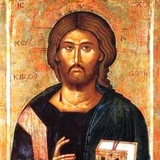
Only-begotten Son and Logos of God, being immortal, You condescended for our salvation to take flesh from the holy Theotokos and ever-virgin Mary and, without change, became man. Christ, our God, You were crucified and conquered death by death. Being one of the Holy Trinity, glorified with the Father and the Holy Spirit: Save us.
The bees of Isidor Timinis, a beekeeper near Athens, Greece show veneration for the Holy First-Martyr and Archdeacon Stephen (Dec 27/ Jan 9). The bees do the same with icons of the Lord, the Holy Theotokos and the saints. The bees regularly “wax" around the icons’ images, but never over top of them.
“Lord Jesus, receive my spirit, wherein O Lord, impute this not to them in sin.” ✝️The Holy First-Martyr and Archdeacon Stephen (Dec 27/ Jan 9)
With joy the young deacon St Stephen gave up his pure soul to Christ. His body, “left for devouring by beasts, was secretly taken up by the illustrious Jewish teacher Gamaliel and his son Habib, and given burial on his estate. And afterwards these both believed in Christ and accepted holy Baptism.” —from the Synaxarion
With joy the young deacon St Stephen gave up his pure soul to Christ. His body, “left for devouring by beasts, was secretly taken up by the illustrious Jewish teacher Gamaliel and his son Habib, and given burial on his estate. And afterwards these both believed in Christ and accepted holy Baptism.” —from the Synaxarion
When spiritual people are affected by vainglory, they feel very little satisfaction and are left with a sense of emptiness in their souls. Their hearts feel empty and do not flutter and leap; and as their vanity increases, the emptiness inside makes them suffer even more. Where there is anxiety and despair, the demons are at work in one's spiritual life. You should not feel anxiety about anything. Anxiety is the work of the devil. Where you see anxiety, be certain that the devil is involved... When we feel anxiety in our spiritual struggle, we must know that we are not moving in the realm of God. God is not a stifling tyrant.
We should all strive with philotimo (selfless love) and according to our strength. It is by cultivating philotimo that we grow in our love of God. When our efforts are driven by philotimo, our prostrations and fasting will be pure outbursts of love, and our path one of spiritual valor... We should simplify our efforts and put all our hope in Christ rather than in ourselves. Christ is full of love, kindness, and consolation. He will never stifle us. He gives abundant oxygen and divine comfort... You must be very careful to live the spiritual life with your heart rather than your mind... first putting your trust in God, with great humility.
✝️ Saint Paisios, Spiritual Counsels, Volume I: With Pain and Love
✝️ Saint Paisios, Spiritual Counsels, Volume I: With Pain and Love
The blessed Ioan (John) David (1920-1995) is a beloved lay-ascetic of the village of Plai, in Romania. He lived a solitary and pious life as a shepherd.
In “Spiritual Stories" by Archimandrite Ioanichie Balan (Romanian Patriarchate), he is remembered as one who “loved peace, silence and solitude so much that he rarely met others. He especially loved his sheep and called them all by name; wolves and thieves never stole them...."
“He lived as a hermit, isolated from the world; he had shelter in a barn in the forest, ate only breadcrumbs, made innumerable prostrations, and glorified God day and night.
Ioan David received spiritual direction from a monk named Simeon. In 1943, the monk Simeon reposed in the Lord and another hermit came to his cell, the monk Varsanufie Scriban, from the north of Moldova. He spent 26 years in that cell, having the humble lay-ascetic John David as his disciple.
So much did this brother increase spiritually that, in addition to constant prayer, he also acquired the gift of foresight, knowing the future, and he was full of humility and spiritual wisdom.
On January 7, 1995, when Saint John the Baptist was celebrated, after several months of suffering, blessed John David delivered his soul into the arms of Christ, being honoured by the locals as a great supplicant and hermit from the Carpathians.”
On January 7, 1995, when Saint John the Baptist was celebrated, after several months of suffering, blessed John David delivered his soul into the arms of Christ, being honoured by the locals as a great supplicant and hermit from the Carpathians.”
“Then I remembered . . . ‘Lord Jesus Christ, Son of God, have mercy on me.’
George Calciu was first imprisoned in 1948 for openly being a Christian in Communist Romania. He was repeatedly tortured until he denied Christ. Anguished over his “weakness,” George vowed to become a priest if he survived. He kept his promise, secretly studied for the priesthood and was ordained in 1973.
Fr. George preached so boldly for Christ and His Church that Communist dictator Nicolae Ceaușescu's secret police imprisoned him and tortured him to such exhaustion that he could not even recall the Lord’s Prayer. “Then I remembered . . . ‘Lord Jesus Christ, Son of God, have mercy on me.’ . . . I was no longer scared . . . and I was able to resist.”
Fr. George of blessed memory, pray for us sinners.
“When we are praying let us be mindful that we are not alone. We are joining our prayers with all the Holy Monks of Mt. Athos, with all the Holy Saints. In this manner, we are connected with them. Let us not lose connection. But rather see this as a privilege that in spite of our sinfulness and our heavy heart, we are being united with the totality of the whole church with those who are in heaven."
☦️ Fr. Felipe Balangit
☦️ Fr. Felipe Balangit
A beloved contributor to African American Orthodox Christianity has reposed. Eternal be the Memory of Abbamoses Berry.
A GIFT REJECTED— by Abbamoses Berry
In the late 1980's, we started an Orthodox Christian Community in St. Louis, Mo. It was located in a storefront, in a depressed part of town (which has since been gentrified).
After the massacre at St. George's Church in Addis Ababa, where 116 people lost their lives, there was an exodus of Ethiopians and Eritreans who had crossed Sudan on foot to safety in refugee camps in Kenya. Some of them were sent from Kenya to the U.S. During this time, St. Louis was one of a few Red Cross refugee centers scattered across the country, which gave assistance to people seeking asylum. In our city, there were established communities of previous refugees, some with their own churches, but this was not the case with the Ethiopians.
I was once at a grocery store in south St. Louis when I noticed a group of Ethiopians being instructed on how to shop in an American supermarket. As I went down the bread aisle, I noticed a woman sitting on the floor in tears, holding her knees and rocking back and forth. I asked the young White woman who was teaching the group what was the matter with that lady. She told me that she'd sent her to the bread aisle, but upon being confronted with everything from pita to hamburger buns to whole wheat, the woman was overcome with sensory overload in this land of plenty. That's when I knew that I had to establish some sort of organization to address the needs of these people. This was the first conception of the Brotherhood of St. Moses the Black.
We turned our storefront church basement into a free store with mostly household items, and one of the church's outreaches focussed on the welfare of the refugees. We were quite fond of one woman, Freyawitz. She was always sincere and pious in church and eager to lend a hand however she could. One early morning after Liturgy, Freyawitz asked me if she could remain in church and just pray. I told her she was welcome to do so, but I had to go to work, and that I'd return to get the key from her when the workday ended. When I arrived, I saw that the sidewalk in front of the church had been swept and rinsed, in the "scrubby Dutch" manner of old south St. Louis. Upon entering the narthex, I noticed that the windows had been washed, the baseboards cleaned - everything was spotless. I realized that Freyawitz must have spent the day cleaning. The nave had also been cleaned, but there was an overwhelming smell of cheap perfume. The carpets had been doused with a Dollar Store knockoff of Chanel #5. I was quite offended. Then I looked at the back of the church, where Freyawitz was standing by an icon of the Mother of God, placed on an analogion. She was smiling from ear to ear at the God-pleasing effort she had made to beautify the church, including providing a lovely (to her) incense-like scent. Seeing her labor of love, I realized how often we reject our brothers' and sisters' acts of lovingkindness when these acts don't mesh with our sensibilities. Freyawitz had given a gift, the best she could give, and it was acceptable in the eyes of the Lord. How often a gift is offered us, but rather than being thankful, we shut a door against it, and by extension, the giver.
We turned our storefront church basement into a free store with mostly household items, and one of the church's outreaches focussed on the welfare of the refugees. We were quite fond of one woman, Freyawitz. She was always sincere and pious in church and eager to lend a hand however she could. One early morning after Liturgy, Freyawitz asked me if she could remain in church and just pray. I told her she was welcome to do so, but I had to go to work, and that I'd return to get the key from her when the workday ended. When I arrived, I saw that the sidewalk in front of the church had been swept and rinsed, in the "scrubby Dutch" manner of old south St. Louis. Upon entering the narthex, I noticed that the windows had been washed, the baseboards cleaned - everything was spotless. I realized that Freyawitz must have spent the day cleaning. The nave had also been cleaned, but there was an overwhelming smell of cheap perfume. The carpets had been doused with a Dollar Store knockoff of Chanel #5. I was quite offended. Then I looked at the back of the church, where Freyawitz was standing by an icon of the Mother of God, placed on an analogion. She was smiling from ear to ear at the God-pleasing effort she had made to beautify the church, including providing a lovely (to her) incense-like scent. Seeing her labor of love, I realized how often we reject our brothers' and sisters' acts of lovingkindness when these acts don't mesh with our sensibilities. Freyawitz had given a gift, the best she could give, and it was acceptable in the eyes of the Lord. How often a gift is offered us, but rather than being thankful, we shut a door against it, and by extension, the giver.
I've noticed that brothers and sisters of good will are at odds with one another these days over so many little things. We need to be careful not to let something like our opinion about the wrong kind of perfume get in the way of something much more profound, such as our shared discipleship.
After I aired out the church overnight, the perfume smell was nearly gone and the offense, such as it was, quickly passed, as is most often the case.
After I aired out the church overnight, the perfume smell was nearly gone and the offense, such as it was, quickly passed, as is most often the case.
“[W]hatever is touched by the Holy Spirit is sanctified and converted." ☦️ St Cyril of Jerusalem
During the Holy Anaphora the priest prays: “Again we offer unto thee this rational and bloodless worship and beseech thee and pray thee and supplicate thee: Send down thy Holy Spirit upon us and upon these Gifts here spread forth. And make this bread the precious Body of thy Christ; Amen. And that which is in this cup, the precious Blood of thy Christ; Amen. Changing them by thy Holy Spirit; Amen. Amen. Amen.”
St John Chrysostom: “At this point, the Divine Liturgy signifies the time of Pentecost.”
"All images reveal and make perceptible those things which are hidden. For example, a man does not have immediate knowledge of invisible things ... Therefore the icon was devised that he might advance in knowledge, and that secret things might be revealed and made perceptible. Therefore, icons are a source of profit, help, and salvation for all, since they make things so obviously manifest, enabling us to perceive hidden things. Thus, we are encouraged to desire and imitate what is good and to shun and hate what is evil."
+ St John of Damascus
+ St John of Damascus
"It is obligatory with prayer and faith to widely bless each other with the Cross! Never, never forget to do it! Even if the spouses quarreled because of something or they have some other temptation, they still have to overcome themselves and necessarily bless each other with the Cross before leaving the house and before going to bed." —Fr. Nikolay Starovatykh
St Seraphim, Wonderworker of Sarov (Jan 2/ Jan 15) was once nearly beaten to death by robbers and walked with a bent back for the rest of his life from the injuries he received. This hunched stance shows in many icons. After recovering from his injuries, he spent a thousand days and nights in prayer on a large rock in the forest, sometimes standing, other times kneeling, leaving the rock only for brief periods. The Uncovering of the Relics of St Seraphim is commemorated on July 19/ Aug 1.
"You loved Christ from your youth, O blessed one, and longing to work for Him alone you struggled in the wilderness in constant prayer and labor. With penitent heart and great love for Christ you were favored by the Mother of God. Therefore we cry to you: 'Save us by your prayers, venerable Seraphim, our father.'” --Troparion, Tone 4
"You loved Christ from your youth, O blessed one, and longing to work for Him alone you struggled in the wilderness in constant prayer and labor. With penitent heart and great love for Christ you were favored by the Mother of God. Therefore we cry to you: 'Save us by your prayers, venerable Seraphim, our father.'” --Troparion, Tone 4
On judging others
"Have compassion on him who has not. Do not condemn him for what he does not have, that he is sinful, wicked, deceitful, talkative, a thief, a fornicator, and a liar. If you gain this knowledge, you can never judge anyone, even if you see him mortally sinning. For immediately you say, "He has not Your grace, my Christ, therefore he sins. If You go away from me also, I will do worse. He is poor. So how do you demand that he be rich? Give him riches so he can have them. He is blind. Give him eyes to see."
☦️ St Joseph the Hesychast