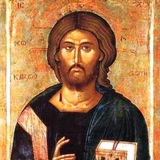
His arduous labours bore so much fruit that within seven years, three bishops were sent from Gaul to help him shepherd his flock, "my brethren and sons whom I have baptized in the Lord - so many thousands of people," he says in his Confession. His apostolic work was not accomplished without much "weariness and painfulness," long journeys through difficult country, and many perils; he says his very life was in danger twelve times.
When he came to Ireland as its enlightener, it was a pagan country; when he ended his earthly life some thirty years later, about 461, the Faith of Christ was established in every corner."
—from Orthodox Daily Posts for Inspiration on Facebook
When he came to Ireland as its enlightener, it was a pagan country; when he ended his earthly life some thirty years later, about 461, the Faith of Christ was established in every corner."
—from Orthodox Daily Posts for Inspiration on Facebook
"Forgive me, a sinner."
On Forgiveness Sunday, the last Sunday before Great Lent, we remember the expulsion of Adam and Eve from Paradise.
As their descendants, we have become heirs of death and corruption-- and in need of forgiveness.
We enter the season of the fast forgiving one another so that God will forgive us. "If you forgive men their trespasses, your heavenly Father will forgive you; but if you do not forgive men their trespasses, neither will your heavenly Father forgive you your trespasses." + Matthew 6:14
Clean Monday (Greek: 'Καθαρά Δευτέρα'), marks the start of Great Lent. We now begin the holy period of prayer, fasting, abstinence and almsgiving.
Many people clean their homes on this day, and in some places families even fly kites, a longstanding Greek tradition, symbolic of Christ’s Resurrection.
Many people clean their homes on this day, and in some places families even fly kites, a longstanding Greek tradition, symbolic of Christ’s Resurrection.
Saint Edward the Holy and Right-believing Martyr, King of England (Mar 18/ Mar 31) was, according to an early source, "a young man of great devotion and excellent conduct. He was completely Orthodox, good and of holy life. Moreover, he loved above all things God and the Church. He was generous to the poor, a haven to the good, a champion of the Faith of Christ, a vessel full of every virtuous grace."
However, the time of Edward’s reign were full of upheaval. The root of the trouble were nobles who coveted the lands which King Edward’s father, King Edgar, had given to the monasteries.
In all the turmoil King Edward stood firm together with the archbishop in defense of the Church and the monasteries. For this reason some of the nobles decided to remove him and replace him with his weaker younger brother, Ethelred. They seized their opportunity on March 18, 979, aided by Ethelred's stepmother, Queen Etheldritha.
After the murder, the queen ordered that the king’s holy body be seized and hidden in a hut nearby. In obedience to her command, the servants took the body by the feet and threw it ignominiously into the hut, concealing it with some mean coverings.
In the hut a lived a woman blind from birth whom the queen used to support out of charity. While she spent the night there alone with the holy body, suddenly, in the middle of the night, a wonderful light appeared and filled the whole hut. Struck with awe, the poor woman cried out: "Lord, have mercy!" At this, she suddenly received her sight, which she had so long desired. And then, removing the covering, she discovered the dead body of the holy king. The present church of St. Edward at Corfe stands on the site of this miracle.
In the hut a lived a woman blind from birth whom the queen used to support out of charity. While she spent the night there alone with the holy body, suddenly, in the middle of the night, a wonderful light appeared and filled the whole hut. Struck with awe, the poor woman cried out: "Lord, have mercy!" At this, she suddenly received her sight, which she had so long desired. And then, removing the covering, she discovered the dead body of the holy king. The present church of St. Edward at Corfe stands on the site of this miracle.
Edward's body was hastily buried at Wareham were it lay for a year before being disinterred. According to the life of Oswald, Edward's body was found to be incorrupt when it was disinterred. The body was taken to the Shaftesbury Abbey, a nunnery with royal connections which had been endowed by King Alfred the Great and where Edward’s grandmother Ælfgifu had spent her latter years.
Edward's remains were reburied with lavish public ceremony. In 1001, Edward's relics, for by now he was reckoned a saint, were translated to a more prominent place within the nunnery at Shaftesbury.
St Edward’s holy relics were hidden during the dissolution of the monasteries in the reign of King Henry VIII. The relics were rediscovered at the abbey in 1931 and are today enshrined in the Orthodox Church of St Edward the Martyr in Brookwood, Surrey.
☦️ The Lenten Prayer of St Ephraim the Syrian
Lord and Master of my life! Take from me the spirit of laziness, despair, lust of power and idle talk. (prostration)
But give rather the spirit of chastity, humility, patience and love to Your servant. (prostration)
Yes, O Lord and King! Grant me to see my own sins and not to judge my brother, for You are blessed unto ages of ages. Amen. (prostration)
O God, cleanse me a sinner! (bow 12 times)
O Lord and Master of my life! Take from me the spirit of laziness, despair, lust of power and idle talk. But give rather the spirit of chastity, humility, patience and love to Your servant.
Yes, O Lord and King! Grant me to see my own sins and not to judge my brother, for You are blessed unto ages of ages. Amen.(prostration)
"The tradition of praying a sundown coincides with the time of lighting the lamps, before the time of electricity. This was a definite transition time in ancient times, something we have lost in our electrical power world where there is no need to change what we are doing because of the setting of the sun. But, this transition required a definite change of activity in the days before electricity.
In the Church at this time of day, as the sun sets, we traditionally gather in the Church to give thanks for all the blessings our Lord has granted us this day. This prayer service begins with the psalm of creation (Psalm 103(104))."
www.orthodoxprayer.org/Hours.html
In the Church at this time of day, as the sun sets, we traditionally gather in the Church to give thanks for all the blessings our Lord has granted us this day. This prayer service begins with the psalm of creation (Psalm 103(104))."
www.orthodoxprayer.org/Hours.html
St. Dorotheos of Gaza on the Holy Lenten Fast: “Everyone who wants to purify himself of the sins of the whole year during these days must first of all restrain himself from the pleasure of eating. For the pleasure of eating, as the Fathers say, caused all men's evil. Likewise he must take care not to break the fast without great necessity or to look for pleasurable things to eat, or weigh himself down by eating and drinking until he is full."
The gentle, charitable St. Cuthbert, Wonderworker of Lindisfarne (Mar 20) could not perform the Holy Liturgy without tears. Likewise, he wept at hearing confessions. His compassion extended to all creatures.
When the saint would stand along the frigid coastline to pray, otters would come around him and lay along his feet to keep them dry and warm.
St. Cuthbert was known to surround himself with a species of duck and gave a rule which prohibited them from being eaten or disturbed. To this day, the species is known as the “Cuddy duck” in St. Cuthbert’s honour.
“Having surpassed thy brethren in prayers, fasting, and vigils, thou wast found worthy to entertain a pilgrim-angel; and having shone forth with humility as a bright lamp set on high, thou didst receive the gift of wonderworking. And now as thou dwellest in the heavenly Kingdom, O our righteous Father Cuthbert, intercede with Christ God that our souls be saved.”
"Come, see a Man who told me all things that I ever did. Could this be the Christ?" (John 4:29)
According to the tradition of the Church, the name of the Samaritan Woman by Jacob's well (Mar 20 and the 5th Sunday of Pascha) is Photini (or Photine, Photina, Svetlana), which means “light" (Φωτεινός). She is sometimes called the first evangelist since after her encounter with Christ at the well, she told her townspeople that she had met the Christ.
"Now if a woman of Samaria is so eager to learn something profitable; if she stays with Christ though not yet knowing Him, what pardon shall we obtain? ... We know Him ... yet are unable to endure anything that is said, but are jaded in our knowledge. ☦️ St John Chrysostom
Great-Martyr Photini, Equal-to-the-Apostles, pray to Christ for the salvation of our souls!
On the 1st Sunday of Great Lent, the Sunday of Orthodoxy, we commemorate the “Triumph of Orthodoxy,” the restoration of the holy icons in the reign of the holy Empress Theodora
St John of Damascus on Holy Images: "I do not worship matter, I worship the God of matter, who became matter for my sake, and deigned to inhabit matter, who worked out my salvation through matter. I will not cease from honouring that matter which works my salvation."
Photo: Holy Trinity Greek Orthodox Church, Orlando, Florida
“Behold the maidservant of the Lord! Let it be to me according to your word.”
The Annunciation to the Most-Holy Theotokos (Mar 25) "is the beginning of our salvation, the revelation of the eternal mystery! The Son of God becomes the Son of the Virgin as Gabriel announces the coming of Grace. Together with him let us cry to the Theotokos: Rejoice, O Full of Grace, the Lord is with you!" (Troparion of the Feast, Tone 4)
The Annunciation to the Most-Holy Theotokos (Mar 25) "is the beginning of our salvation, the revelation of the eternal mystery! The Son of God becomes the Son of the Virgin as Gabriel announces the coming of Grace. Together with him let us cry to the Theotokos: Rejoice, O Full of Grace, the Lord is with you!" (Troparion of the Feast, Tone 4)