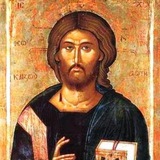
St. Porphyrios of Kavsokalyvia called St. Evmenios Saridakis (1931-1999) “the hidden Saint of our time” and often confessed to him. “A saint like Elder Evmenios comes along only once every two hundred years.”
As a priest, St. Evmenios (May 23) was afflicted by the harsh test of leprosy but was healed at the Hospital for Infectious Diseases near Athens, where he was blessed to meet and become a disciple and caretaker of the leprosied holy monk Saint Nikephoros.
All those who encountered the grace-filled Fr. Evmenios were struck by his love for every person. He was known for his laughter and also for his tears of compassion. He would be seen exiting the Inner Sanctum during the Liturgy, with his beard soaked by his tears for the suffering.
Having seen human suffering, he stayed at the hospital where he was healed. There he was “to begin his pastoral work, in the presence of which, those with theological degrees and ecclesiastic offices ought to kneel” (Greek language book, “Fr. Evmenios, The Hidden Saint Saint of our Time” by Monk Simon).
When his grandmother took young New Martyr Yevgeny (Eugene) Rodionov (May 23) for his first confession, the priest noticed that he was not wearing a cross. During the confession he put on a cross which Eugene steadfastly refused to take off, even when his mother told him he would be ridiculed at school for wearing it.
By 1995, the young man enlisted in the Russian army, and after basic training he was assigned to the border posts of Chechnya-Igusheti, where he was kidnapped and tortured by Chechen Muslims who tried to convert him to Islam, and attempted to coerce him to remove his cross.
Cynically, Yevgeny’s torturers decided to murder him on his nineteenth birthday. In his last moments, he told them: “My cross, I have been carrying it for seven consecutive years, I have never taken it off and never will, no matter what you do to me!” His captors then cut off his head with a knife, but they did not dare to remove the cross from his neck.
Nine harrowing months later, his heartbroken mother, Lyubov Vasilievna, found the body of her son. Yevgeny Rodionov’s body was then taken for burial to a resting place close to the Church of the Ascension of Christ in Kurilovo, near Moscow. Military and ordinary people come from all over Russia to venerate the hero. His mother said that once a veteran of the Great Patriotic War came to Yevgeny's grave. The old soldier took off the medal "For Courage" and put it on the gravestone.
St. Yevgeny was posthumously awarded the Order of Courage and the Order of Glory to Russia. But his most glorious reward is the Martyr’s Crown. Glory to God in His saints!
St. Yevgeny was posthumously awarded the Order of Courage and the Order of Glory to Russia. But his most glorious reward is the Martyr’s Crown. Glory to God in His saints!
“Faithfulness shall spring from the earth and justice look down from heaven. (Psalm 84 [85]:12)”
The Venerable Head of the Holy Prophet, Forerunner and Baptist John was first found on the Mount of Olives, where it had been hidden by Joanna, wife of Chusa, after the Saint's beheading. The second finding was at the city of Emesia during a time of unrest at Constantinople. The third finding came during a period of iconoclastic persecution. In around the year 850, after the veneration of icons was restored, Patriarch Ignatius saw in a vision the place at Komana where the head was buried in the ground. He revealed his vision to the emperor, who sent a delegation to Komana. There the head was found and transferred to Constantinople on May 25/ June 7.
The Venerable Head of the Holy Prophet, Forerunner and Baptist John was first found on the Mount of Olives, where it had been hidden by Joanna, wife of Chusa, after the Saint's beheading. The second finding was at the city of Emesia during a time of unrest at Constantinople. The third finding came during a period of iconoclastic persecution. In around the year 850, after the veneration of icons was restored, Patriarch Ignatius saw in a vision the place at Komana where the head was buried in the ground. He revealed his vision to the emperor, who sent a delegation to Komana. There the head was found and transferred to Constantinople on May 25/ June 7.
Part of the Holy Forerunner's head is now on Mt. Athos. The main portion rests at the Roman Catholic Cathedral of Our Lady, in Amiens, France. In recent years, Orthodox molebens and sometimes Divine Liturgies have been served there.
"As a divine treasure hidden in the ground was your head revealed to us by Christ, O prophet and Forerunner."
"As a divine treasure hidden in the ground was your head revealed to us by Christ, O prophet and Forerunner."
St. Bede the Venerable of Jarrow in Northumbria (May 27) “lived joyfully, giving thanks to God day and night..."
"He sang antiphons according to our and his custom, and among others this one: 'O King of Glory, Lord of Power, who this day didst ascend as Victor above all the heavens, leave us not orphaned behind Thee, but send us the promised Spirit of the Father, Alleluia.' And when he came to the words 'leave us not orphaned behind Thee', he burst into tears. Then, an hour later, he began to sing again. We wept with him; now we read, then we wept; but we could not read without tears." (Quotes are from multiple sources, complied by Vladimir Moss)
Holy Father Bede, pray to God for us!
http://www.orthodox.net/western-saints/bede-of-jarrow.html
May 29, 1453: The fall of Constantinople.
After just 24 hours, the vast majority of the populace had been either raped, despoiled, or enslaved. After seeing the great structures of the city being destroyed, Mehmet II ordered a stop to the traditional three days of rape, pillage, and looting routinely allowed after a conquest.
After just 24 hours, the vast majority of the populace had been either raped, despoiled, or enslaved. After seeing the great structures of the city being destroyed, Mehmet II ordered a stop to the traditional three days of rape, pillage, and looting routinely allowed after a conquest.
At Tabenissi monastery, any penance St. Theodore the Sanctified (May 16/ May 29) assigned to his brethren, he also completed the same for himself.
At the age of twelve, looked upon a festive meal of delicacies prepared by his family for the feast of Theophany. He told them, “If you enjoy this food, you will not enter into eternal life.”
At the age of twelve, looked upon a festive meal of delicacies prepared by his family for the feast of Theophany. He told them, “If you enjoy this food, you will not enter into eternal life.”
"Come, see a Man who told me all things that I ever did. Could this be the Christ?" (John 4:29)
The Sunday of the Samaritan Woman by Jacob's well commemorates the woman who, tradition tells us, was named Photini (or Photine, Photina, Svetlana), which means "light" (Φωτεινός). She is sometimes called the first evangelist since after her encounter with Christ at the well, she told her townspeople that she had met the Christ.
"Now if a woman of Samaria is so eager to learn something profitable; if she stays with Christ though not yet knowing Him, what pardon shall we obtain? ... We know Him ... yet are unable to endure anything that is said, but are jaded in our knowledge.
+ St John Chrysostom
Great-Martyr Photini, Equal-to-the-Apostles, pray to Christ for the salvation of our souls
☦️ I will come into Your house in the greatness of Your mercy: and in fear I will worship toward Your holy temple. Lead me, O Lord, in Your righteousness because of my enemies; make Your way straight before me, that with a clear mind I may glorify You forever, One Divine Power worshiped in three persons: Father, Son, and Holy Spirit. Amen. ☦️