Glory to Thy Precious Cross O Lord! At the Red Sea, Moses prefigured the Holy Cross.
“Lifting up the rod, he stretched out his hand and split the Sea for Israel to cross on land. Then he stretched it out again, and the sea returned and covered Pharaoh's chariots. The Cross was thus portrayed as our invincible armor. So let us sing to the Lord, Christ our God, for He is greatly glorified.”
—Katavasias of the Cross, Ode i. Mode pl. 4 on the commemoration of the Procession of the Precious Wood of the Life-giving Cross of the Lord (Aug 1/ Aug 14)
Pray for the people of Greece. Several villages and monasteries in the Attica region have been evacuated because of raging wildfires fanned by intense winds.
Several monasteries have also been evacuated, including the Holy Dormition Monastery in Penteli and St. Ephraim the New Monastery in Nea Makri which firefighters are battling to save.
Several monasteries have also been evacuated, including the Holy Dormition Monastery in Penteli and St. Ephraim the New Monastery in Nea Makri which firefighters are battling to save.
The Most-Holy Theotokos was prepared for her death, announced to her by the angel Gabriel as she visited Gethsemane to honour her Son. At the commemoration of the Dormition of our Most Holy Lady Theotokos (Aug 15/ Aug 28 ), let us remember that we also have an end, a dormition.
Most Holy Theotokos, save us!
Most Holy Theotokos, save us!
“You should know than the remedy against temptation is not only prayer but also spiritual joy, and joy turned into gladness. ‘Rejoice and be exceedingly glad,’ exhorts the Saviour (Matthew 5:12).
Some people might think this is a pleonasm, but joy and gladness are not the same thing. Joy is a spiritual state that you feel vibrating in you; you have a state of joy. Gladness is the manifestation of this joy, the fruit of internal joy.
When your soul is sad, when your soul is closed off, it cannot be glad. And we absolutely need to cultivate joy.
—His Eminence Iustinian Chira, Archbishop of Maramures, Romania (1921 - 2016)
Not too many years ago the Abbess of a convent of the Russian Orthodox Church Outside of Russia, a woman of righteous life, was delivering a sermon in the convent church on the feast of the Dormition of the Most Holy Mother of God. With tears she entreated her nuns and the pilgrims who had come for the feast to accept entirely and wholeheartedly what the Church hands down to us, taking such pains to preserve this tradition sacredly all these centuries—and not to choose for oneself what is “important” and what is “dispensable”; for by thinking oneself wiser than the tradition, one may end by losing the tradition.
Thus, when the Church tells us in her hymns and icons that the Apostles were miraculously gathered from the ends of the earth in order to be present at the repose and burial of the Mother of God, we as Orthodox Christians are not free to deny this or reinterpret it, but must believe as the Church hands it down to us, with simplicity of heart.
☦️ Fr. Seraphim Rose, introduction to The Orthodox veneration of the Theotokos by St. John Maximovitch
☦️ Fr. Seraphim Rose, introduction to The Orthodox veneration of the Theotokos by St. John Maximovitch
“We venerate your most pure image, O Good One.”
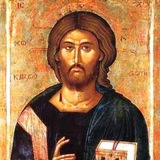
The icon of the Holy Face of Jesus Christ, "The Saviour Not Made by Hands" (Mandylion) was made by the Lord Himself, who pressed His Holy Face on a cloth and gave it to an artist commissioned by Abgar, who ruled at Edessa, in Syria. The commemoration of its translation to Constantinople is commemorated on Aug 16/ Aug 29.
Abgar, who was stricken with leprosy, had sent the artist, Ananias, to Jerusalem to paint a likeness of the Divine Teacher. When Ananias returned to Edessa with the cloth, it brought miraculous healing to Abgar. The ruler put the Holy Napkin in a gold frame adorned with pearls and placed it in a niche over the city gates. On the gateway above the icon he inscribed the words, “O Christ God, let no one who hopes on Thee be put to shame.”
Arabs, who later seized the city, did not prevent the veneration of the icon, which by that time had wrought countless miracles. In 944, emperor Constantine Porphyrogenitos paid a ransom for the icon, The icon was then brought to Constantinople.
Christ our God, as we behold the victorious image or Your true incarnation, we honour it with veneration!
Christ our God, as we behold the victorious image or Your true incarnation, we honour it with veneration!
“A Christian must be courteous to all. His words and deeds should breath with the grace of the Holy Spirit, which abides in his soul, so that in this way he might glorify the name of God. He who regulates all of his speech also regulates all of his actions. He who keeps watch over the words he is about to say also keeps watch over the deeds he intends to do, and he never goes out of the bounds of good and benevolent conduct. The graceful speech of a Christian is characterized by delicateness and politeness. This fact, born of love, produces peace and joy.”
✠ St Nektarios of Aegina
✠ St Nektarios of Aegina
Preasfântă Născătoare de Dumnezeu, miluiește-ne pe noi. (Most Holy Birthgiver of God, have mercy on us.)
“St. Gregory Palamas questions even the ability of words to grasp the mystery of the Birthgiver of God: What word could describe, Mother of God, Virgin, your godly, brilliant beauty? For it is not possible to grasp all your attributes in thought or word, since they are beyond the mind and words. But it is possible for us to praise you, who receive us out of your love for mankind. You are the dwelling place of all graces and the fullness of all beauty and all good, the living icon of virtue and of all goodness, the only one worthy to encompass all the gifts of the Spirit....
“St. Gregory Palamas questions even the ability of words to grasp the mystery of the Birthgiver of God: What word could describe, Mother of God, Virgin, your godly, brilliant beauty? For it is not possible to grasp all your attributes in thought or word, since they are beyond the mind and words. But it is possible for us to praise you, who receive us out of your love for mankind. You are the dwelling place of all graces and the fullness of all beauty and all good, the living icon of virtue and of all goodness, the only one worthy to encompass all the gifts of the Spirit....
It is not possible for us to understand with our mind and to express the mystery of the Virgin Mary, but it is possible to praise her. Another father says that after the word is born in our mind, the soul breaks into song, which means that man’s attempt to contemplate the Mother of God cannot succeed unless that endeavor is transformed into a song of praise to the Birthgiver. We cannot talk about the Virgin, we can only hymn her. We cannot explain through words, we can only witness her mystery in praises.
Song brings us to thanksgiving, and the joy of thanksgiving becomes a new song, says a hymnologist of Mount Athos. And in this élan of song and thanksgiving we discover Christ, her Son, for where the Mother is, there is also the Son: heavenly delight and joy beyond this world is the moment in which man grasps the mystery of the economy of the Incarnation through the mediation of the Most Holy Virgin. Mary with Jesus, Jesus with Mary, these two names most pure and most sweet—this is Paradise, says Athanasius the Iberian.”
—from Romanian Metropolitan Nicolae’s Meditation for the Feast of the Dormition of the Theotokos
—from Romanian Metropolitan Nicolae’s Meditation for the Feast of the Dormition of the Theotokos
St. Gregory the Theologian wrote lovingly of his mother, St Nonna (Aug 5/ Aug 18): “What time and place of prayer ever eluded her? She was drawn to this each day before anything else, and she had complete faith that her prayers would be answered.” Through his mother’s wonder-working prayers, St Nonna’s pagan husband Gregory the elder had a dream vision in his sleep, in which, says the younger Gregory, “it seemed as though he was singing the following verse of David: I was glad when they said of me, let us go into the house of the Lord (Ps. 121: 1).” In the singing of the psalm was itself was was the actual desire to do so!” St Gregory’s conversion was no doubt the result of St Nonna’s fervent prayers.
The elder Gregory went to the First Council at Nicea, where he made known his conversion to Christ and was ordained presbyter and then bishop of Nazianzus and devoted himself totally to the Church.
The elder Gregory went to the First Council at Nicea, where he made known his conversion to Christ and was ordained presbyter and then bishop of Nazianzus and devoted himself totally to the Church.