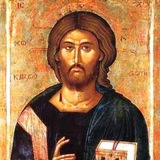
When the Emperor Constantine sent his mother, the Empress Saint Helena (both commemorated on May 21/ June 3) to locate the Holy Sepulchre, the tomb of Jesus Christ, in 325 AD, she did so with the help of locals. To prevent early believers from venerating the site, the Roman emperor Hadrian had a temple built to Jupiter over the Holy Sepulchre in 125 AD. However. the location of the site was never forgotten. Locals believers directed St Helen to the temple and veneration and pilgrimage has continued since then.
Recently, the Holy Sepulchre was opened as part of a larger project to repair damage to the Church of the Holy Sepulchre (Church of the Resurrection). It has been re-sealed and might not be revealed again for centuries. The True Cross of Our Lord Jesus Christ, also discovered by St Helen, was elevated in the Church of the Resurrection. The Feast Day of the Elevation (Exaltation) of the Cross is Sept 14/ Sept 27.
Recently, the Holy Sepulchre was opened as part of a larger project to repair damage to the Church of the Holy Sepulchre (Church of the Resurrection). It has been re-sealed and might not be revealed again for centuries. The True Cross of Our Lord Jesus Christ, also discovered by St Helen, was elevated in the Church of the Resurrection. The Feast Day of the Elevation (Exaltation) of the Cross is Sept 14/ Sept 27.
“I come to You, O Christ,
Blind from birth in my spiritual eyes
And I call to You in repentance:
You are the most radiant light of those in darkness!”
The miracle described in the Gospel reading (John 9:1-38), for the Sunday of the Blind Man (Sixth Sunday of Pascha), is even more remarkable than it might seem at first.
St Basil and other Fathers tell us that our Lord didn't just give sight to a blind man born "who was blind from his birth" (John 9:1). He placed clay in the man’s empty sockets and told him to wash in the pool of Siloam. When the blind man, did this, the eyes of clay became living eyes!
Saint Demetrius of Rostov, in his Great Synaxarion, mentions that the blind man's name was Celidonius. One tradition ascribes to St. Celidonius the founding of the Christian church at Nîmes in Gaul (present-day France).
St. Porphyrios of Kavsokalyvia called St. Evmenios Saridakis (1931-1999) “the hidden Saint of our time” and often confessed to him. “A saint like Elder Evmenios comes along only once every two hundred years.”
St. Evmenios (May 23) was afflicted by the harsh test of leprosy but was healed at the Hospital for Infectious Diseases near Athens, where he was blessed to meet and become a disciple and caretaker of the leprosied holy monk St Nikephoros.
All those who encountered the grace-filled Fr. Evmenios were struck by his love for every person. He was known for his laughter and also for his tears of compassion. He would be seen exiting the Inner Sanctum during the Liturgy, with his beard soaked by his tears.
Having seen human suffering, he stayed at the hospital where he was healed. There he was “to begin his pastoral work, in the presence of which, those with theological degrees and ecclesiastic offices ought to kneel” (Greek language book, “Fr. Evmenios, The Hidden Saint Saint of our Time” by Monk Simon).
When his grandmother took young New Martyr Yevgeny (Eugene) Rodionov (May 23) for his first confession, the priest noticed that he was not wearing a cross. During the confession he put on a cross which Eugene steadfastly refused to take off, even when his mother told him he would be ridiculed at school for wearing it.
By 1995, the young man enlisted in the Russian army, and after basic training he was assigned to the border posts of Chechnya-Igusheti, where he was kidnapped and tortured by Chechen Muslims who tried to convert him to Islam, and attempted to coerce him to remove his cross.
Cynically, Yevgeny’s torturers decided to murder him on his nineteenth birthday. In his last moments, he told them: “My cross, I have been carrying it for seven consecutive years, I have never taken it off and never will, no matter what you do to me!” His captors then cut off his head with a knife, but they did not dare to remove the cross from his neck. [1/2]
[2/2] Nine harrowing months later, his heartbroken mother, Lyubov Vasilievna, found the body of her son. Yevgeny Rodionov’s body was then taken for burial to a resting place close to the Church of the Ascension of Christ in Kurilovo, near Moscow. Military and ordinary people come from all over Russia to venerate the hero. His mother said that once a veteran of the Great Patriotic War came to Yevgeny's grave. The old soldier took off the medal "For Courage" and put it on the gravestone.
St. Yevgeny was posthumously awarded the Order of Courage and the Order of Glory to Russia. But his most glorious reward is the Martyr’s Crown. Glory to God in His saints!
St. Yevgeny was posthumously awarded the Order of Courage and the Order of Glory to Russia. But his most glorious reward is the Martyr’s Crown. Glory to God in His saints!
“Faithfulness shall spring from the earth and justice look down from heaven. (Psalm 84 [85]:12)”
The Venerable Head of the Holy Prophet, Forerunner and Baptist John was first found on the Mount of Olives, where it had been hidden by Joanna, wife of Chusa, after the Saint's beheading. The second finding was at the city of Emesia during a time of unrest at Constantinople. The third finding came during a period of iconoclastic persecution. In around the year 850, after the veneration of icons was restored, Patriarch Ignatius saw in a vision the place at Komana where the head was buried in the ground. He revealed his vision to the emperor, who sent a delegation to Komana. There the head was found and transferred to Constantinople on May 25/ June 7.
Part of the Holy Forerunner's head is now on Mt. Athos. The main portion rests at the Roman Catholic Cathedral of Our Lady, in Amiens, France. In recent years, Orthodox molebens and sometimes Divine Liturgies have been served there.
“I come to You, O Christ,
Blind from birth in my spiritual eyes
And I call to You in repentance:
You are the most radiant light of those in darkness!”
The miracle described in the Gospel reading (John 9:1-38), for the Sunday of the Blind Man (Sixth Sunday of Pascha), is even more remarkable than it might seem at first.
St Basil and other Fathers tell us that our Lord didn't just give sight to a blind man born "who was blind from his birth" (John 9:1). He placed clay in the man’s empty sockets and told him to wash in the pool of Siloam. When the blind man, did this, the eyes of clay became living eyes!
Saint Demetrius of Rostov, in his Great Synaxarion, mentions that the blind man's name was Celidonius. One tradition ascribes to St. Celidonius the founding of the Christian church at Nîmes in Gaul (present-day France).
Blind from birth in my spiritual eyes
And I call to You in repentance:
You are the most radiant light of those in darkness!”
The miracle described in the Gospel reading (John 9:1-38), for the Sunday of the Blind Man (Sixth Sunday of Pascha), is even more remarkable than it might seem at first.
St Basil and other Fathers tell us that our Lord didn't just give sight to a blind man born "who was blind from his birth" (John 9:1). He placed clay in the man’s empty sockets and told him to wash in the pool of Siloam. When the blind man, did this, the eyes of clay became living eyes!
Saint Demetrius of Rostov, in his Great Synaxarion, mentions that the blind man's name was Celidonius. One tradition ascribes to St. Celidonius the founding of the Christian church at Nîmes in Gaul (present-day France).