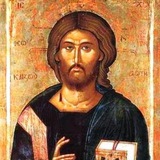
“O Lord and Master of my life...", the familiar prayer of humility said during Great Lent, comes to us from the Monk Ephrem the Syrian (Jan 28/ Feb 10) a most humble teacher of repentance of the 4th century. In his youth he was the disciple of Saint James, Bishop of Nisibis, one of the 318 Fathers at the First Ecumenical Council. He was an ardent student and sought-after teacher of Holy Scripture as well as composer of many prayers and hymns which have enriched Church's Divine-services.
Saint Ephrem “accepted only the dignity of deacon, in which he remained until death.” Saint Basil the Great “once invited the Monk Ephrem to accept the cathedra-chair of a bishop, but the saint feigned folly to avoid for himself this honour, in humility reckoning himself unworthy of it.”
—quotes from the Synaxarion
The “Triodion” starts this Sunday, the Sunday of the Publican. The name "Triodion" means “three odes” and refers to the ten weeks leading up to Pascha, as well as to the book which contains the hymns, readings, and prayers specific to this season.
During the Triodion, the Canons (the series of hymns sung at Matins) contain only three odes instead of the usual nine.
The Lenten Triodion book is used continuously in services from the Sunday of the Publican through Great Lent and Holy and Great Week.
☦️ Saint Theophan the Recluse:
"Use the time of the Triodion to cleanse your souls through persistent prayer, fasting, and good deeds. Let the chants of the Triodion penetrate your heart and awaken your longing for God.
May the Lord bless you and strengthen you in this spiritual struggle, so that you may reach with joy the light of His Resurrection!"
When disputes arose among believers as to which of the three holy hierarchs, Basil the Great, John Chrysostom and Gregory of Nazianzus (Synaxis, Jan 30/ Feb 12) was the greatest, the three settled the matter themselves, appearing in great glory to Bishop John of Euchaita, declaring:
“As you see, we are one in God and there is nothing contradictory in us; neither is there a first or a second among us.” The saints also advised Bishop John that he write a common service for them and to order a common feast day of celebration.
Let us honour with hymns the three great torch-bearers of the triune Godhead: Basil, Gregory and John.
One of the most remarkable miracles of St Brigid (Feb 1) is her healing of a blind nun named Dara.
Once, during a particularly beautiful sunrise, the Saint took pity on Dara, making the sign of the cross and praying that Dara would be healed of her blindness, so as to experience the beauty of the sunrise. Dara's eyes were opened and she saw the sun in the east, and the trees and flowers sparkled with dew. Then, after awhile she turned to St Brigid and said, “Close my eyes again, dear Mother, for when the world is visible to the eyes, then God is seen less clearly by the soul.” St Brigid prayed and Dara again became blind.
St Brigid founded a monastery on land given to her by the King of Leinster. The land was called Cill Dara (Kildare), or “the church of the oak.” This was the beginning of women’s cenobitic monasticism in Ireland.
Devotion to St Brigid remains strong in Ireland where she is one of the country’s patron saints. She is also venerated by many in northern Italy, France, and Wales.
And behold, there was a man in Jerusalem whose name was Simeon, and this man was just and devout, waiting for the Consolation of Israel, and the Holy Spirit was upon him. And it had been revealed to him by the Holy Spirit that he would not see death before he had seen the Lord’s Christ. So he came by the Spirit into the temple. And when the parents brought in the Child Jesus, to do for Him according to the custom of the law, he took Him up in his arms and blessed God and said: Lord, now let Your servant depart in peace, according to Your Word, for my eyes have seen Your salvation which You have prepared before the face of all peoples: a light to enlighten the Gentiles and the glory of Your people Israel.
✝️ Luke 2:25-32, from the Gospel Reading for The Meeting of our Lord and Saviour, Jesus Christ, in the Temple (Feb 2)
✝️ Luke 2:25-32, from the Gospel Reading for The Meeting of our Lord and Saviour, Jesus Christ, in the Temple (Feb 2)
On World Cancer Day, 1994, St. Paisios of Mt. Athos had surgery to remove a colon tumor. By then, the cancer had already spread to his liver and lungs. He was just a few months from death.
A fellow monk asked him, “Geronda, are you in pain?” He answered: “I’m used to pain. My illnesses helped me more than my whole monastic life ever did.”
St. Paisios was unafraid of death. To the illnesses that had troubled him since his youth, he would say: "You do your job, and I’ll do mine."
God revealed to St. Paisios that Paradise is full of people who died from cancer. Some Elders have called cancer a “holy disease” informing the person that eternity is approaching. This may be a difficult pill for many to swallow, but a diagnosis of cancer may give a person time to repent and better prepare for eternity.
For St. Paisios, even more important than miraculous physical cures is the abandonment of our own will to the will of God, when one “manages to eliminate his will to zero."
She is the patron saint of breast cancer patients, nurses, and victims of violence.
During the third-century persecution under the emperor Decius, the young virgin St. Agatha of Catania (Feb 5) could not be coerced by the city prefect, Quintianus, to sacrifice to the gods. She was subjected to cruel torments, including the attempted removal of her breasts with metal tongs. When this failed, her torturers used knives.
The holy Apostle Peter appeared to St. Agatha in prison and healed her wounds. Quintianus was astonished to see her completely healed, with no trace of cutting. Then the torture began again, but as it did, an earthquake shook the city. Among those killed in the destruction were two of Quintianus’s advisors.
The terrified inhabitants of Catania rushed to Quintianus, demanding an end to Agatha’s tortures. Fearing a revolt, he sent St Agatha back to prison. There St Agatha, offering thanks to God, peacefully surrendered her soul to Him.
Prayer is our very breath. Prayer should be like a vigil lamp in our hearts: permanent. We must always make sure that it has oil to continue burning. In the moments when we find it most difficult to pray, we should pray at least a little so that the light in our hearts won't go out. We must be like the wise virgins, not like the foolish maidens, so that we will not be taken by surprise when death comes. —Elder Sergei of Vanves
The truth would not be silenced. When St. Meletius (Feb 12), hymned as “a model of faith and the image of gentleness”, began preaching the Son's consubstantiality with the Father, an Arian archdeacon put his hand over the then-bishop of Antioch’s mouth. Undeterred, Meletius, reacted by extending three fingers towards the people, closed them, and extended one only, signifying the equality and unity of the Trinity. The frazzled archdeacon then seized his hand, but in doing so, released his mouth. Meletius declared even more passionately the true doctrine of the Holy Trinity and the declarations of the Council of Nicaea.
Speaking the truth would get the righteous and gentle St. Meletius banished three times from the episcopal throne. Each time, he was eventually restored.
It was St Meletius who ordained St John Chrysostom reader and deacon in Antioch.
Speaking the truth would get the righteous and gentle St. Meletius banished three times from the episcopal throne. Each time, he was eventually restored.
It was St Meletius who ordained St John Chrysostom reader and deacon in Antioch.