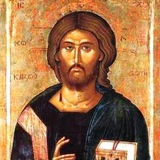
"When we are stricken with sorrows, pain, suffering of body or soul; when our sins have overtaken us, and when we come to despair; when we feel abandoned by God and men; when we are afflicted by our own passions and by the piercing attacks of the demons; and when we have stubbornly kicked against God’s good-will, isolated ourselves and have wandered astray into spiritual death and hell—
Then, when all hope is lost, and all we have is the slightest turning of our thoughts and hearts to heaven, seeking wordlessly the salvation of Christ, then it is that we should and must turn to His Mother."
Excerpted from a sermon by a monk of Holy Cross Monastery, Wayne, WV, on the Feast of the Protection of the Theotokos.
The reasons why Jesus Christ came into the world are as follows:
1. The love of God for the human race: ‘For God so loved the world that He gave His only begotten son’ (John 3:16).
2. The restoration of the image and likeness of God in fallen man. The Holy Church in the First Canon of Christmas, Canticle 1, sends up its hymn of praise, referring to this: 'Man fell from the divine and better life: though made in the image of God, through transgression he became wholly subject to corruption and decay. But now the wise Creator fashions him anew.’
3. The salvation of human souls: 'For God sent not His Son into the world to condemn the world, but that the world through Him might be saved’ (John 3:17).
We, therefore, following the purpose of our Deliverer and Lord, Jesus Christ, must spend our lives in accordance with His divine teaching, in order that through it we may receive salvation for our souls.
+St Seraphim of Sarov
Thousands of residents and pilgrims gathered in the Eastern Romania city of Iasi on Oct 14 to celebrate the 11th-century saint, St Parascheva, the wonderworking patron saint of the Moldova region, renowned for her life of piety and charity.
Normally, on Oct 13-14, throngs of pilgrims line up for up to 24 hours outside St. Paraschiva Metropolitan Cathedral in the city of Iași to venerate her incorrupt relics. This year, Covid restrictions left many heartbroken faithful unable to venerate the beloved Saint at her relics.
Normally, on Oct 13-14, throngs of pilgrims line up for up to 24 hours outside St. Paraschiva Metropolitan Cathedral in the city of Iași to venerate her incorrupt relics. This year, Covid restrictions left many heartbroken faithful unable to venerate the beloved Saint at her relics.
The Holy Apostle and Evangelist Luke (Oct 18), a native of Syrian Antioch, and a companion The holy Apostle Paul is hymned as “recorder of the joyous Gospel of Christ and the scribe of the Acts of the Apostles, for his writings are a testimony of the Church of Christ: He is the physician of human weaknesses and infirmities. He heals the wounds of our souls, and constantly intercedes for our salvation!”
His Gospel was written by Saint Luke in the years 62-63 at Rome, under the guidance of the Apostle Paul.
After the martyr's death of the First-Ranked Apostles Peter and Paul, Saint Luke left Rome to preach in Achaeia, Libya, Egypt and the Thebaid. In the city of Thebes he finished his life in martyrdom.
Tradition ascribes to him the writing of the first icons of the Mother of God. "Let the grace of He born of Me and My mercy be with these icons", -- said the All-Pure Virgin in beholding the icons. Saint Luke wrote likewise icons of the First-Ranked Apostles Peter and Paul.
“Let us praise the godly Luke: he is the true preacher of piety, the orator of ineffable mysteries and the star of the Church; for the Word, Who alone knows the hearts of men, chose him, together with wise Paul, to be a teacher of the gentiles.” —Kontakion, Tone 2
Glory to Thee for calling me into being
Glory to Thee, showing me the beauty of the universe
Glory to Thee, spreading out before me heaven and earth
Like the pages in a book of eternal wisdom
Glory to Thee for Thine eternity in this fleeting world
Glory to Thee for Thy mercies, seen and unseen
Glory to Thee through every sigh of my sorrow
Glory to Thee for every step of my life's journey
For every moment of glory
Glory to Thee, O God, from age to age
from Ikos 1, "Akathist of Thanksgiving”, found among the effects of Protopresbyter Gregory Petrov upon his death in a prison camp in 1940. The title is from the words of Saint John Chrysostom as he was dying in exile. It is a song of praise from amidst the most terrible sufferings attributed to Metropolitan Tryphon of Turkestan.
The prophet Joel (800 B.C., Oct 19) called the people to fasting and the priests to tearful penitential prayer, that God would have mercy on them: "Sanctify a fast … and cry unto the Lord" (Joel 1:14); "Let the priests, the ministers of the Lord, weep between the porch and the altar" (Joel 2:17).
The central message of the Book of Joel is thus that “the day of The Lord draws near” (1:15) All must be made aware of the darkness and gloom that is to come. He calls for the people to turn back to God with all their hearts because He is merciful and compassionate. Repentance will save the Lord’s people from captivity.
He also foretold the coming of the Holy Spirit on the day of Pentecost (Joel 2:28, and quoted by the Apostle Peter in Acts 2:17), and the saving power of the Name of our Lord Jesus Christ (Joel 2:32).
Further, he prophesied and described the Dread Judgment of God, and also prophesied the glory of God's Holy Church.
“Enlightened by the Spirit, your pure heart became the dwelling place of most splendid prophecy; for you saw things far off as if they were near. Therefore, we honor you, blessed and glorious Prophet Joel.”
Kontakion, Tone 4
“Enlightened by the Spirit, your pure heart became the dwelling place of most splendid prophecy; for you saw things far off as if they were near. Therefore, we honor you, blessed and glorious Prophet Joel.”
Kontakion, Tone 4
St Hilarion the Great (Oct 21), hymned as “a rampart for ascetics” was for Palestine what St Anthony was for Egypt. Saint Anthony would even send sick people to Hilarion for healing.
St Hilarion, after distributing his inherited wealth to the poor following the death of his pagan parents, entered the desert of Palestine at the age of fifteen. He devoted himself entirely to unceasing prayer and strict fasting, living in a hut made of reeds.
His fame spread throughout Palestine and into Egypt and Syria by the age of twenty-two, crowds of faithful flocked to him. There were soon two thousand monks who gathered to live around Hilarion in their own cells.
At the age of sixty-three, Hilarion began to long for the solitude of his youth. Six thousand wanted to follow him wherever he went. He persuaded them to go back, but took forty disciples with him, who were able to endure long journeys on foot and fast until sunset. Wherever he went, crowds of faithful came running after him.
He spent the last five years of his life in a difficult to reach cave in Paphos, where he was visited only by one disciple named Hesychios. In 372, at the age of eighty, he departed from this world.
His final words were: "Go forth, O my soul. What do you fear? Go forth! Why are you disquieted within me? You have served Jesus Christ for almost seventy years and do you fear death?" With these words he gave up his soul to God.
St. Nikolai Velimirovich offers the great Saint this hymn:
“Holy Hilarion, like a brilliant comet,
Fleeing from men, traveled half the world.
But such a star hides in vain:
Its own light reveals it to the world.
But such a star hides in vain:
Its own light reveals it to the world.
Hilarion wished to escape earthly glory,
But from glory the saint could not flee.
Where God did not proclaim him, the demons did,
Being terrified by the saint, who cast them out.
Wherever he settled, Hilarion the Wonderful
Worked miracles and healed the sick,
Conquered his weakness and passions.
A conqueror of the world, he subdued the demons.
He hid in caves, yet was proclaimed by all.
He shunned all, but was glorified by all.
The Lord glorifies His glorifiers,
And crowns victorious runners with wreaths.
When the race of earthly life passes,
The wreaths of everlasting life are given.
The aged Hilarion, ever young in spirit,
Now takes delight in the Lord face to face.
Even now his prayers wage war for us,
That in His compassion the Lord would have mercy on us.”
Kontakion, Tone 3
“By a flood of tears you made the desert fertile, and your longing for God brought forth fruits in abundance. By the radiance of miracles you illumined the whole universe! Our Father Hilarion pray to Christ God to save our souls!”
O my brethren, how lamentably shallow are the minds of all those who do not know the Law of God! The depth of man’s mind is measured by the depth of his knowledge of God’s law. The mind of him who meditates on the mysteries of God’s law is deep, wide and exalted; and the mind is the rudder of the heart and will. O my brethren, how shallow, unstable and dissolute is the will of him who does not subordinate his will to the will of God! Indeed, it is lamentably shallow, unstable and dissolute. What is the Law of God, brethren? It is the expression of God’s will. Where is that expression to be found? In Holy Scripture and in the Tradition of the saints of the Church of God. Blessed is he who knows the will of God and fulfills it.
O Lord God, great and powerful, merciful and just; enlighten our minds by Thy holy law, so that we may conform our wills to Thy man-loving and saving will.
To Thee be glory and praise forever. Amen.
Excerpt from The Prologue from Ohrid: Lives of Saints by St Nikolai Velimirovich
O Lord God, great and powerful, merciful and just; enlighten our minds by Thy holy law, so that we may conform our wills to Thy man-loving and saving will.
To Thee be glory and praise forever. Amen.
Excerpt from The Prologue from Ohrid: Lives of Saints by St Nikolai Velimirovich
St Demetrius Memorial Saturday (4th Saturday of October) honours those who fell in the Battle of Kulikovo. On the eve of the battle, Russian Prince Demetrius of the Don, greatly devoted to the holy Great Martyr Demetrius of Thessalonica, solemnly transferred to Moscow the icon of the Great Martyr from the Dimitriev cathedral of Vladimir.
In the battle, September 8, 1380, the Feast of the Nativity of the Most Holy Theotokos, Prince Saint Demetrius smashed the military might of the Golden Horde. The victory was the first Russian national deed, rallying the spiritual power of the Russian nation around Moscow.
In the battle, September 8, 1380, the Feast of the Nativity of the Most Holy Theotokos, Prince Saint Demetrius smashed the military might of the Golden Horde. The victory was the first Russian national deed, rallying the spiritual power of the Russian nation around Moscow.
St Kenneth, Wonder-Worker of Ireland and Scotland (Oct 11/ Oct 24), also known as Cainnech and Canice, is one of the greatest Irish ascetics and one of St Columba's first companions to Iona in the 6th century. The remains of a monastery, (photo) with graves of the MacLean clan, are found today on St Kenneth's Isle (Inchkenneth).
St. Kenneth became a disciple of St. Finnian of Clonard and studied at his monastery. The school founded by St. Finnian trained over 3,000 prominent Irish ascetics. St. Kenneth established monasteries throughout Ireland. The Irish county Kilkenny (“Kenneth’s Church” in Gaelic) was one of the last areas in Ireland to convert to Christianity.
Holy Father Kenneth, Wonder-Worker of Ireland and Scotland, pray to God for us!