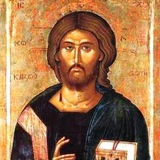
"Intelligent men are not those who are erudite in the sayings, but those who can discriminate between good and evil." + St. Anthony the Great (Jan 30/ Jan 17)
LIVE FEED from St. Anthony's Greek Orthodox Monastery in Florence, Arizona
https://www.twitch.tv/stanthonysmonastery
LIVE FEED from St. Anthony's Greek Orthodox Monastery in Florence, Arizona
https://www.twitch.tv/stanthonysmonastery
Twitch
StAnthonysMonastery - Live on Twitch
Church services at St. Anthony's Greek Orthodox Monastery in Florence, AZ
"The truly blessed are not the ones who can work miracles or see angels; the truly blessed are the ones who can see their own sins."
+Our Venerable and God-bearing Father Anthony the Great (Jan 17/ Jan 30), Father of monasticism.
+Our Venerable and God-bearing Father Anthony the Great (Jan 17/ Jan 30), Father of monasticism.
Let us become like Christ, since Christ became like us. +St Gregory the Theologian, Archbishop of Constantinople (Feb 7/ Jan 25)
"He prays, but he answers prayers. He weeps, but wipes away tears. He asks where Lazarus has been laid, for he is man; but he raises him to life, for he is God. He is sold, dirt cheap, for thirty pieces of silver, but he redeems the world, at great cost, with his own blood. … He dies, but he brings to life, and by his own death destroys death. He is buried, but he rises again. He descends into hell, but rescues the souls imprisoned there."
+St Gregory the Theologian (Feb 7/ Jan 25)
+St Gregory the Theologian (Feb 7/ Jan 25)
"As a fish cannot swim without water, and as a bird cannot fly without air, so a Christian cannot advance a single step without Christ."
+St Gregory (The Theologian) of Nazianzus (Feb 7 / Jan 25)
+St Gregory (The Theologian) of Nazianzus (Feb 7 / Jan 25)
St. Nonna (Aug 5/ Aug 18), the mother of St. Gregory the Theologian (Jan 25/ Feb 7) raised St Gregory in Christian piety.
St. Gregory wrote lovingly of her: “What time and place of prayer ever eluded her? She was drawn to this each day before anything else, and she had complete faith that her prayers would be answered. Although greatly moved by the sorrows of strangers, she never yielded to grief to the extent that she allowed any sound of woe to escape her lips before the Eucharist, or a tear to fall from her eye, or for any trace of mourning to remain on a Feast day, though she repeatedly endured many sorrows. She subjected every human thing to God.”
St. Gregory wrote lovingly of her: “What time and place of prayer ever eluded her? She was drawn to this each day before anything else, and she had complete faith that her prayers would be answered. Although greatly moved by the sorrows of strangers, she never yielded to grief to the extent that she allowed any sound of woe to escape her lips before the Eucharist, or a tear to fall from her eye, or for any trace of mourning to remain on a Feast day, though she repeatedly endured many sorrows. She subjected every human thing to God.”
Prayer for the Protection of Unborn Children from Abortion
“Be merciful, O Lord, to those who, through ignorance or willfulness, affront Your divine goodness and providence through the evil act of abortion. May they, and all of us, come to the light of Your Truth and glorify You, the Giver of Life, together with Your Father, and Your All-Holy and Life-giving Spirit, now and ever and unto ages of ages. Amen.”
“Be merciful, O Lord, to those who, through ignorance or willfulness, affront Your divine goodness and providence through the evil act of abortion. May they, and all of us, come to the light of Your Truth and glorify You, the Giver of Life, together with Your Father, and Your All-Holy and Life-giving Spirit, now and ever and unto ages of ages. Amen.”
In 438 A.D., 30 years after the death of Saint John Chrysostom the Golden Trumpet Of Orthodoxy, Patriarch Proculus, Archbishop of Constantinople delivered a homily in memory of his spiritual father that "so enflamed the love of the people and the emperor" that all of them desired that Chrysostom"s relics be translated to Constantinople (Feb 9/ Jan 27).
It was said that the sarcophagus, containing the relics of St. John Chrysostom, did not allow itself to be moved from its resting place until the emperor wrote a letter to Chrysostom begging him for forgiveness (for Emperor Theodosius' mother, Eudoxia, was the culprit responsible for the banishment of this saint) and appealing to him to come to Constantinople, his former residence. When this letter of repentance was placed on the sarcophagus, its weight became extremely light.
At the time of the translation of his relics, many who were ill and who touched the sarcophagus were healed. When the relics arrived in the capital, then the emperor in the name of his mother as though she herself was speaking over the relics, again, prayed to the saint for forgiveness. 'While I lived in this transient life, I did you malice and, now, when you live the immortal life, be beneficial to my soul. My glory passed away and it helped nothing. Help me, father; in your glory, help me before I am condemned at the Judgment of Christ!'
When the saint was brought into the Church of the Twelve Apostles and placed on the patriarchal throne, the masses of people heard the words from St. Chrysostom"s mouth saying: 'Peace be to you all.'" (Source: crkvenikalendar.com/datumen-2019-2-9)
Icon: Emperor Theodosius II receives the relics of St John Chrysostom
Eternal Orthodox Church calendar
Church calendar with all holidays, celebrations and fasts of the year. Saint John Chrysostom, The Golden Trumpet Of Orthodoxy, Venerable Titus Of The Monastery Of The Caves In Kiev, Saint Marciana the Queen, Venerable Claudinus, Venerable Peter of Egypt.…
When the coffin of St John Chrysostom was brought to the Church of the Holy Apostles in Constantinople, the people cried out, “Father, take up your throne.” Patriarch Proclus and the clergy standing by the relics witnessed St John opening his mouth and saying, “Peace be to all.” Many were healed of sickness at his tomb.
On Feb 9/ Jan 27 the Church celebrates the translation of the honourable relics of Saint John Chrysostom from the village of Comana, where he died in exile, to Constantinople, where earlier he had presided over the Church.
Grace shining forth from your lips like a beacon has enlightened the universe;
It has shone to the world the riches of poverty;
It has revealed to us the heights of humility.
Teaching us by your words, O Father John Chrysostom,
Intercede before the Word, Christ our God, to save our souls.
St. Blath of Kildare (January 29) was a 6th-century nun who served her obedience as cook at Saint Brigid's Convent in Kildare.
She was known for her cooking. It is said that bread and bacon at Brigid's table were better than a banquet elsewhere. She can be considered as an example of one who undertook the most basic of daily tasks with devotion to Christ, and in doing so, created something extraordinary.
A miracle concerning Blath says that an almost empty dearth of milk lasted well beyond what it should have after Blath continued to dip cup after cup of milk from the almost empty dearth for the poor. Blath is the Irish word for “flower”, and is thus Latinized as Flora.