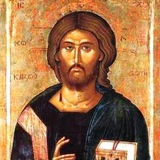
O how needful it is that we entreat the Lord to give the soul the humble Holy Spirit! The lowly soul enjoys great peace, while the proud soul is a torment to herself. The proud man does not know the love of God and is far from Him. He is proud of being rich or learned or famous, but, alas, he is unaware of his poverty and ruin, for he does not know God. But the man who struggles against pride the Lord will help to overcome this passion.
+St. Silouan the Athonite
+St. Silouan the Athonite
The Lord Christ is sweeter than milke and honey; He is a closer kinsman to us than our father and mother; more dear to us than our own children and friends; more precious than all visible treasures; more costly than this life, for He gives life eternal. Compared to Him, everything in the world is inferior, trivial, bitter, weak, cheap and transitory. To whoever receives Him, it is easier to leave everything, because he has received the best and Him Who is the very best.
O Lord Jesus, Treasury of all eternal riches, help us to unbind ourselves from everything and to cling to Thee, our Good and our Life.
To Thee be glory and praise forever. Amen.
—from The PROLOGUE OF OHRID ☦️ February 13
Today’s complete Prologue reading at
http://mewe.com/join/orthodoxfaith
O Lord Jesus, Treasury of all eternal riches, help us to unbind ourselves from everything and to cling to Thee, our Good and our Life.
To Thee be glory and praise forever. Amen.
—from The PROLOGUE OF OHRID ☦️ February 13
Today’s complete Prologue reading at
http://mewe.com/join/orthodoxfaith
“God, be merciful to me a sinner!”
The Sunday of the Publican and the Pharisee is the first Sunday of a three-week period before the start of Great Lent. It marks the beginning of a time of preparation for the spiritual journey of Lent. It is a time for Orthodox Christians to draw closer to God through worship, prayer, fasting, and acts of charity.
“Let us flee from the pride of the Pharisee! And learn humility from the Publican’s tears! Let us cry to our Savior, have mercy on us, only merciful One!”
—Kontakion, Tone 4
But let us fear even the shadow of “Thank God, that I am not like other men.” Terrible to the soul is self-appreciation; it is destructive to the soul to evaluate others by comparing them to yourself. —from a homily by Archimandrite John (Krestiankin), published posthumously https://orthochristian.com/144387.html
Why do men leave one place and settle in another place? Primarily because they hope that they will be more fortunate in the other place. And in truth, from the worldly view of life and contentment, places can be different--better or worse. He who does not hope in a better life after death seeks a better sensual pasture in this life. But if we listen to the hearts of those men who were able to live in the so-called best places on earth, we will detect dissatisfaction, sorrow and despair. They did not find that which they were seeking. They ate to excess in every place, and finally, still hungry, they looked death in the eye.
But look at the Christian saints! They sought places with the least pastures: places that were "arid, impassible and devoid of water," isolated and terrible places which attracted the least attention and for which no one competed. They considered every place on earth equally worthless, but they chose those places solely because they wanted to draw nearer in spirit and mind to their eternal homeland. And if one were to listen to their hearts, one would perceive joy and contentment.
—from The PROLOGUE OF OHRID ☦️ February 14
Cont’d at
https://mewe.com/join/orthodoxfaith
—from The PROLOGUE OF OHRID ☦️ February 14
Cont’d at
https://mewe.com/join/orthodoxfaith
Peace of soul is precious for every man. For those who have attained peace of soul, the body can be in constant motion--in work or in pain--but their souls, affixed to God, always remain in unwavering peace. St. Seraphim of Sarov teaches: "It is necessary by all means to preserve peace of soul and not be disturbed by the insults of others. That is why it is necessary, at all costs, to restrain oneself from anger, and through vigilance over oneself to preserve the mind and heart from indecent movements. To preserve peace of soul, it is also necessary to avoid judging others. By not judging and by silence, peace of soul is preserved. When a man is in such a state of mind, he receives divine revelations. In order for a man to be preserved from judging others, he must be vigilant over himself, he must not receive ungodly thoughts from anyone, and he should be dead toward everything worldly.
—from the PROLOGUE OF OHRID ☦️ February 15
Today’s complete Prologue reading at
http://mewe.com/join/orthodoxfaith
—from the PROLOGUE OF OHRID ☦️ February 15
Today’s complete Prologue reading at
http://mewe.com/join/orthodoxfaith
Contemplate the Lord Jesus, praying on dark nights, alone in the mountains, for my salvation, for your salvation, and for the salvation of all men:
1. How He lifted His hands up toward heaven; how He bent to the ground; how He knelt in prayer many nights; in prayer for my salvation, for your salvation, and for the salvation of all men;
2. How He sweated at prayer and wept for my salvation, for your salvation, and for the salvation of all men;
3. How He kept vigil in prayer, tormenting His body without sleep and rest, for my salvation, for your salvation, and for the salvation of all men.
—from the PROLOGUE OF OHRID ☦️ February 16
Today’s complete Prologue reading at
http://mewe.com/join/orthodoxfaith
St Nicholas, Equal of the Apostles and Archbishop of Japan (Feb 16/ Mar 1), prayerful intercessor for Japan and its people brought the Gospel to Japan in an era when Japanese looked upon foreigners as beasts and Christianity as a villainous foreign sect. In this atmosphere, the Russian-born Archbishop Nicholas and his flock endured many years of persecution. Yet, in 1911, a half century since the young hieromonk Nicholas had first set foot on Japanese soil, there were over 33,000 Orthodox Christians in 266 communities.
Archbishop Nicholas departed peacefully to the Lord in 1912.
When The Holy Synod of the Russian Orthodox Church glorified St Nicholas in 1970, he had fir many decades been honoured in Japan as a righteous man, and a prayerful intercessor before the Lord.
Archbishop Nicholas departed peacefully to the Lord in 1912.
When The Holy Synod of the Russian Orthodox Church glorified St Nicholas in 1970, he had fir many decades been honoured in Japan as a righteous man, and a prayerful intercessor before the Lord.
O holy Saint Nicholas, the Enlightener of Japan,
You share the dignity and the throne of the Apostles:
You are a wise and faithful servant of Christ,
A temple chosen by the Divine Spirit,
A vessel overflowing with the love of Christ.
O hierarch equal to the Apostles,
Pray to the life-creating Trinity
For all your flock and for the whole world.
--Troparion, Tone 4
With great difficulty and with even greater effort and sacrifice, the tares of heresy were sifted from the wheat of the truth of Orthodoxy. The heretics have always made use of lower means and base persons in undermining Orthodoxy. Archmandrite Eutyches of Constantinople and Patriarch Dioscorus of Alexandria--who spread the heretical teaching that there were not two natures in Christ, divine and human, but rather one nature--had as their ally in the imperial court the vile eunuch Chrysaphius. Empress Eudoxia was secretly aligned with them. Patriarch Flavian (Feb 17) like a lion, fearlessly defended Orthodoxy. In this he was assisted by Pulcheria, the sister of the emperor. The eunuch Chrysaphius presented to Emperor Theodosius the most disgusting slanders against Flavian, so that the emperor would remove him from the throne and replace him with the heretic Eutyches.
When this and all else failed, the heretics plotted to kill Flavian. At the Robber Council in Ephesus [431 A.D.], they beat him and trampled upon him so badly that St. Flavian gave up his soul to God on the third day. What happened in the end? At the Fourth Ecumenical Council [Chalcedon, 451 A.D.], Eutyches and Dioscorus were anathematized. The eunuch was ousted from the court and shamefully ended his life. The Empress Eudoxia was banished from Constantinople to Palestine. Flavian and Pulcheria were proclaimed saints, and the Orthodox Faith was victoriously confirmed.
—from the PROLOGUE OF OHRID ☦️ February 18
Cont’d at
mewe.com/join/orthodoxfaith
—from the PROLOGUE OF OHRID ☦️ February 18
Cont’d at
mewe.com/join/orthodoxfaith
Orthodox Faith pinned «When this and all else failed, the heretics plotted to kill Flavian. At the Robber Council in Ephesus [431 A.D.], they beat him and trampled upon him so badly that St. Flavian gave up his soul to God on the third day. What happened in the end? At the Fourth…»
Contemplate the Lord Jesus in the midst of the common people:
1. How with love He taught the people as a parent teaches his children;
2. How the common people received His words, were astonished by His works, and glorifed God;
3. How even today, the common people, free from corruption, receive His words with joy and thanksgiving.
— from the PROLOGUE OF OHRID ☦️ February 19
Continued at
mewe.com/join/orthodoxfaith