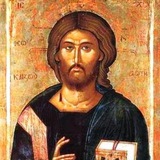
You became man, O Christ.
You took human nature from the Virgin!
As a man, you asked where Lazarus was buried,
Though as God, you know all things!
You have given us a pledge of your own resurrection
By raising your friend as if from sleep, O Word of God,
Though his flesh had tasted corruption from four days in the tomb.
#LazarusSaturday
On Great and Holy Monday, we remember Christ's divine power and of God's judgment symbolized in Christ’s cursing of the fig tree. The tree portrayed the Jewish synagogue, which had not produced the fruit of faithful obedience to God and so was stripped of all spiritual grace. (Matthew 21: 18-20)
We also remember the patriarch Joseph, betrayed by his brothers and sold to foreigners for thirty pieces of silver. In the Old Testament story (Genesis 37, 39, 41), Joseph typifies in himself the betrayal, Passion, death and glorification of out Lord Jesus Christ.
We also remember the patriarch Joseph, betrayed by his brothers and sold to foreigners for thirty pieces of silver. In the Old Testament story (Genesis 37, 39, 41), Joseph typifies in himself the betrayal, Passion, death and glorification of out Lord Jesus Christ.
This media is not supported in your browser
VIEW IN TELEGRAM
Bridegroom Matins is a service specific to the first four evenings of Holy Week and commemorates the last days in the earthly life of the Lord.
Christ the Bridegroom in the parable of the ten Virgins (Matthew 25: 1-13), is the same Bridegroom of the Church as described in the Book of Isaiah (chapter 54). The title Christ the Bridegroom indicates His divine presence and watchfulness during Holy Week and His selfless love for His Bride, the Church.
Video: Behold the Bridegroom Cometh. Choir of Valaam Monastery, Russia., in English. Full video at https://mewe.com/join/orthodoxfaith
“Accept the fountains of my tears, You who draw out from the clouds the water of the sea.”
The Troparion of Kassianias (The Hymn of Kassiani), chanted on the evening of Holy Tuesday, was composed by Ergoumenissa (Abbess) Kassiani, the founder of a women’s monastery in Constantinople, where she devoted her life to asceticism and the composing of liturgical poetry. The best known of her compositions is the Doxastikon Hymn on the Aposticha of the Bridegroom Orthros (Matins) for Great and Holy Wednesday. In Greek parish churches, it is chanted on Tuesday evening.
“Lord, when the woman who had fallen into many sins perceived Your divinity, she assumed the role of a myrrh-bearing woman, and lamenting brought fragrant oils to anoint You before Your burial.
‘Woe is me,’she says.
‘Night for me is a frenzy without restraint, very dark and moonless, a sinful love-affair.
Accept the fountains of my tears, You who draw out from the clouds the water of the sea.
Take pity on me, and incline to the sighing of my heart, You who bowed the heavens by Your ineffable self-emptying.
I shall cover Your unstained feet with kisses, and wipe them dry again with the locks of my hair; those feet, whose sound at twilight in Paradise echoed in Eve's ears, and she hid in fear.
Who can reckon the multitude of my sins, or fathom the depths of Your judgments, O my life-saving Saviour?
Do not despise me, Your servant, since without measure is Your mercy.’”
The hymn is performed in this video by professor of Byzantine music and arch cantor Nikodimos Kavarnos and his choir.
https://youtu.be/o12p6gh446k
YouTube
Το τροπάριο της Κασσιανής the Hymn of KASSIANI part2/2 Νικόδημος
Το τροπάριο της Κασσιανής υπό την χορωδία του πρωτοψάλτου
και καθ. Βυζ. Μουσικής Καβαρνού Kabarnos Νικόδημος , αποτελούμενη κατά το πλείστον από τους μαθητές του. εκκλησιαστικοι υμνοι
Κύριε, ἡ ἐν πολλαῖς ἁμαρτίαις περιπεσοῦσα γυνή,
τὴν σὴν αἰσθομένη…
και καθ. Βυζ. Μουσικής Καβαρνού Kabarnos Νικόδημος , αποτελούμενη κατά το πλείστον από τους μαθητές του. εκκλησιαστικοι υμνοι
Κύριε, ἡ ἐν πολλαῖς ἁμαρτίαις περιπεσοῦσα γυνή,
τὴν σὴν αἰσθομένη…
This media is not supported in your browser
VIEW IN TELEGRAM
"Behold, the Bridegroom Comes"
Great and Holy Thursday Matins and washing of the feet, Archbishop Ambrose at St. Petersburg Theological Academy
Original, full video: https://www.youtube.com/watch?v=AZ0fN1VPJtM
Great and Holy Thursday Matins and washing of the feet, Archbishop Ambrose at St. Petersburg Theological Academy
Original, full video: https://www.youtube.com/watch?v=AZ0fN1VPJtM
On Great and Holy Friday, March 30, 1945, the Righteous Maria of Paris (Skobtsova) was selected for the Nazi gas chamber at Ravensbruck, where she met her martyrdom on Great and Holy Saturday. For her efforts in rescuing Jewish children in Paris, she is among the "righteous gentiles" honoured in Israel.
St Maria devised a plan involving Paris garbage collectors, who hid the children in trash cans so they could be whisked away to safety outside the city and spared from the same death she would suffer.
St Maria devised a plan involving Paris garbage collectors, who hid the children in trash cans so they could be whisked away to safety outside the city and spared from the same death she would suffer.
Media is too big
VIEW IN TELEGRAM
Video: one of the most the ancient Christian hymns: "O Gladsome Light" (Φῶς Ἱλαρόν), with images from Holy Friday vespers
O Gladsome Light of the holy glory of the immortal, heavenly, holy, blessed Father,
O Jesus Christ: Having come to the setting of the sun,
having beheld the evening light,
we praise the Father, the Son, and the Holy Spirit: God.
Meet it is for Thee at all times to be hymned with reverent voices,
O Son of God, Giver of life.
Wherefore, the world doth glorify Thee.
Valaam Monastery Choir, from the album, "Taste of the Fountain of Immortality"
Orthodox Faith
Video: one of the most the ancient Christian hymns: "O Gladsome Light" (Φῶς Ἱλαρόν), with images from Holy Friday vespers O Gladsome Light of the holy glory of the immortal, heavenly, holy, blessed Father, O Jesus Christ: Having come to the setting of the…
“Truly this was the Son of God.” (Mt. 27:54)
The Warrior Saints are a group of saints who were usually actual soldiers in life and martyrs to Christ in death. Their prototype was Holy Martyr Longinus, the centurion who witnessed the Crucifixion and confessed, “Truly this was the Son of God” (Mt. 27:54).
The warrior martyrs' steadfastness in the midst of the most brutal tortures and executions would lead thousands to Christ. St Longinus was eventually beheaded for preaching the Gospel.
St Longinus icon from the Nea Moni, 11th-century monastery on the island of Chios, Greece
The Holy Fire has descended! Holy Saturday 2022
https://www.youtube.com/watch?v=4HwolTtTg0I
https://www.youtube.com/watch?v=4HwolTtTg0I
YouTube
LIVE NOW: The Miracle of The Holy Fire 2022 from the Church of the Holy Sepulcher in Jerusalem 2022
As the Holy Great Martyr George the Victory-Bearer (Apr 23/ May 6), was being tortured, he addressed Emperor Diocletian, “Do not imagine that it is any human learning which keeps me from being harmed by these torments. I am saved only by calling upon Christ and His Power. Whoever believes in Him has no regard for tortures and is able to do the things that Christ did” (see John 14:12).
Saint George was the patron saint and protector of several of the great builders of the Russian state. St Vladimir’s son, Yaroslav the Wise (in holy Baptism George), advanced the veneration of the holy martyr in the Russian Church. He built the city of Yuriev, translated "of Yurii". “Yurii” is the diminutive of “George”. Yaroslav also founded the Yuriev monastery at Novgorod and built a church of Saint George the Victory Bearer at Kiev.
Saint George was the patron saint and protector of several of the great builders of the Russian state. St Vladimir’s son, Yaroslav the Wise (in holy Baptism George), advanced the veneration of the holy martyr in the Russian Church. He built the city of Yuriev, translated "of Yurii". “Yurii” is the diminutive of “George”. Yaroslav also founded the Yuriev monastery at Novgorod and built a church of Saint George the Victory Bearer at Kiev.