I Chose the Frontline: Ethiopia’s Marburg Battle
In November 2025, when Ethiopia’s Ministry of Health issued an urgent call for healthcare workers to deploy to Jinka following the country’s first-ever confirmed Marburg virus disease outbreak, I faced one of the hardest decisions of my life. Marburg is a rare and highly lethal viral hemorrhagic fever with no approved vaccine or specific cure—yet I answered the call.
Three days after the official declaration on 14 November, I arrived in Jinka, a place unfamiliar to me, to confront an unfamiliar and terrifying enemy.
For one intense month, I lived and worked in layers of personal protective equipment, under strict infection prevention protocols and the constant shadow of loss. This was not heroic or glamorous—it was duty in its rawest and most demanding form. I was honoured to work alongside a dedicated team of two Emergency and Critical Care Medicine physicians and two critical care nurses deployed from Black Lion Hospital, Hawassa, and Arba Minch, together with the exceptional staff of the Jinka Treatment Center.
One moment still brings tears to my eyes: our first confirmed survivor—a resilient 15-year-old girl who battled high fever, bleeding, and overwhelming fear. With round-the-clock supportive care, tranexamic acid to control haemorrhage, a full course of remdesivir used under emergency authorization, and unwavering team vigilance, she tested negative twice and was discharged. That moment felt like sunlight breaking through storm clouds—proof that even against one of the world’s deadliest viruses, lives can be saved.
Then came one of our darkest moments. One of our brightest colleagues—a devoted mother of three—fell ill after weeks of selfless service. Fear gripped us all. But through guideline-based care, collective emotional and clinical support, and sheer determination, she recovered. Watching her walk out of the unit smiling and waving goodbye reminded us why we endure: courage is contagious, and recovery is possible.
Some of the hardest days involved families clinging to hope amid devastation. I will never forget an 18-year-old sister and her 19-year-old brother, already orphaned by cancer after losing their father, now facing Marburg together. We kept them side by side for comfort. Their eventual negative test results and tearful words—“We thought we would die too”—transformed grief into gratitude and reaffirmed the healing power of empathy in crisis.
This experience was a whirlwind of raw emotion, profound learning, and renewed faith in collective action. From the leadership of the Ministry of Health and regional health bureaus, to EPHI, WHO, and every colleague who stood beside me—special thanks to the Jinka Treatment Center team (Dr Nardos, Dr Abel, Dr Temesgen, and all staff), and my fellow deployed physicians Dr Getachew and Dr Ayenew, Yeshi, Hailu, and the entire fearless team.
Through Ethiopia’s swift and coordinated response, the outbreak was contained in under three months. On 26 January 2026, the Ministry of Health officially declared the outbreak over, following 42 consecutive days with no new cases.
To anyone facing the unknown: meet challenge with competence, compassion, and commitment. That is how duty becomes collective victory.
H.E. Frehiwot Abebe, State Minister of Health, recently told The Ethiopian Herald that Ethiopia is positioning itself as a pharmaceutical manufacturing hub for Africa by expanding local production, meeting international quality standards, and attracting investment to serve both domestic and continental markets.
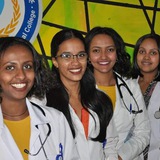
Dr. Nardos Keyema and Dr. Temesgen Girma, graduates of the Class of 2025, were recognized by the South Ethiopia Regional State Health Bureau and the Public Health Institute for their dedicated frontline service during the Marburg virus outbreak.
For more than three months, they provided patient evaluation, diagnosis, and clinical care under high-risk conditions while strictly following infection prevention and control measures.
This recognition follows Ethiopia’s official declaration of the end of the outbreak.
The SPHMMC community proudly celebrates their commitment and service.
SPHMMC Hosts Journalist Roundtable to Raise Awareness on Hydrocephalus and Spina Bifida
St. Paul’s Hospital Millennium Medical College (SPHMMC), in collaboration with the Alliance for Birth Defects and Reach Another Foundation, today organized a half-day journalist roundtable discussion on hydrocephalus and spina bifida — two major pediatric neurosurgical conditions affecting children in Ethiopia.
The session brought together journalists from government, private, and online media houses to strengthen accurate reporting and public awareness. Expert speakers included Dr. Surafel Mekonnen and Dr. Jerusalem Bergene (SPHMMC Neurosurgeons), Dr. Yakob Seman (CEO,Reach Another Foundation), Dr. Nebyat Tesfaye (Director,Alliance for Birth Defects), Dr. Felagot Tadesse (SPHMMC OB/GYN Subspecialist), and Mr. Meseret W. Yohannis (EPHI Researcher). They shared clinical and research insights on prevention, treatment, and the social and economic impact on families.
Speakers emphasized clear, simplified health messaging and the importance of inclusion, ensuring children living with these conditions have equal access to healthcare, education, and social opportunities.
Research shows Ethiopia records about 3.2 million births annually, with 41.09 per 10,000 live births affected by spina bifida, while hydrocephalus remains a common pediatric neurosurgical condition. The discussion also highlighted the financial burden many families face during early treatment.
SPHMMC and its partners reaffirmed their commitment to strengthening public awareness and promoting responsible health reporting.