Binance Investigated by CFTC in US - Report
Major crypto exchange Binance is being investigated by the US Commodity Futures Trading Commission (CFTC) over concerns that it allowed Americans to place wagers that violated US rules, Bloomberg reported, citing undisclosed people familiar with the matter. (Upated at 14:28 UTC: updates throughout the entire text.)
The CFTC is seeking to determine whether Binance, which isn’t registered with the agency, permitted US residents to buy and sell derivatives that the regulator polices, the report said, adding that the platform hasn’t been accused of wrongdoing.
Following the news, Binance coin (BNB), ranked 3rd by market capitalization, dropped by around 7%, to USD 257, before recovering to USD 263 (14:25 UTC). The price is down by 15% in a day, trimming its weekly gains to 14%. Bitcoin (BTC) also corrected from around USD 56,500 to USD 55,353. It trades now at USD 55,931 and is down by 1.6% in a day.
The CFTC told Cryptonews they do not "confirm or deny, nor comment on, inquiries regarding investigative matters."
Binance declined to comment, per the report. However, Binance added that they "take a collaborative approach in working with regulators" and they take their "compliance obligations very seriously". In the US, per the exchange, they block US residents from its website and analyze deposits and withdrawals for signs of illicit transactions.
In November 2020, Changpeng Zhao, CEO of Binance, said that the company is "continually" trying to improve ways they're blocking users in the US from accessing Binance, as users "do find intelligent ways to get around our block sometimes and we just have to be smarter about the way we block."
The CFTC considers cryptoassets to be commodities and claims jurisdiction over their futures and other derivatives.
The commision already charged founders of another crypto giant, BitMEX, with operating an unregistered trading platform and violating multiple regulations. First reports about the ongoing investigation appeared in July 2019, while the official charges were announced in October 2020.
As reported yesterday, Binance has named Max Baucus as a policy and government-relations adviser. Baucus, a 79-year-old Democrat who served as Senator from Montana for more than three decades including a seven-year stint as Chairman of the Senate Finance Committee, and later as US ambassador to China from 2014-2017, will provide guidance and policy advice covering some of the world’s most important financial jurisdictions and agencies.

Who's Metakovan, The Buyer of USD 69M Beeple's NFT
MetaKovan is the pseudonymous buyer of a non-fungible token (NFT) piece valued at nearly USD 70m - but some claim to know his identity, and that there is a conflict of interest present given the existing business association with the artist, while others are unsure if the buyer was buying artwork or clout.
On March 12, it was officially announced that MetaKovan, the founder of NFT fund Metapurse, bought artist Beeple's NFT piece 'Everyday: The First 5000 Days' for the record-breaking ethereum (ETH) 42,329 (USD 69.4m at the time and around USD 75m today). "Around 22 million viewers tuned in to Christies for the final moments of bidding," said the press release.
Yet, not much is known about the bid war winner, MetaKovan. He's quoted as saying that this NFT is "going to be pretty hard to beat," that it's "the most valuable piece of art for this generation" and is worth a USD 1bn, and that "the only thing you can't hack digitally is time."
Per the information provided by the announcement on Metapurse, it's an NFT production studio, as well as the world's "largest NFT fund," financed by MetaKovan and operated jointly with Twobadour. Besides the latest Beeple's piece, the fund also contains the complete set of the 20 first-edition Beeple Everydays: The 2020 Collection, bought in a December 2020 auction for USD 2.2m. Other pieces include Urbit Galaxy, F1 DeltaTime III, First Supper, and virtual estates in Cryptovoxels and Decentraland (MANA).
Both Metakovan's Twitter account and the Nifty Gateway marketplace account show his participation in NFT auctions. Savage$77, for example, is MetaKovan's sold out collection that includes footage from his computer during the December 11 Beeple auction.
However, per independent reporter Amy Castor, MetaKovan may be crypto entrepreneur Vignesh Sundaresan, based on his voice in interviews and provided "origin stories." In the recent Good Time Show interview, MetaKovan said he got into crypto in 2013, lived in Canada for a while, and moved to Singapore in 2017 as crypto regulations in North America were "very unclear," which Castor says is Sundaresan's story as well.
The latter, she said, is the co-founder of Canadian bitcoin (BTC) ATM company BitAccess, as well as founder of Singapore-based Lendroid Foundation, consulting firm Portkey Technologies, and defunct Canadian crypto exchange Coins-e which was accused by some users as being a potential scam.
"This is about pumping Metapurse's token B20," claims Castor, "so holders and Metapurse can benefit when they go to sell the token—i.e., get more ETH, buy more NFTs, rinse, repeat."
B20's total supply is 10m, and Metapurse owns 59% of it. At the same time, Beeple owns 2% of all the tokens, which Castor suggested could be a cause for a conflict of interest.
"At the end of the day, this is a straight-up initial coin offering-style index fund to speculate on NFTs, with a twist: MetaKovan owns most of the tokens—and he has an existing business relationship with the artist," Castor argued.
Per the author, Sundaresan asked for the post to be taken down as it contains "several factual inaccuracies" but he reportedly did not point them out.
Per CoinGecko, at 14:46 UTC, B20 is trading at almost USD 14, having dropped 12% in a day. Two spikes are obvious this month: March 10 to USD 28.45, and March 13 (post-auction) to USD 26.15. The price is up by 1,594% in a month.

Misinfo Over Gemini Bitcoin Inflow Reminds To DYOR
Analysts have blamed misinfo for bitcoin (BTC)’s correction yesterday from USD 60,000 to below USD 54,000, with a whale alert from CryptoQuant suggesting that nearly BTC 19,000 (USD 1bn) flowed into Gemini exchange, potentially to be sold.
While CryptoQuant was initially sticking by its interpretation of the BTC flow, other analysts are suggesting either that the movement was internal or that it was Gemini topping up its liquidity from another exchange.
Either way, their arguments point to the danger of reading too much, too soon into inflow data, which can often be much more ambiguous or complex than its status as ‘data’ suggests.
Early in the morning (UTC time) on Monday, South Korea-based analytics firm CryptoQuant sent out a whale alert to nearly 30,000 traders, indicating that a trader or group of traders had deposited BTC 18,969 into Gemini. The firm’s CEO, Ki Young Ju, tweeted in confirmation soon after that the alert was “legit.”
It was around this time that traders, who may or may not have caught wind of the alert, began dumping bitcoin. From a bullish price of about USD 60,500 at 04:00 UTC on Monday, bitcoin had fallen to USD 55,500 by 10:00.
As Ki Young Ju tweeted later on Monday, the signal appeared to have caused a technical correction, with bitcoin’s price falling by 10%.
However, while some traders appear to have acted on CryptoQuant’s alert, possibly triggering a wave of liquidations and accelerating the selloff, other analysts have taken issue with its interpretation of the flow data. In particular, Glassnode claimed soon after the correction on Monday that the movement of bitcoin into Gemini was actually internal, and not the result of users preparing to sell.
Glassnode’s interpretation was backed up by other prominent analysts, including Willy Woo and Alex Krüger. Woo pointed out that it isn’t the first time in recent weeks that “bogus” data has caused a dip.
Others joined in the chorus of analysts blaming ‘bad’ data (or bad interpretations) for bitcoin’s correction, including Casa co-founder Jameson Lopp and crypto mining pool Poolin VP Alejandro De La Torre. However, CryptoQuant was sticking by its guns, denying that the BTC flow was internal to Gemini, as Glassnode claimed.
The plot has thickened even further though, with crypto intelligence firm Coin Metrics notifying CryptoQuant that the transfer was from a BlockFi wallet to Gemini.
If true, this technically invalidates the claim that the flow was internal to Gemini. On the other hand, BlockFi and Gemini are partners, with Gemini providing the former with custodial services.
In either case, earlier today, CryptoQuant said that “technically, it was an "external transfer" from BlockFi to Gemini” and concluded:
“Data was solid and the signal was correct in this case, but some words might have confused our customers. We'll remove definitive words like 'possibly dumping' so that people can make their own decisions.”
As such, the original alert’s suggestion of a ‘whale’ moving BTC to Gemini to sell it was fairly misleading. And if nothing else, it shows that it might be a good idea to take a step back, think twice and do your own research (DYOR) before acting on data.
At the time of writing (16:27 UTC), BTC trades at USD 55,829 and is down by 2% in a day, trimming its weekly gains to less than 7%. It rallied by 19% in a month and 934% in a year.

Unconfirmed Report From Court Hearing May Have Sparked XRP Rally
Recent statements by an attorney who claims to have attended a court hearing in the ongoing US Securities and Exchange Commission (SEC)'s case against blockchain company Ripple might have helped XRP today.
At the time of writing (14:07 UTC), XRP, ranked 7th by market capitalization, trades at USD 0.563 and is up by 11% in a day and 27% in a week, almost erasing its monthly losses. The price is up by 259% in a year.
"On a scale of 1-10, this hearing was an 11 for Ripple," attorney Jeremy Hogan, who is not one of the lawyers in the case, said in a video, claiming the regulator's lawyer allegedly implied that exchanges wouldn't be violating securities laws by relisting XRP.
This discovery hearing was related to one of the four pending main motions in the case, specifically to compel the discovery of the documents by the SEC related to two executive's financial information. Magistrate Judge Sarah Netburn asked if there is any evidence that the trading records provided are incomplete or fraudulent, to which Hogan said the SEC didn't have "a good response."
Also, according to the attorney, the Judge said that her "understanding about XRP is that not only does it have a currency value but it has a utility and that utility distinguishes it from bitcoin and ether." Hogan said that Netburn is resting her statement on two premises: XRP having currency value and utility - which is opposite of a security, which the SEC argues XRP is.
The Judge also "skeptically made a remark to the SEC attorney that based upon his theory everybody who's sold XRP ... are selling illegal securities," Hogan said. According to him, the SEC's attorney replied that only Ripple and its employees can sell it illegally. Hogan suggested that this means that the exchanges which delisted XRP due to this case were not and would not violate the securities law if they relisted it.
Additionally, per Hogan, after the motion to intervene - filed by XRP holders who were alleging that they were not being adequately represented in the lawsuit - had been denied, the letter was refiled, asking for the court to allow "over ten thousand XRP Holders" to intervene in the action.
Chainalysis Valued at USD 2B as Investors See Demand For Crypto Intelligence
USbased major blockchain analysis company Chainalysis announced today that it has raised USD 100m, bringing its valuation to over USD 2bn.
The company said that the Series D financing round was led by Paradigm, while previous investors Addition and Ribbit increased their investment in the company. Additionally, TIME Ventures, the investment fund for Marc Benioff, participated as well.
This follows Chainalysis' USD 100m Series C round in November 2020. Per Crunchbase, until November, the company had raised USD 166m in total. With this latest round, it would presumably make USD 266m.
The company said that the new capital will be used to extend its business so to provide enterprise data solutions to:
crypto businesses and financial services providers that want to optimize their market development strategies based on insights into their customers' behaviors;
asset managers and financial institutions that want to better understand cryptocurrency market trends given the increasing adoption of crypto;
and government agencies that work on building detailed pictures of threat actors that abuse crypto.
Over the past year, the company has increased its annual recurring revenue (undisclosed) by more than 100% year-over-year. Additionally, they doubled the client base to include government agencies in over 30 countries and private sector businesses in over 60 countries; hired 116 new employees; expanded their partnership program, now consisting of more than 50 companies; and they've expanded their support to cover over 100 digital assets across 10 native blockchains, encompassing approximately 90% of cryptocurrency economic activity, they claim.
"The company plans to hire hundreds of new positions across all functions in 2021 to continue its global expansion," they added.
Backed by Accel, Benchmark and other major venture capital names, Chainalysis provides data, software, services, and research to government agencies, exchanges, financial institutions, and insurance and cybersecurity companies in over 60 countries.

Ukrainian Finance Minister Says Crypto Is ‘Promising’
The new Ukrainian finance minister has spoken about the state’s plans to regulate the domestic crypto market, and claimed that although he has doubts about what is “backing” crypto, he feels it is “promising.”
In an interview with 24 Novosty, the recently appointed minister, Serhiy Marchenko, stated that the nation’s Ministry of Digital Transformation “has the desire to regulate the cryptocurrency market,” but mused that crypto “might become the global currency for settlements in the future.”
“Cryptocurrency is a promising story. The only problem is that I do not fully understand the nature of how crypto is being backed. Backing is provided only by the virtual demand of various industry players. It is not backed by an economy, production, assets or capital. Unlike stocks, bonds or derivatives, which are underpinned by collateral assets, crypto is not an asset in its purest form,” he said.
Marchenko went on to add that a “deeper understanding” of the crypto market would be necessary to gauge if tokens could be used in “calculations” in the future, but conceded,
“Unfortunately, I am not a cryptocurrency specialist.”
The new economic chief spoke about the possibility of using crypto in financial “calculations,” claiming its potential role in this sense was a “rather interesting and promising story.”
Regardless, Marchenko expressed doubts about crypto, and advised citizens to express caution, concluding,
“In terms of crypto’s worth as a tool for investment, an asset and a means of value storage – well, everyone should make their own decision on this front, at their own discretion.”
Marchenko, aged 40, is one of the youngest finance ministers in Europe, and served as Deputy Minister of Finance between 2016 and 2018, but has been working in tax and finance-related government ministries since 2002.
Ex-SEC Chair On Bitcoin Regulation
Get your daily, bite-sized digest of cryptoasset and blockchain-related news – investigating the stories flying under the radar of today’s crypto news.
Former US Securities and Exchange Commission (SEC) chairman Jay Clayton, who now advises One River Asset Management on cryptocurrency, told CNBC that bitcoin (BTC) was not a security before he joined the SEC, but that it doesn't mean it shouldn't be regulated, and that regulation of the asset will come. "Where digital assets land at the end of the day ... will be driven in part by regulation, both domestic and international, and I expect - and I’m speaking as a citizen now - that regulation will come in this area both directly and indirectly," he said.
A Spanish financial regulator has clamped down on public-space bitcoin and crypto ads after a series of campaigns found their way onto billboards in major cities, including the capital Madrid. Per Forosocuellamos, the Comisión Nacional del Mercado de Valores (CNMV), the Spanish market regulator, has expressed its displeasure at the advertisers and has received the backing of the Ministry of Finance. Going forward, crypto advertisers will have to obtain CNMV approval for their advertising activities or face fines of up to USD 353,000. One domestic crypto exchange has recently run a billboard campaign with the slogan: “The revolution has just begun. Welcome to bitcoin.”
The US Financial Crimes Enforcement Network (FinCEN) said that its Director Kenneth A. Blanco will depart FinCEN on April 9, after serving as the organization’s director since December 2017. Michael Mosier, former FinCEN Deputy Director and current Counselor to the Deputy Secretary of the Treasury, will return to FinCEN as Acting Director. Mosier previously worked at the cryptocurrency analytics, compliance, and investigations firm Chainalysis, where he was Chief Technical Counsel.
Canadian digital asset manager 3iQ Corp and investment firm CoinShares announced that they will launch a new exchange-traded fund (ETF). The 3iQ CoinShares Bitcoin ETF will be offered in Canada, and the Toronto Stock Exchange has conditionally approved the listing of the fund's units. 3iQ will act as the investment and portfolio manager of the ETF which is expected to begin trading in early April, 2021. CoinShares also disclosed a strategic investment in 3iQ.
South Korean prosecutors have sold off a bitcoin haul they had been in possession of since a bust in 2017. Per Chosun and Asia Kyungjae, the sale raised over USD 10.8m, but the funds – some BTC 191 – had been worth a mere few thousand dollars when they were seized. The state was forced to hang on to the tokens as there had been – until last month – no legal means of disposing of crypto holdings seized in criminal proceedings. The law enforcement authorities, in Suwon, near Seoul, had confiscated the funds during a bust on an illegal pornography distribution ring.
The Tezos Foundation has invested in fintech venture studio Draper Goren Holm. The studio announced plans to incubate and accelerate startups built on the Tezos blockchain, while the Foundation is also becoming an official limited partner of Draper Goren Holm with an emphasis on the next generation of Tezos-based startups.
Mark Palmer, global financial services firm BTIG's managing director and financial technology analyst, initiated coverage of business intelligence company Microstrategy on Thursday with a "buy" rating and a USD 850 price target, reported MarketWatch. Palmer said that his valuation is based on a sum-of-the-parts analysis of the company and a bullish outlook on bitcoin, with a price estimate of USD 95,000 by the end of 2022. Shares of the company are up 84% in the year to date, while the gains are up 530% on a 12-month basis.
Garlinghouse Backtracks on BTC as Ripple Gains Ground on SEC & XRP Soars
Brad Garlinghouse, the CEO of Ripple, appears to have reeled in some of his criticism of bitcoin (BTC) after a backlash on social media, while Ripple itself last week scored a legal victory of sorts.
As reported last week, the Ripple chief, who is currently fighting a battle with the American regulatory Securities and Exchange Commission (SEC) over the nature of the Ripple-affiliated XRP token, took aim at BTC’s energy credentials.
Last week, he opined that BTC was “not ideal as a payments mechanism” due to its high energy usage – while the Ripple Chief Technology Officer claimed that BTC’s Proof-of-Work consensus mechanism had been touted as a “secret sauce” but showed “cracks” right from its inception.
However, in a series of tweets, Garlinghouse conceded that he had “hit a nerve” and clarified that he was not in favor of a “ban” on BTC. Instead, he added that “we, collectively, can and should understand Proof-of-Work’s carbon footprint.”
He also posted his sources for his calculations on BTC’s energy usage and ended with a call-to-arms and final plea to the BTC community, writing,
“We have the tools to make crypto 100% renewable and reach its full potential. Let’s focus on the solutions to change the opinion of US Treasury Secretary Janet Yellen, Bill Gates, and countless others who have pointed out concerns about energy usage instead of accusing me of spreading FUD fear, uncertainty, and doubt.”
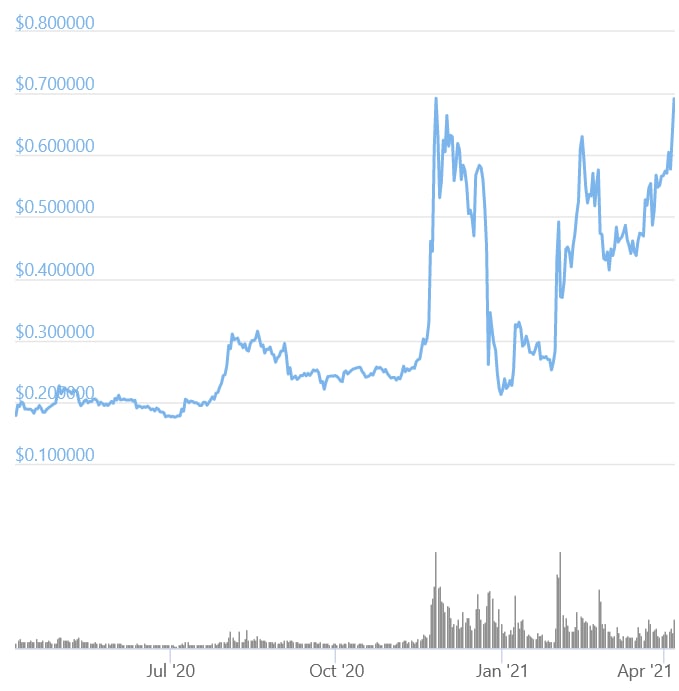
Garlinghouse was tweeting as XRP prices surged once again, peaking at just over USD 0.7 in the early hours of Monday morning (UTC). At the time of writing (08:13 UTC), XRP trades at USD 0.69 and is up by 17% in a day and 26% in a week.
On an XRP forum, token advocates welcomed the “return of the 70s” and price highs not seen since 2018 – although the token did experience a period of sudden growth in November last year.
“I believe when we break through USD 0.80 (hopefully in the coming weeks) then we will really see some fireworks. If that breakthrough is accompanied by some positive news in the SEC case (summary judgment on the current XRP status, relisting, settlement etc) then it is the perfect setup. ... Until then I will just hodl and wait,” one commenter wrote.
XRP reached its all-time high of USD 3.40 in January of 2018.
Ripple last week scored a legal victory of sorts, with a judge in New York agreeing to redact the contents of an email exchange between Garlinghouse and an unnamed individual about Ripple’s venture capital operations, as well as two unnamed parties debating how XRP is conceived by the general public – per Tweets released by the company’s lawyers.
Ripple had hoped to force redactions of two further emails, one of which reveals financial data about the Ripple co-founder Chris Larsen. The other is an exchange with private investors. The SEC is determined to ensure that these two documents be allowed as evidence in the trial.
The token’s recent surge upwards has taken it far beyond the levels it was trading at prior to the SEC’s intervention back in December 2020, when – in its own words – it stated that it was “alleging that Ripple’s chiefs raised over USD 1.3bn through an unregistered, ongoing digital asset securities offering.”
Coinbase Listing Won't Help Bitcoin Price - Analyst
The narrative that the listing of the shares of major crypto exchange Coinbase is helping the price of bitcoin (BTC) higher - is false, according to a prominent Bitcoiner, Vijay Boyapati, the author of 'The Bullish Case for Bitcoin' and Senior Software Engineer at Peach.
Many people are speculating that interest in Coinbase would trigger "a fresh wave up in Bitcoin's bull market," argued Boyapati in his Twitter thread. Additionally, as Coinbase reported estimated Q1 revenues of USD 1.8bn with some USD 800m in profit, it is likely that the company will be valued around USD 100bn once they become public, he said.
However, the question is if "this huge liquidity event" will transfer over to bitcoin? The answer, per Boyapati, is that it may not be the case:
"If investment dollars that flow to Coinbase provide a "crypto" allocation that will satisfy many retail and institutional investors, in a way this steals potential investment demand away from bitcoin."
The reason behind this, as Boyapati explains, is that many "unsophisticated" retail and institutional investors may buy into Coinbase's direct listing as a way to get exposure to the "crypto" space, but "the capital allocated with this mindset will NOT be used to purchase BTC."
According to him, there is a correlation between the BTC price and Coinbase's valuation but the two assets are vastly different: the former being a form of money and valued based on the attributes that make for a good store of value, and the latter being a stock, valued based on cash flow.
Still, there might be another way for BTC to benefit from the direct listing, but would this one work?
As reported, Coinbase is preparing for a direct listing of its shares on April 14. Unlike the traditional initial public offering (IPO), in a direct listing, the company sells shares directly to the public without getting help from intermediaries.
As it's not an IPO, employees and insiders can sell their shares right away.
"A 100 billion dollar liquidity event puts a LOT of cash in the hands of Coinbase employees and executives," Boyapati said. "CEO Brian Armstrong will become a very rich man."
This still doesn't mean that the employees will decide to invest that money into BTC. This is particularly notable as the company itself "hasn't shown a particularly strong desire to acquire bitcoins in its treasury," wrote Boyapati, adding that "culture starts from the top and Brian has never been the most enthusiastic fan of Bitcoin."
Additionally, contrary to those seeking to get a taste of the crypto space, Coinbase's employees may decide it better to diversify away from the industry in which they work than move deeper into it by buying BTC.
However, Boyapati concluded that "it's important to understand that when the next leg up for bitcoin begins, it is simply because bitcoin is in a massive secular bull market. It is a false narrative to believe Coinbase is driving bitcoin higher."
Boyapati previously argued that the company would've been a lot bigger if they have held their profits in BTC instead of USD.

Bitcoin on-chain data suggests no bull market top at $60K, selling activity declining
For the very first time in a Bitcoin (BTC) bull market, not only long-term investors but also short-term speculators who usually add to the daily sell pressure toward the end of a market cycle have become increasingly confident of higher prices as they hold on to their Bitcoin.
This only adds to the already existing supply shock. If demand remains strong, this is a recipe for another leg up for the BTC price.
Every Bitcoin bull market usually coincided with an increasing number of short-term speculators coming into the market hoping to turn a quick profit, while long-term speculators start to add sell pressure toward the second half of the market cycle to realize their profits.
One of the best on-chain indicators to see this trend unfold in each cycle is called HODL waves. Hereby, the length at which each BTC address holds Bitcoin before they are sold into the market is clustered into term buckets that are then visualized in different color bands.
For example, someone who held on to their Bitcoin for five months would fall into the 3m-6m bucket, the light orange color band. If that person decides to sell, it falls out of that bucket and would show up in the 24h-term bucket, the dark red color band.
This means, the redder the colors are in the HODL waves chart on a respective date, the more short-term turnover of Bitcoins happens. This activity is almost at its lowest during a bear market, and at its highest during a bull market, while the short-term activity tends to peak around a bull market top.
Since the Bitcoin price fluctuates significantly during the market cycles, and HODL waves only account for the absolute number of Bitcoins moved, this chart does not account for the total value realized on a respective day by a Bitcoin seller.
As it becomes increasingly lucrative for hodlers to take profit the higher the price rises, the HODL waves can be weighted by the realized price, which is the price at which each Bitcoin on average was last bought /sold.
This adjustment allows for visualizing the value-driven profit-taking on a daily basis through the value-adjusted colored, term buckets.
Once HODL waves are weighted by the realized price, the Realized Cap HODL Waves are derived, a concept that was first introduced by on-chain analyst Typerbole. This adjustment reveals that the 1w-1m bucket tops coincide with every single bull market top so far.
This indicator does not only suggest that the current selling activity is not at a typical bull market peak yet, it even reveals that for the first time in Bitcoin's bull market history this trend is declining while the price continues to rise.
This is a very unusual trend in a bull market. Assuming that the price peak has not been reached yet, this suggests that profit-seekers, whether they are short- or long-term focused, are starting to hold on to their Bitcoin again, expecting higher prices to come and by that adding to the Bitcoin supply squeeze on exchanges.
Rafael Schultze-Kraft, Glassnode CTO, takes a similar view by looking at long-term hodlers through Coin Days Destroyed, an indicator that shows the total holding days "destroyed" by holders selling their Bitcoin.
Based on a 3-months moving average of this indicator, the destruction has retraced to a level last seen in the summer of 2019 at times where the price peak was already reached.
CEO says PayPal’s crypto commerce may reach $200M volume in just months
As the price of Bitcoin continues to reach new all-time highs, major corporations with existing crypto offerings in place are beginning to discuss grand plans for the future.
Most recently, Dan Schulman, CEO of PayPal, hinted at future developments for PayPal’s crypto offering during Forbes’ “2021 Blockchain 50 Symposium: Crypto Goes Corporate,” an online event that took place on April 13.
During a fireside chat with Michael del Castillo, associate editor at Forbes, Schulman mentioned that the financial system will undergo more changes over the next five years compared to the progress that has been made in the previous 30 years. Schulman further noted that digital currencies, like Bitcoin (BTC), will lead the way, mentioning that there will be far less cash and credit card transactions in the next five to 10 years. Schulman said:
“We are moving into the era of digital currencies, and those digital currencies hold tremendous promise, whether these are cryptocurrencies or central bank digital currencies. I believe digital currencies can increase the utility of payments and make the financial system more inclusive and less expensive.”
According to Schulman, one of the biggest challenges facing society today is the fact that millions of people everywhere are being excluded from today’s financial system. This has become especially apparent in the United States, as Americans with bank accounts have started receiving their latest round of economic stimulus checks via direct deposit. Unfortunately, millions of unbanked and underbanked Americans must wait much longer to receive paper checks in the mail.
Schulman noted that today’s financial system is relatively inefficient, mentioning that it takes too long to receive money, which is even more challenging for lower-income individuals. “It’s not inclusive at all,” he said.
In order to solve these ongoing issues, Schulman explained that PayPal’s crypto offering, which went live in the United States in November 2021, will eventually allow users to do more than just buy, sell and hold Bitcoin, Ether (ETH), Litecoin (LTC) and Bitcoin Cash (BCH). While PayPal revealed at the end of March that the platform would soon allow its merchants to accept cryptocurrency as a medium of exchange, Schulman hinted that this is just the beginning of many possibilities:
“PayPal really wants to use cryptocurrency as a funding source for everyday transactions. The endgame, though, is a more noble vision of this inclusive economy, and things will be done much differently than today.”
In addition to crypto payments, Schulman shared that PayPal will eventually leverage smart contracts and other underlying technologies to ensure that a payment is more than just a transaction. “This is the promise of all digital currencies — they can create incremental value from just a basic transaction.”
While PayPal’s crypto plans are notable, it’s important to point out that innovation may take longer than expected. For instance, when del Castillo asked Schulman about how long he expects PayPal’s crypto service to reach $200 million in volume, Schulman boldly answered that it would take only a matter of months, or maybe less.
Although this is encouraging for crypto adoption, del Castillo noted that it took Coinbase Commerce, a platform that supports cryptocurrency payments for online retailers, 13 months to generate $200 million in volume.
However, Cointelegraph previously reported that the success of Coinbase Commerce was partly due to the 8,000 retailers currently using Coinbase for payment services. Schulman mentioned during the fireside chat that PayPal has over 375 million consumers of digital wallets and about 30 million merchants on the platform. In turn, PayPal may very well break new boundaries when it comes to digital payments for commerce.
Diem Launch, Deutsche CELO
The Facebook-backed Diem Association (formerly Libra) is aiming to launch a pilot with a single stablecoin pegged to the USD in 2021, CNBC reported, citing an undisclosed person familiar with the matter. The pilot will be small in scale, focusing largely on transactions between individual consumers, and there may also be an option for users to buy goods and purchases.
Major German telecommunications company Deutsche Telekom has indirectly made "a significant purchase" of CELO, the native coin of the eponymous open-source blockchain ecosystem. It will be the first telecommunications company to join the global Celo Alliance for Prosperity, the press release stated. Deutsche Telekom will operate infrastructure across the Celo ecosystem, via its subsidiary T-Systems MMS, which will operate as a validator utilizing the Open Telekom Cloud (OTC).
Inflows into digital asset investment products nearly tripled to USD 233m last week, the largest inflows since early March, according to digital asset management firm CoinShares. Bitcoin (BTC) saw the largest inflows of USD 108m, ethereum (ETH) continued to see outsized inflows relative to its market capitalisation of USD 65m, bitcoin cash (BCH) saw USD 4m, polkadot (DOT) USD 5m, binance coin (BNB) USD 3m, tezos (XTZ) USD 7m, and multi-asset USD 6m, while XRP saw weekly inflows of USD 33m, nearly doubling its assets under management (AUM) to USD 83m. This renewed appetite for digital assets is due to a combination of increasing acceptance from institutional investors, fears for inflation and price momentum, according to CoinShares.
Aleo said it has raised USD 28m to build the next-generation platform for decentralized, private applications. The round was led by Andreessen Horowitz (a16z) with participation from Placeholder VC, Galaxy Digital, Variant Fund, and Coinbase Ventures among others.
Former US Acting Comptroller of the Currency Brian P. Brooks is joining Binance as Chief Executive Officer, effective May 1, 2021. Often referred to in the media as “the first fintech Comptroller” and “Crypto Comptroller,” Brooks led the government’s efforts to provide regulatory clarity for stablecoins, digital asset custody, and the development of blockchain payment networks, and granted the first federal bank charter to a cryptocurrency company, said the announcement. He was also a member of the board of directors of the Federal Deposit Insurance Corporation, a voting member of the Financial Stability Oversight Council, and the Chief Legal Officer of Coinbase Global, among other roles.
Christopher Giancarlo, the former chairman of the US Commodity Futures Trading Commission (CFTC), known as “Crypto Dad” for his early embrace of digital assets, joined the board of cryptocurrency lender BlockFi, Bloomberg Law reported. Giancarlo headed the CFTC when the Chicago Board Options Exchange and CME Group Inc. first offered bitcoin futures contracts, while he advocated for a “do no harm” regulatory stance toward blockchain products in his February 2018 congressional testimony.

Young & Angry Voters Warn Politicians Over Crypto Crackdown
The South Korean government is facing the prospect of an embarrassing climbdown after a furious backlash from 20-39-year-olds in the country over its proposed crypto “crackdown.”
The furor came to a head over the weekend, after a perfect storm of tumbling crypto prices and a strongly worded warning about crypto from the head of the regulatory Financial Services Commission.
The Commission’s chief, Eun Sung-soo, essentially echoed the rhetoric espoused by the government and the central Bank of Korea in recent weeks, claiming that crypto has no “intrinsic” value and is fundamentally unregulated.
He also warned that the vast majority of crypto exchanges in the country were liable to close in September after new regulations came into force. The regulations require exchanges to abide by anti-money laundering protocols, obtain data security certification and strike banking contracts with domestic partners. So far, only four exchanges have met these and other criteria.
But it appears Eun’s warning hit a particular nerve with twenty- and thirtysomethings, and the comments appear to have been badly timed to say the least. In the wake of his comments, which had already drawn ire from online commentators and crypto communities, crypto prices took a tumble, exacerbating the situation.
The presidential website has been flooded with petitions calling for Eun’s resignation. The most popular of these has over 130,000 signatories at the time of writing (April 26, 11 UTC).
Another petition to the president requesting that the government fire Eun has gathered almost 80,000 signatures. Its author also demanded that Seoul create a framework of regulations that would make South Korea a “crypto industry powerhouse.”
Another yet, with almost 20,000 signatories, urged Seoul that it intended to tax crypto – which it does from 2022 – it should recognize the industry as a legitimate and above-board sector.
Irked by what he considered to be a condescending tone, one forum poster said they had been angered by the fact that Eun had also said of crypto:
“If younger people go down the wrong path, it is their elders’ duty to correct them and tell them where they have gone wrong.”
The government is wary of the backlash, recalling the depression among crypto investors sparked in the country in the last bear market (early 2018). A spate of suicides and alienation followed a crackdown that resulted in a total ban on initial coin offerings (ICOs) and other measures, with many directly blaming the government.
More pressing is the fact that presidential elections are looming in March next year. The ruling Democratic Party was dealt a massive blow in its reelection hopes last month when it lost the key Seoul mayoral election to the rival, conservative People’s Power Party.
At elections in recent years, support for the Democratic Party has been high among those aged 20-40, and the party appears keen to claw back support as the clock ticks down to March 2022. But it is among this group that crypto investment appears to be the highest, with many pinning their hopes on the future of tokens.
Per the news agency Yonhap, Democratic Party officials stated that they were now “trying to look at the issue” by striking up channels of “communication with young people who invest in crypto.” The party also added that it might be better to leave regulation “to the markets.”
However, the People’s Power Party appears to have gladly taken the opportunity for some political point-scoring, announcing, per a separate Yonhap report, that it had set up its own “task force” to investigate the issue.
The opposition party was quoted as stating that it wanted to address the situation and claimed that “young people feel betrayed” by the government’s actions.
People’s Power lawmakers said that young people were right to feel a sense of “resentment” over the issue, claiming that Seoul should have consulted with “experts” before making its crypto policy choices.

Europe awaits implementation of regulatory framework for crypto assets
The global landscape of crypto-asset regulations is diverse and, even though it is getting more complex, many regulators are still choosing to wait and see how this space develops and what others will do. Right now, all eyes are on the European Union and its bespoke approach to regulating crypto assets.
As part of an expansive digital finance package announced in September 2020, the European Commission, or EC, issued a regulatory proposal titled Markets in Crypto-Assets, or MiCA. The proposal is now making its way through the legislative process and is subject to intense debates. This important regulatory step has been accelerated by concerns over the increasingly fragmented national regulatory landscape for crypto assets within the EU.
The other important trigger for regulatory scrutiny has been the rise of stablecoins. Stablecoins have been around for a few years — with the first stablecoin, Tether (USDT), dating back to 2014 — but they received little regulatory attention until June 2019, when Facebook’s project Libra (which was later rebranded as Diem) was announced. It was a wake-up call for many authorities, as they came to realize that global stablecoins could quickly reach a large scale due to strong network effects, and that this could have systemic implications for the financial sector.
The EC stepped in to capture and regulate all crypto assets not covered by existing EU financial services and proposed a bespoke, comprehensive, mandatory regime for crypto assets under MiCA. The regulation will apply directly across the EU, without the need to transpose it into national laws, and will replace all national frameworks. It aims to provide legal certainty for the industry and market participants, and facilitate legal harmonization.
MiCA establishes a set of uniform guiding principles for crypto assets that are already applicable more generally in the financial markets, including transparency and disclosure, authorization and supervision, set of the operation, organization and governance measures, consumer protection, and prevention of market abuse.
MiCA provides much-needed definitions and classifications of crypto assets. This is a welcome development that can help to consolidate divergent definitions and taxonomies used across different European jurisdictions and by different market participants. To capture the entire universe of crypto assets (except for crypto assets already covered by financial regulations), a crypto asset is defined very broadly under MiCA as a digital representation of value or rights, which may be transferred and stored electronically using distributed ledger technology or similar technology. This means that any asset put on a blockchain could potentially fall within MiCA regulatory requirements regardless of its nature and economic function. We have to wait for the final version of the regulation to see if any exceptions to this broad scope of application will be introduced in the negotiation process.
E-money tokens, which are used as a means of exchange and aim to achieve stable value by referring to the value of a single fiat currency that is legal tender, such as the euro or U.S. dollar. This would include stablecoins like USD Coin (USDC) and a single currency-pegged Diem (Libra 2.0).
Asset-referenced tokens that purport to maintain a stable value by referring to several fiat currencies that are legal tender, one or several commodities, one or several crypto assets, or a combination of such assets. This would include the originally proposed, and currently no longer pursued, version of Libra (Libra 1.0).
Finally, the third category of crypto assets is a catch-all for all other crypto assets. It would cover utility tokens and algorithmic stablecoins, but also possibly Bitcoin (BTC) and other similar tokens.
Bitcoin ‘of great concern,’ Ireland’s central bank official warns
Ireland’s central bank director general for financial conduct is the latest official to point out issues of Bitcoin (BTC) and the cryptocurrency industry following a major market sell-off.
The growing popularity of cryptocurrencies like Bitcoin is “of great concern,” the Central Bank of Ireland’s Derville Rowland warned, Bloomberg reports Monday.
“Crypto assets are quite a speculative, unregulated investment,” and investors should be “really aware they could lose the whole of that investment,” Rowland stated after crypto markets shed nearly $1 trillion in a matter of days in one of the biggest historic crypto sell-offs.
Rowland’s perspective on the crypto is set to contribute to the global regulation of the space as the official will take over as chairwoman of the European Securities and Markets Authority’s investment management standing committee in July. Earlier this year, the financial authority outlined the same concerns around crypto, stating that these types of assets are not regulated and pose significant risks for investors due to its highly volatile nature.
One of the top executives at Ireland’s central bank, Rowland is known for her stringent stance on financial violations as well as involvement in major enforcement investigations. In March, the central bank fined Ireland’s largest stock broker, Davy, for breaching market rules, eventually pushing the firm to put itself up for sale.
Aside from pointing the finger at crypto, Rowland also reportedly outlined the problem of “gamification” of stock investing, referring to coordinated trading via social media platforms, including Reddit-driven GameStop short squeeze. The official said that the ESMA and Ireland’s central bank have held discussions on the issue. While there’s not yet a time-line for any new rules, regulations need to be “technology neutral, so that you’re not getting better protections in older paper-based processes then you are in more online processes,” Rowland said.
A number of central bank officials have raised the alarm on crypto investment recently. In early May — prior to a downturn on crypto markets — the Bank of England governor Andrew Bailey warned that cryptocurrencies have no intrinsic value and that people should only buy them if they’re prepared to lose their money. Last week, Bank of Japan governor Haruhiko Kuroda slammed Bitcoin, arguing that most of the trading was speculative.
Binance’s Regulatory Hurdles: A Quick Recap
Binance has been facing a tough time in recent weeks, with a slew of regulatory issues in several countries. The list of countries that are investigating the cryptocurrency exchange has grown significantly, with the U.K., Singapore, and Thailand all investigating the trading platform.
Binance has decided to stop its operations in the province of Ontario entirely. The largest cryptocurrency exchange by volume chose to shut operations in the business rather than meet the same fate that befell other crypto exchanges in the province.
Over the past few weeks, the Ontario Securities Commission has upped the ante on exchanges, with the exchanges having actions filed against them for allegedly not complying with security laws in the province.
The withdrawal comes after the Ontario Securities Commission filed a slew of allegations against Bybit for failing to comply with regulations. The commission has also filed allegations against other exchanges such as KuCoin and Poloniex.
The U.K.’s financial regulator, the Financial Conduct Authority, has also ruled against Binance, stating that the cryptocurrency exchange cannot conduct “regulated activities” in the U.K. This is the first step in blocking the exchange from operating in the country.
Binance can still continue to serve its U.K.-based customers. However, it has to notify them now that the exchange is not authorized to operate in the U.K. Binance had withdrawn its application for registering as a licensed crypto firm in May due to non-compliance with anti-money laundering regulations.
Barclays bank has also announced to its U.K. customers that had made payments to Binance that it has blocked payments to the exchange. Barclays communicated to their customers that the block was done to “help keep your money safe.”
Barclays stated that while this does not hinder customers from withdrawing their funds from Binance, it has been taken in light of the recent FCA ruling against Binance. Binance responded by terming the decision as “disappointing” and stated that the action is based on an incomplete and inaccurate understanding of events.
Binance has also come under significant scrutiny in Singapore, Thailand, and Japan. Authorities in Singapore have indicated that they have taken note of the developments against Binance and were preparing action of their own. The Monetary Authority of Singapore was quoted saying,
We are aware of the actions taken by other regulatory authorities against Binance and will follow up as appropriate.”
For the moment, Binance is operating as usual while the regulator investigates and looks into applications and operating permits. The Securities and Exchange Commission of Thailand has also filed a criminal complaint against Binance for operating a digital assets business without a proper license. This action was initiated after Binance failed to submit a response to a warning letter sent out in April.
To pile more misery on Binance, Japan also warned the exchange that it is operating in the country without the requisite permissions. This is the Financial Services Agency’s second warning to Binance after a warning was issued in March 2018 for the same reason.
Binance commented on the matter, stating,
“Binance does not currently hold exchange operations in Japan, nor do we actively solicit Japanese users. As you can understand, we do not comment, as a matter of policy, on specific matters related to any regulators.”
Robinhood Crypto Pays $15M Fine In Anti-Money Laundering Settlement
The online brokerage firm Robinhood has landed themselves in regulatory trouble, after it has emerged that their crypto division will have to pay a New York regulator a $15 million settlement following an anti-money laundering probe.
According to flings with the SEC, Robinhood disclosed that they were facing penalties over anti-money laundering and cybersecurity. Resulting in a $15 million penalty and the addition of a monitor who will ensure that the firm adheres to anti-money laundering and cybersecurity practices.
This is not the first time that Robinhood has got itself into hot water, only last month the firm had to pay out $70 million in penalties to the Financial Industry Regulatory Authority (FINRA) for its systemwide outages and misleading communication and trading practices.
The regulatory organization released a statement addressing the fine:
"FINRA considered the widespread and significant harm suffered by customers, including millions of customers who received false or misleading information from the firm, millions of customers affected by the firm’s systems outages in March 2020, and thousands of customers the firm approved to trade options even when it was not appropriate for the customers to do so,”
Robinhood recently filed to go public, and will trade under the ticker HOOD. The number of controversies that the organization has experienced this year alone has not stopped the overall growth of the company, and strong support of the much anticipated IPO.
The strong interest in Robinhood crypto is fueled in part by the boom of crypto meme stocks and the younger generation of retail traders who make use of accessible trading platforms such as Robinhood. The rise in cryptocurrency transactions was noted in Robinhood’s IPO prospectus, where it revealed that 17% of transaction-based revenue in the latest quarter came from cryptocurrencies.
Dogecoin, in particular, is responsible for a substantial portion of cryptocurrency revenue on the platform. Robinhood warned their investors that should the current demand for Dogecoin decline, their business may be affected:
"A substantial portion of the recent growth in our net revenues earned from cryptocurrency transactions is attributable to transactions in Dogecoin. If demand for transactions in Dogecoin declines and is not replaced by new demand for other cryptocurrencies available for trading on our platform, our business, financial condition, and results of operations could be adversely affected,"

Facebook to Ramp up Payments Ahead of Diem Launch
The social media heavyweight Facebook is forging ahead with more Facebook Pay innovations ahead of the launch of its stablecoin project Diem (formerly Libra).
Per The Verge, the new Facebook Pay solution is to be expanded beyond the Facebook ecosystem, which includes platforms like WhatsApp, and onto third-party platforms. The move will begin with Shopify merchants, who will be “first in line to add the system on their sites, with others to follow.”
The launch will take place in August.
Facebook has had to radically revamp its Diem plans after many of its major partners backed out of the project and the company itself faced major head from regulators and politicians the world over. But the company has instead responded by moving further into the payments space.
As previously reported, the social media giant has created Facebook Financial, which is headed by its blockchain lead David Marcus.
The firm had initially sought to develop the payments solution to keep users on its platform for longer periods of time, as well as those of its affiliates Instagram, Messenger, and WhatsApp. It is also hoping to prioritize the launch of payment solutions for WhatsApp in India and Brazil.
The firm has also been testing QR code-powered pay links for use with Facebook Pay. These would allow American users to send and request money from one another – and allow users to share Facebook Pay addresses while outside Facebook ecosystem apps.
Facebook wrote on its Facebook Pay website,
“Facebook Pay is being rolled out to a small set of countries and apps first, with the intention of bringing this service to more people over time.”
Back in May, the Diem project announced a partnership with the United States-based crypto player and chartered bank Silvergate as part of what it termed a “strategic shift to the United States” – a big climbdown from its lofty former goals of essentially creating the first-ever truly global, tech giant-affiliated stablecoin.
Silvergate is set to issue Diem’s token and manage the Diem group of firms’ USD reserves. Diem has claimed it is still working on plans to develop a global payments network – and it appears that Facebook Pay could eventually become part of this ecosystem.
The group added that a “Diem USD pilot” was being prepared, although no tentative launch dates have yet been mentioned.

Valuart Commences First NFT Auction For Banksy’s ‘Spike’ From Its Exclusive Lineup Of Works
Valuart has entered the NFT market with its first digital original version of ‘Spike’ by Banksy, now listed for auction. The 1:1 NFT dropped today represents the first of a series of exclusive monthly drops.
‘Digital Original’ NFTs Of Renowned Works To Hit The Auction Block
To cater to the growing demand of NFTs and empower artists by helping them harvest more value from work, Valuart, a startup minting licensed NFTs from original artworks, is creating ‘Enhanced NFTs’ of original art. As part of their mission to revolutionize the art NFT universe, Valuart plans to launch digital originals (1:1 digital clones) of some of the world’s most iconic ‘licensed’ works.
Starting today, July 22nd, Valuart will continue unveiling a series of exclusive NFTs created from licensed artworks of some of the most prominent artists. The first NFT, ‘Spike’ by Banksy, is now listed for auction on the official platform as a 1:1 NFT. Per Valuart, 50% of the revenue from the NFT auction will go towards charity.
‘Spike’ is based on an original masterpiece from Banksy, a popular street artist known for his innovative works of art that prominently feature social and political activism. The original artwork is currently owned by Vittorio Grigòlo, Co-founder of Valuart and world-famous tenor, who has decided to auction the digital version. The NFT version of the ‘Spike’ masterpiece is a CGI artwork combined with an aria performed by Vittorio himself. The storyline for this new NFT depicts ‘Spike’ to be slowly drifting across space before making its way to Earth and emerges as a newly minted NFT.
Vittorio Grigòlo, Co-founder of Valuart, said, “I’m very excited about this new project. After months of hard work we can finally share with everyone what we created. I’m convinced that this is the future of how we perceive, admire and give value to art and artists. This first drop is just a stepping stone that will pave the way towards a very exciting future! We wanted to support the NFT revolution by creating a platform that would represent the safe haven for artists and their art, art collectors and art lovers in general.”
Following this, Valuart will mint ‘digital originals’ of other renowned artworks and creations from across the world. While details about the upcoming NFTs are still under wraps, Valuart has announced that it will drop the ‘Mantum and the Stole’ NFT on October 22. Created by Stefano Zanella, Pope John Paul II first wore this unique design on December 24, 1999, to mark the opening of the Holy Door of the Vatican Basilica.
The NFT market continues to expand with few signs of slowing demand. During the first quarter of 2021, NFT trading volumes surged by 2100% compared to the fourth quarter of 2020, primarily driven by the growing retail adoption of digital collectibles.
As a platform, Valuart is dedicated to the curation, validation, and digitization of selected works via NFT technology, thereby adding more value to the art. By creating a backlog of partnerships with prominent creators, the platform ensures high-end artistic crossover while optimizing art commercialization.
Valuart tokenizes physical art certificates of authenticity by employing blockchain technology before generating a ‘digital original’ version of the artwork. The platform then collaborates with artists to create ‘Licensed NFTs’ or ‘Enhanced NFTs’ by enabling crossovers between creators to benefit creators, collectors, and investors alike.

Dot.Finance’s First Governance Proposal Is Getting Defi Users Excited
Dot.Finance successfully launched its decentralized autonomous organization (DAO) last week, the end result being that $PINK token holders are now able to propose and vote on prospective changes to the Dot.Finance protocol.
The first proposal users are considering is whether to increase staking rewards in the PINK/BNB vault by 3 million PINK tokens over the coming four months. It’s a proposal that looks highly likely to pass, with YES currently leading NO by 1.94 million votes to 40,000.
A Dot.Finance community member attempted to demystify exactly what the change would mean should the proposal be carried.
‘Assuming the proposal will pass (atm it's 99.66% Yes, so it's fair to assume so), what will be the "boosted" APR? Considering a baseline of 250K PINK + 750K PINK boost – it gives us 4 times 144.15% or 576.6%,” explained Twitter user Crypto Wombat (CW) on October 1st. “This is just mind boggling sic figure...”
CW goes on to explain that this increased APR would, in turn, lead to vastly increased APY for users. According to CW, the consequence of this increased APR would be that the APY on the vault would be raised to 30,418.88%.
In other words, if a user were to stake $100 in the PINK/BNB vault, and if no other factors changed, the person would receive $30,318.88 at the end of a one-year period.
While the thought of turning $100 into over $30,000 certainly sounds appealing, the idea comes with a number of health warnings – which CW is quick to point out. CW lists three primary risk factors which must be considered.
Firstly, the promotion with increased PINK is only running for four months, not a year. Secondly, the price of PINK could rise or fall, significantly affecting the yield. Lastly, as the total volume locked in the protocol increases, an individual’s proportional share of the yield will decrease. More investors means the increased rewards have to be spread more thinly.
For its part, Dot.Finance has been keen to focus on the long-term benefits of decentralized governance rather than the short-term boon of a single proposal.
‘The governance voting will give a measure of broader debate and clearer consensus around important decisions related to product development, growth directions, or features requested by users, fostering community involvement where our users have the freedom to participate in voicing their thoughts around the future of the Dot.Finance platform,’ said Dot.Finance via Medium.
While the ethos behind Dot.Finance’s governance may be sound, and its motivations noble, it could as yet transpire that CW has the measure of the defi market and what excites them best. Principles sure are nice to have, but they don’t buy lambos