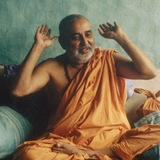
Supreme Peace
Swamishri arrived at the Swaminarayan Akshardham in New Delhi yesterday, after celebrating the 150th Anniversary Celebrations of Akshar Deri in Gondal. In contrast to the thousands of devotees and 800 sadhus in Gondal, there were only a few sadhus seated here before him. Due to this stark difference, Harinivas Swami asked Swamishri, “After celebrating a big festival in Gondal, you must be feeling at ease and peace here with only a few sadhus before you.”
Swamishri replied, “[I] experience supreme peace no matter how many are present or not. I’m connected with two – Maharaj and Swami – and so I’m always at peace – 24 hours.”
Everyone was left speechless and realized that Swamishri’s inner peace and joy were not dependant on mundane standards and circumstances.
31 January 2018, New Delhi
Glory of Seva
Paramchintan Swami narrated an inspiring incident of Mahant Swami Maharaj during his satsang tour in Australia in 2015. “Swamishri had reached the airport to take the flight from Melbourne to Auckland. They had a lot of luggage. Two youths and an attendant sadhu were carrying bags to the check-in counter. Mahant Swami Maharaj also started carrying two handbags to the check-in counter. The sadhus and youths tried to restrain him, saying, ‘Swami, there’s no need for you to carry them. We will do it.’ But Swamishri said, ‘How blessed I am to get this opportunity of doing seva!’”
At 82 years, Swamishri’s seva helps us to realize the value and glory of seva.
13 February 2018, Melbourne
Bhagwan and Guru
Swamishri was asked, “Being engaged in so many works and activities of the BAPS Sanstha do you experience tension?”
Swamishri replied, “I leave the tension on Bhagwan.” Then Swamishri smiled and added, “Pramukh Swami Maharaj has done everything. He has left nothing undone.”
Swamishri’s words reveal his profound faith in Bhagwan Swaminarayan and devotion to his guru (guru bhakti).
23 April 2018, New Delhi
Daily Home Assembly
In May 1977, Pramukh Swami Maharaj was answering a pile of letters at the Swaminarayan Mandir in Dadar, Mumbai.
Dhirendrabhai Vinchhi, a devotee of Surat, asked Swamishri, “What type of letters do you get?”
Swamishri replied, “People seek guidance or blessings for their problems like a court case, business crises, family illness, delinquent child, poor academic results, a pending file for visas to America,...”
Then Dhirendrabhai requested, “Can you show us an answer to all our problems so that we may never have to write such letters to you?” Swamishri revealed, “If all the family members sit together daily to listen to spiritual discourses then there won’t be the need to write such letters.”
This revolutionary concept of Daily Home Assembly introduced by Pramukh Swami Maharaj has worked wonders in dissolving family ills. The daily practice of home assembly has harmonized strained relations between mothers-in-law and daughters-in-law, bridged differences between husbands and wives, helped rein in anger, improved concentration and academic performance in children and enhanced virtues like tolerance, understanding, morality and spiritual faith. Daily Home Assembly is a seminal contribution by Swamishri for making families, society and the world a happier and peaceful place to live in.
May 1977, Mumbai
Real Growth
As Swamishri lay down to sleep, he was informed about Raju Dave's birthday. Then a sadhu told Swamishri, 'For the last 15 years, Raju has not grown in height at all!'
Swamishri commented, 'It doesn't matter whether he grows in height or not. By growing in Satsang, everything is included. Nothing beats it. There is no better way to happiness. By progressing in Satsang, Maharaj is pleased. Progress in Satsang is real growth.'
20-3-1993, Mumbai
On Marriage
In our increasingly independent, interactive and alluring society, social issues are burgeoning at an alarming rate. One particular issue that fragments the family is when a youth chooses to marry someone against the wishes of his or her parents.
A youth in London had decided to marry a girl who was not of the Gujarati community. His father and mother, both devotees, were pained and unhappy about his decision. Despite explaining to him not to marry, he remained adamant.
When Swamishri arrived in London in 1998, the father requested Swamishri to explain to his son. At first Swamishri was reluctant to do so because the boy did not know him. Finally, at the father's insistence, Swamishri called his son and advised, 'As a satsangi you should understand as to how can you make your parents unhappy when they gave birth to you and raised you! If the girl really loves you, then has she accepted satsang? You have been friends with her for six years but has your influence changed her? Has she given up eating meat and drinking beer? Instead, you have started eating and drinking. She did not give up meat, and you are ready to forsake your parents! So, just think about it.' Then Swamishri explained to his father, 'I've talked to your son. Now he will do as it pleases him. You should imbibe the philosophy of the temporariness of this world (sankhya). Tell me, how many more years have you to live? So, engage yourself in bhajan (worship) and you will have peace and happiness.'
Swamishri advocates that youths should always marry according to our tradition and with the consent of parents.
1998, London
A True Honeymoon
A devotee and his son approached Swamishri, 'He got married recently. Please bless him,' said the father.
Placing his hands on the son's shoulder, Swamishri asked, 'In a few days time, where do you plan to go?'
'On a honeymoon to the Maldives,' the son replied. 'It's near Sri Lanka.'
'What's the need for it?' Swamishri asked, 'You'll spend 25,000 rupees just to pollute your soul!'
The father intervened by telling Swamishri, 'It's going to cost 100,000 rupees!'
'Well, I thought it was 25,000 rupees,' revealed Swamishri; and then lovingly explained to the son, 'When you go there and if the two of you quarrel, you'll return back with problems. Instead, it would be better to go for the darshan of our mandirs. You will gain the fruits of a pilgrimage. In this age, this type of extravagance has increased. This is not our tradition.'
The son changed his mind at Swamishri's request and agreed to go on a pilgrimage instead. Swamishri inspired the youth to follow the tradition of Indian culture to go for darshan of God in mandirs.
14-2-1999, Atladra
Sharp Memory
Mr. A.K. Saxena, the general manager of Amdavad Telecom came for Swamishri's darshan. Introducing him, a sadhu said, 'Bapa, he's coming for your darshan for the first time.'
Swamishri immediately said, 'We've met before... where...?'
'That was S.K. Gupta,' suggested the sadhu.
'No, not Mr. Gupta. It was Mr. Saxena,' Swamishri replied. Resolving the issue, Mr. Saxena said, 'Yes, three years ago I had come for Swamishri's darshan.'
Swamishri blessed him. As Mr. Saxena left, he commented, 'Three years ago, I had met Swamishri for a few moments only. Since then, Swamishri has met thousands of people, yet he still remembers me by name!'
Such is Swamishri's memory power, that even at the age of 78, his recall is as sharp as ever.
6-3-1999, Sarangpur
Glory of God
Swamishri arrived at Gandhinagar from Atladra. After darshan, he sat down for dinner. Hitesh Dharia, a guide at the Akshardham monument, narrated the experiences of visitors to Akshardham. At the end, Hitesh asked Swamishri, 'What is the fruit of visiting Akshardham?'
Swamishri replied, 'Whoever visits will see and appreciate. They will experience peace and happiness...'
'Can I say what the real benefit of visiting Akshardham is?' Hitesh interrupted. Then he answered, 'The biggest benefit for a visitor to Akshardham is that he gets to know about Pramukh Swami Maharaj.'
Hearing this Swamishri countered, 'Everything is due to the grace of Bhagwan Swaminarayan. The murti seated here in Akshardham is divine and because of the murti everyone benefits by their visit here.'
'But, you reveal the true identity and glory of that murti,' Hitesh said.
'Yes, but the real force is God. Without God, we are worth nothing,' concluded Swamishri.
Swamishri's devotion for God and personal humility touched everyone.
20-2-1999, Gandhinagar
Happiness and Miseries
An Indian newspaper editor asked Swamishri a few questions:
Q: Spirituality is the right path, and man should follow it. However, those who walk the path of immorality and perform impious acts achieve mundane progress and are happier, whereas those who are spiritual are unhappy and miserable. Why is this?
A: Outwardly it seems that one who has wealth is happy, but one cannot always believe this to be true. On the surface it appears that he is happy, but inside he is unhappy. He is always running, evading and anxious. The fruit of immorality (adharma) is misery and pain. Sooner or later he will have to suffer for it. One who does good will get good fruits. He feels happy within and God looks after him and makes him happier.
Duryodhan was immoral and he seemed happy outwardly, whereas the Pandavs had to roam in the forests during their exile. But, the peace the Pandavs had, Duryodhan did not have!
Q: Why do you, a great sadhu, accept illness?
A: The human body is a home to illnesses.
Q: Though this is true, you should not accept it.
A: (With reference to accepting illness Swamishri added) So that others may derive strength and inspiration, and not become afraid of diseases or illnesses, one should engage in bhajan.
10-4-1999, Surat