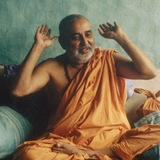
Person in Whom God Fully Resides
'… God fully resides in the heart of a person who possesses the following understanding: 'The earth remains stable and trembles; the stars remain steady in the sky; the rains fall; the sun rises and sets; the moon appears and disappears, waxes and wanes; the vast oceans remain constrained within their boundaries; a drop of liquid develops into a human possessing hands, feet, a nose, ears and the rest of the ten indriyas; the clouds, through which lightning strikes, float unsupported in the sky - these and a countless variety of other wonders are due only to the form of God that I have attained.' With this understanding, he has the conviction that no one except the incarnate form of God is the cause of these wonders. He realises, 'The countless wonders which have occurred in the past, those which are currently taking place, and those which will occur in the future are all only due to the manifest form of God that I have attained.'
[Gadhadã I-27]
Key to Progress in Satsang
'Conversely, when a person is likely to progress in Satsang, pure desires steadily flourish within him. Day by day, he sees only virtues in all of the satsangis. He views all devotees as superior to himself and considers himself to be insignificant. Moreover, he experiences the bliss of Satsang in his heart 24 hours a day. Such characteristics indicate that pure desires have flourished. In fact, the more such a person practises satsang, the more he benefits; and eventually, he attains profound greatness.'
[Gadhadã I-27]
Intensification of Bhakti
Thereupon Gopãlãnand Swãmi asked, 'How can the force of bhakti coupled with dharma, gnãn and vairãgya be intensified? Shriji Mahãrãj replied, 'There are four means to accomplish this: One is a pure place, the second is an auspicious time, the third is pious actions, and the fourth is the company of a holy person. Of these, the influence of actions is slight, whereas the influences of place, time and company are more powerful… Therefore, one should stay where there is a pure place and should abandon - by whatever means necessary - a place where the time has become unfavourable. One should keep the company of devotees of God as well as the company of the Sant who is a knower of Brahma and who observes the five religious vows. As a result, a devotee\'s bhakti for God gains tremendous vigour. This is the answer to your question.'
[Gadhadã I-29]
Types of Sense Pleasures for a Devotee
After thinking for quite some time, Shriji Mahãrãj said, 'In this world, a materialistic individual who is attached to the vishays cannot survive without indulging in them. Moreover, just as that non-believer indulges in vishays, similarly, a devotee of God also indulges in vishays. However, the two are different. In what way? Well, the materialistic person, who is attached to the vishays, enjoys only worldly vishays, whereas for a devotee of God, listening to discourses of God is the only vishay for his ears; touching the holy feet of God or touching the holy dust from the feet of the Sant is the only vishay for his skin; doing darshan of God or the Sant is the only vishay for his eyes; taking the prasãd of God and singing His praises are the only vishays for his tongue; and smelling the flowers and other objects which have been offered to God is the only vishay for his nose. In this manner, there is a difference between the vishays that a non-believer indulges in and those that a devotee indulges in.'
[Gadhadã I-32]
Highest of all Endeavours
Thereupon Muktãnand Swãmi asked, 'The scriptures have described innumerable spiritual endeavours to please God; but amongst them all, which one is so powerful that it alone earns as much pleasure of God as is earned by performing all spiritual endeavours combined? Please reveal it to us.'
Shriji Mahãrãj began by saying, 'Please listen as I tell you the one spiritual endeavour by which God can be pleased.' He then continued, 'Accepting the firm refuge of God is the single, greatest endeavour amongst all spiritual endeavours for pleasing God. That refuge, though, must be extremely firm and without any flaws.'
[Gadhadã I-33]
Cause of Suffering
Muktãnand Swãmi then asked, 'It is extremely difficult for a person to attain God. Moreover, there is no greater benefit and no greater bliss than attaining God. Why, then, do people forsake such immense bliss and strive agonisingly for worthless objects? That is the question.'
Shriji Mahãrãj said, 'Here, I shall answer that. When one ignores the injunctions of God and begins to stray away from them, one suffers. On the other hand, if one acts according to those injunctions, one will experience the true bliss of God. So, in fact, one suffers only to the extent that one transgresses the injunctions of God. Therefore, renunciants should live according to the injunctions that have been prescribed for renunciants, and householders should live according to the injunctions that have been prescribed for householders. One suffers to the extent that one lapses in observing these injunctions.'
[Gadhadã I-34]
Happiness and Misery
'Therefore, the happiness and misery experienced by a non-believer is determined by his own karmas. As for a devotee of God, whatever misery he suffers is due to negligence in observing God's injunctions for the sake of worthless objects; and whatever happiness he does experience is a result of following the injunctions of God.'
[Gadhadã I-34]
Introspection
After glancing at all of the devotees, Shriji Mahãrãj thought for a considerable length of time and said, 'Please listen, I have something to say.' He then continued, 'From the time a satsangi enters the Satsang fellowship, he should examine his mind by thinking, 'In the first year, my mind was like this; then it was like this. Previously, I had this much desire for God and this much desire for the world.' In this manner, he should repeatedly reflect on this yearly total of desires and always strive to gradually, yet constantly eradicate all worldly desires that remain in his mind. If, however, he does not introspect in this manner and allows those desires to accumulate, then they will never be overcome.'
[Gadhadã I-38]
Divinizing One's Mind
'In reality, the mind is saturated with desires for the world. But, in the manner in which sesame seeds are imbued with scent by padding them between alternating layers of flowers, the mind should be similarly saturated with flowers in the form of the constant remembrance of God's divine actions and incidents - coupled with an understanding of His greatness. The mind should constantly be entangled in a web in the form of these divine actions and incidents of God, and thoughts relating to God should be constantly conceived in the mind. As one thought subsides, another thought should be conceived. As the second subsides, a third should be conceived. In this manner, the mind should not be left idle...'
[Gadhadã I-38]
Mental Detachment
'Furthermore, a householder should engage in worldly activities physically, but mentally - just like the renunciant - he should also remain free of worldly desires and contemplate on God. Also, he should engage in social activities according to the command of God…'
[Gadhadã I-38]
'Furthermore, a householder should engage in worldly activities physically, but mentally - just like the renunciant - he should also remain free of worldly desires and contemplate on God. Also, he should engage in social activities according to the command of God…'
[Gadhadã I-38]