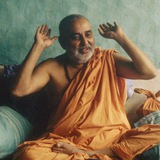
The Sadhu Helps one Conquer Internal Enemies
'Now, if a sãdhu were to criticise and insult those internal enemies of lust, anger, etc., then a person who has the aforementioned thought would not develop an aversion towards that sãdhu. On the contrary, he would be grateful to the sãdhu and would feel, 'This sãdhu is helping me conquer my enemy, and thus he is an extremely great benefactor.' A person who has attained such a thought can destroy all of his inner enemies. Thereafter, no vicious swabhãvs will be able to remain in his heart…'
[Gadhadã II-15]
The Power of Thought
'… In the very same way, if the inner enemies of lust, anger, etc., hinder a person while he is striving to attain liberation, he would harbour the same sort of enmity towards them as well; moreover, that enmity would never diminish. Whoever applies such a thought can eradicate all swabhãvs with that thought alone.'
[Gadhadã II-15]
The Worst Type of Evil Company
'Having thought over it from all aspects, I have come to the conclusion that of all the so-called evil company in the world, the company which is worse than all others is that of those who do not have bhakti towards God, or the faith in their hearts that God loves His devotees, is the master of all, is the uplifter of the wretched, and is also the redeemer of sinners…'
[Gadhadã II-18]
Shriji Maharaj Reveals His Divinity
'Realise that the form amidst the divine light is this Mahãrãj visible before you. If you cannot do that, then at least realise, 'Mahãrãj sees the form which is amidst that aksharrup light.' Even if you can understand this much, you will be able to maintain affection for Me. As a result, you will attain ultimate liberation…'
[Gadhadã II-13]
The Obstacle-free Path
'… Hence, there is no other obstacle-free path like that of having the firm refuge of God.'
[Gadhadã II-13]
'… Hence, there is no other obstacle-free path like that of having the firm refuge of God.'
[Gadhadã II-13]
No Option to Understanding this Principle
'Whether this principle is understood after being told once, or after being told a thousand times; whether it is understood today, or after a thousand years, there is no option but to understand it. Even if one were to ask Nãrad, the Sanakãdik, Shukji, Brahmã and Shiv, since they are wise, even they, using many different techniques, would point to the manifest form of God and the manifest form of the Sant as being the only granters of liberation. They would also explain that the greatness of the manifest form of God and the manifest form of the Sant is exactly the same as the greatness of past forms of God and the Sant.'
[Gadhadã II-21]
Outcome of Deficiency in Understanding God
'… However, if any deficiency remains in understanding God, then one's flaw will never be eradicated. Therefore, one should attempt to understand this principle by any means within this lifetime.'
[Gadhadã II-13]
'… However, if any deficiency remains in understanding God, then one's flaw will never be eradicated. Therefore, one should attempt to understand this principle by any means within this lifetime.'
[Gadhadã II-13]
Conquering Desires for the Panchvishays the Simple Way
Thereafter, Muktãnand Swãmi asked another question: 'Can the desires for the panchvishays be conquered by vairãgya, or can they be conquered by other means?'
Shriji Mahãrãj answered, 'Whether or not one has vairãgya, if one diligently observes the niyams prescribed by God, then the desires for the panchvishays can be conquered.'
[Gadhadã II-16]
Without Conviction all Efforts are Pointless
“… But a person without such a conviction of God – even if he is a sincere renunciant and is vigilantly striving to eradicate lust, anger, avarice, etc. – will not be able to eradicate those vicious natures by his efforts alone. Ultimately, he will become evil and go to narak.”
[Gadhadã II-14]
“… But a person without such a conviction of God – even if he is a sincere renunciant and is vigilantly striving to eradicate lust, anger, avarice, etc. – will not be able to eradicate those vicious natures by his efforts alone. Ultimately, he will become evil and go to narak.”
[Gadhadã II-14]
Dharma is Supported by Maintaining Faith in God
Thereupon Muktãnand Swãmi asked, “Some may have faith in God like Arjun, and others may have faith in dharma like Yudhishthir. Of these two, if one attempts to maintain faith in God, faith in dharma may decline; and if one attempts to maintain faith in dharma, faith in God may decline. So, what means can one employ so that neither of the two declines?”
Shriji Mahãrãj replied, “The first canto of the Shrimad Bhãgwat includes a dialogue between Pruthvi and Dharma that mentions that God possesses the 39 redemptive attributes8, i.e., truthfulness, purity, etc. Thus, all forms of dharma are supported by the form of God. That is precisely why God is called ‘Dharma-dhurandhar’.”
[Gadhadã II-16]