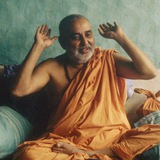
Means to Acquiring Virtues of Satpurush
'… A person imbibes the virtues of such a Purush, who has no affection for anything except God, by believing, 'This Purush is extremely great. Despite thousands of people standing before him with folded hands, he does not have the slightest desire for the pleasures of the world. As for me, I am extremely insignificant, and I am solely attached to worldly pleasures. I do not understand anything at all about God. Shame on me.' In this way, he feels remorse and imbibes the virtues of the great Purush. He also feels remorse after realising his own flaws. While repenting in this way, vairãgya arises in his heart, and thereafter, he acquires virtues similar to those of that Satpurush…'
[Gadhadã I-67]
Attributes of One who has Conquered His Mind
Thereupon Muktãnand Swãmi asked a question: 'The verse 'Jitam jagat kena, mano hi yena |' explains that a person who has conquered his mind can be said to have conquered the whole world. But how can one know whether the mind has been conquered?'
Shriji Mahãrãj replied, 'When the indriyas withdraw from the panchvishays, i.e., sights, sounds, smells, tastes and touch, and no desire to indulge in those vishays remains, then all of the indriyas are said to be conquered. Moreover, when the indriyas do not come into contact with the vishays, the mind also does not come into contact with the indriyas, and its vrutti remains within the heart. In this way, one who has shunned the panchvishays with absolute resolution should be known as having conquered one's mind…'
[Sãrangpur -1]
Missing Element for Developing Affection for God
Then Motã Yogãnand Swãmi asked, 'Despite having perfect faith in God, why does a person still not develop affection for God and discourses related to God?'
Shriji Mahãrãj explained, 'It is because he has not yet realised the greatness of God as it is. If a person does thoroughly realise the greatness of God, then he does not develop affection for anything besides God, even if he tries. In addition, he develops unflinching affection only for God, His Sant, and the discourses and devotional songs related to God.'
[Gadhadã I-78]
Understanding Scriptures
'Besides, the words of the scriptures cannot be understood in their true context by anyone except an ekãntik bhakta…'
[Gadhadã I-66]
'Besides, the words of the scriptures cannot be understood in their true context by anyone except an ekãntik bhakta…'
[Gadhadã I-66]
Power of Faith
Thereupon Shriji Mahãrãj said, 'If a devotee of God has faith in God coupled with the knowledge of His greatness and also thoroughly realises the greatness of the sãdhus and satsangis, then even if that devotee's karmas as well as kãl happen to be unfavourable, both kãl and karma combined are incapable of harming him due to the extreme force of his bhakti. On the other hand, a person lacking faith in God and His Sant does not benefit in any way, even if God wishes to do good for that person.'
[Gadhadã I-72]
God and His Abode - Akshardham
Thereupon Shriji Mahãrãj explained, 'When God incarnates for the purpose of granting liberation to the jivas, He is always accompanied by His Akshardhãm, His attendants - who are formed of chaitanya - and all of His divine powers; but they are not perceived by others… Therefore, a devotee of God should realise that the form of God along with His Akshardhãm is present on this earth, and he should also explain this fact to others.'
[Gadhadã I-71]
Influences of Spiritual and Evil Persons
Thereafter Muktãnand Swãmi asked another question: 'Places, times and actions become either favourable or unfavourable. Is this due to the company one keeps, or to some other factor?'
Shriji Mahãrãj explained, 'All places are a part of the earth, and so they are the same everywhere. Time is also the same everywhere. However, wherever an extremely powerful spiritual person presides, adverse places, adverse times and adverse actions all become favourable by his influence. Conversely, by associating with an extremely vile sinner, even favourable places, favourable times and favourable actions become adverse. Therefore, the person is the governing factor in determining whether places, times and actions are favourable or unfavourable.'
[Gadhadã I-59]
Attributes of One with Firm Faith
'…Shriji Mahãrãj continued, 'I shall now briefly explain the characteristics of a person with profoundly firm faith, so please listen attentively. Firstly, even if he has intense renunciation, a person with perfect faith will do any task on the path of pravrutti asked of him, without ever backing away. Moreover, he does not do it reluctantly; he does it willingly. The second characteristic is that regardless of any swabhãv he may possess - even if it cannot be eradicated by a million means - if he senses God's insistence in forsaking that swabhãv, he forsakes it immediately. The third characteristic is that despite his own drawbacks, he is unable to live without the discourses and devotional songs related to God, and without the Sant of God even for a moment. He finds faults only within himself and thoroughly imbibes the virtues of the Sant. He also understands the great glory of the discourses and devotional songs of God, as well as of the Sant of God. A person with such understanding should be known to have perfect faith…'
[Gadhadã I-63]
Greatest Endeavour
Thereupon Shriji Mahãrãj said, 'Of all spiritual endeavours, to eradicate worldly desires is the greatest endeavour. The means of doing this is as follows: Bearing in mind one's craving for the vishays, i.e., sights, sounds, smells, tastes and touch, one should introspect, 'Is my desire for God equal to my desires for the world? Is it greater? Or is it less?' One should examine oneself in this manner…'
[Gadhadã I-60]
Perfect Faith
Paramchaitanyãnand Swãmi then asked, 'Mahãrãj, what type of thoughts does a person with perfect faith in God have?'
Shriji Mahãrãj replied, 'A person with perfect faith feels within, 'I have attained all there is to attain; and wherever the manifest form of God resides, that itself is the highest abode. All these sãdhus are like Nãrad and the Sanakãdik; all satsangis are like Uddhav, Akrur, Vidur, Sudãmã, and the gopas of Vrundãvan; and all female devotees are like the gopis, Draupadi, Kuntãji, Sitã, Rukmini, Lakshmi and Pãrvati. Now I have nothing more to achieve - I have attained Golok, Vaikunth and Brahmapur.' A person with perfect faith has such thoughts and experiences extreme elation in his heart. One who experiences such feelings within should be known to have perfect faith.'
[Gadhadã I-63]