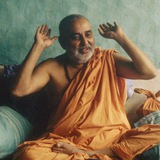
The Need of a Satpurush To Attain Gnan
'Gnãn arises if one listens to the Upanishads such as the Bruhadãranya Upanishad, Chhãndogya Upanishad, Kathavalli Upanishad, etc.; the Bhagwad Gitã; the Vãsudev Mãhãtmya; the Vyãs Sutra and other scriptures from a Satpurush.'
[Loyã-9]
'Gnãn arises if one listens to the Upanishads such as the Bruhadãranya Upanishad, Chhãndogya Upanishad, Kathavalli Upanishad, etc.; the Bhagwad Gitã; the Vãsudev Mãhãtmya; the Vyãs Sutra and other scriptures from a Satpurush.'
[Loyã-9]
Atma Contemplation Like That of King Janak
'… Similarly, a devotee with gnãn like Janak, harbours the thought, 'I am the ãtmã - pure, chetan, unchanging, the embodiment of bliss, and imperishable. Vishays like women and other things, however, are full of misery; they are vain, perishable, and jad.' With this thought, he believes only his own self, the ãtmã, as being the embodiment of bliss. Also, he believes, 'The pleasure and pleasantness which are apparent in the vishays - i.e., sounds, touch, etc. - are only experienced due to the ãtmã. But, when the ãtmã leaves the body, that which was once pleasurable becomes miserable.' He contemplates upon his ãtmã in this manner.'
[Loyã-10]
The Sticky Nature of the Chitt
'… The nature of the chitt is similar to this; it sticks to whatever object it recalls. In fact, the chitt even attaches itself to things that are utterly insignificant, such as stones, or rubbish, or dog excrement - things in which there is not even the slightest pleasure. If it recalls such useless things, it will then also contemplate upon them. Such is its sticky nature.'
[Gadhadã II-6]
Overcoming One's Swabhavs
Shriji Mahãrãj replied, 'A recently formed swabhãv is overcome by staying in the company of a pious sãdhu and by making a little effort to eradicate it…'
[Loyã-8]
Shriji Mahãrãj replied, 'A recently formed swabhãv is overcome by staying in the company of a pious sãdhu and by making a little effort to eradicate it…'
[Loyã-8]
Being Independent Vishays
'… When a person who has such gnãn of his own self and of God attains a vishay, regardless of how appealing it may be, his mind would not be even slightly affected by it. He does indulge in the essential vishays, i.e., sounds, touch, etc., but he does not become dependent upon them; rather, he indulges in them independently, of his own accord…'
[Loyã-10]
Overcoming Lust, Anger, etc...
'… Similarly, through the bliss of one's ãtmã, one should remain fulfilled within. Externally, one should obstruct the 'inflow' of the vishays through the indriyas. This is the only definite method for overcoming lust, anger, etc. Except for this, though, they cannot be overcome by fasting alone. So please imbibe this thought firmly in your lives.'
[Gadhadã II-2]
Those Who Survive in Satsang only until they are Confronted by an Adverse Situation
Nityãnand Swãmi then asked, 'Someone may identify his self with the body and may be attracted to the panchvishays as well; yet he seems to survive in the Satsang fellowship. How can this be explained?'
Shriji Mahãrãj replied, 'He survives in Satsang only as long as he is not confronted by an adverse situation. If a great sãdhu or God were to denounce his egotism, cravings for taste, avarice, lust, anger or his belief that he is the body, then he would surely develop contempt for that sãdhu. Then he would certainly malign him and thus fall from Satsang…'
[Loyã-17]
Realising the Bliss of God to be the Greatest Happiness
Nityãnand Swãmi then asked, 'Someone may identify his self with the body and may be attracted to the panchvishays as well; yet he seems to survive in the Satsang fellowship. How can this be explained?'
Shriji Mahãrãj replied, 'He survives in Satsang only as long as he is not confronted by an adverse situation. If a great sãdhu or God were to denounce his egotism, cravings for taste, avarice, lust, anger or his belief that he is the body, then he would surely develop contempt for that sãdhu. Then he would certainly malign him and thus fall from Satsang…'
[Loyã-17]
God is One and Unparalleled
'Also, one should understand, 'God is one and unparalleled, while others such as Prakruti-Purush, etc., are His devotees and meditate on Him.' That is why they are referred to as forms of God. Just as a great sãdhu who meditates on God is known as a form of God, in the same way Prakruti-Purush, etc., are also forms of God…'
[Panchãlã-2]
From Whom Should Scriptures be Heard?
'… Therefore, one should only hear the sacred scriptures from a holy person, but never from an unholy person.'
[Loyã-11]
'… Therefore, one should only hear the sacred scriptures from a holy person, but never from an unholy person.'
[Loyã-11]