Eminent Orator
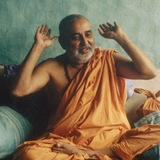
The recitation of Satsangijivan was sponsored by Harilal Sheth, the grandson of Shivlal Sheth. Four puranis (reciters) were appointed to give the discourses in turn. Yagnapurushdasji's turn was last. All the devotees were immensely pleased to witness the unique style of his discourse, his subtle knowledge of Vachanamrut and the methodology adopted by him in expounding the subject with the authority of other scriptures and support of appropriate illustrations. The next day when someone went to call for the Sheth to attend the discourse, the latter replied, 'Please inform me when it is Yagnapurushdasji's turn to recite the katha.' The sadhus got envious on hearing this reply. On the last day a question arose as to which of the reciters should be honored first. The Sheth directed in clear words, 'He should be honored first whose recitation has been the most satisfactory. Everyone in the assembly has been pleased with Shastri Yagnapurushdasji's recitations. Hence he should be honored first.' This augmented the indignation of the sadhus.
With the evil intention of slighting Yagnapurushdasji, Sadhu Raghuvircharandas said, 'Today one who has stooped so low as to accept a tailor and a cobbler as his gurus is being honored in this assembly as a very respectable person!'' Hearing this, Yagnapurushdasji roared like a lion, 'The right to be a guru does not vest solely in those who wear the saffron. If you are going to discriminate against Pragji Bhakta and Jaga Bhakta, who have been graced by Gunatitanand Swami and who have attained the Brahmic consciousness, merely on the ground of caste, Maharaj will not excuse you.' With these words he sat down.
The elderly sadhus rebuked Raghuvircharandas. Harilal Sheth went forward for the pujan (honoring) of Yagnapurushdasji, but the latter courteously declined, and allowed the aged sadhu Haridas Swami to be honored first and himself to be honored last.
I do nothing for my own personal enjoyment
“… In fact, all of My activities are for the sake of the devotees of God; there is not a single activity which I perform for My own personal enjoyment.”
[Gadhadã II-55]
“… In fact, all of My activities are for the sake of the devotees of God; there is not a single activity which I perform for My own personal enjoyment.”
[Gadhadã II-55]
The three attributes of a staunch satsangi
“A person who possesses three attributes can be called a staunch satsangi. What are these three attributes? The first is to strictly adhere to the niyams prescribed by one’s Ishtadev – to such an extent that one would never forsake those disciplines even at the cost of one’s life. The second is to have extremely firm faith in God, so much so that one would never sway from it even if others or one’s own mind were to raise doubts. The third is to be loyal to those Vaishnav devotees who worship one’s Ishtadev – just as parents are loyal to their children, a son is loyal to his father, and a wife is loyal to her husband. One who possesses these three attributes completely can be called a staunch satsangi.”
[Gadhadã II-61]
How to Love God
“Please listen, I wish to speak to all of you. When you were singing devotional songs, and as I was listening to them, a thought occurred to Me, which I shall now share with you. If one wants to love God, one should love Him while believing oneself to be the ãtmã, which is characterised by pure existence…”
[Gadhadã II-57]
One should apply these two types of gnan with great fervour
“If one attains the gnãn of one’s jivãtmã and the gnãn of God’s greatness as mentioned earlier, then even if one has somehow become attached to any sort of pleasures of the panchvishays, one would not remain bound by them, but would, in fact, break that bondage and withdraw from them. How, then, can one who forsakes the pleasures of the panchvishays become attached? Therefore, having listened to these two types of gnãn, one should apply them within one’s mind with great fervour…”
[Gadhadã III-39]
The half-fallen satsangi
“… Also, a devotee of God should perceive flaws primarily in himself. Conversely, a person who perceives flaws in others and only virtues in himself may be known as a satsangi, but he should be known to be half-fallen.”
[Gadhadã II-26]
“… Also, a devotee of God should perceive flaws primarily in himself. Conversely, a person who perceives flaws in others and only virtues in himself may be known as a satsangi, but he should be known to be half-fallen.”
[Gadhadã II-26]
While simultaneously dwelling in Akshardham...
“… In the same way, Purushottam Bhagwãn manifests in whatever form is required in whichever brahmãnd – while simultaneously dwelling in Akshardhãm. Actually, He Himself forever dwells in Akshardhãm. In fact, wherever that form of Purushottam resides, that is the very centre of Akshardhãm.”
[Gadhadã II-42]
Knowledge to help overcome adversity
“… In the same way, only when a person is constantly obsessed by these two topics can that gnãn be realised. Then, that gnãn would assist him against any sort of adversity that may befall him. For example, when Hanumãnji brought the vishalyakarani herbal medicine for Rãmchandra and gave it to him to drink, all of the arrows from Rãmchandraji’s body fell out by themselves. Similarly, all of the ‘arrows’ in the form of the indriyas’ desires to indulge in the vishays are removed when these two points have been imbedded in a person’s mind. That is to say, the vruttis of his indriyas withdraw from the pleasures of the vishays and become rooted only in God. Only he is a satsangi, because only he who associates with his own satya ãtmã and satya God can be called a satsangi.”
[Gadhadã III-39]
All-in-one - The extremely divine bliss of God
“The pleasures associated with sights, sounds, smells, tastes and touch are all found to co-exist in one place – the blissful and divine form of Purushottam Bhagwãn. When we have the darshan of that form of God, we can enjoy the bliss of that beauty, as well as the bliss of the other four types of vishays, i.e., sounds, touch, etc. That gratification occurs simultaneously. With worldly vishays, however, when one indulges in one vishay, one receives the gratification of only that vishay, but not of the others. Thus the pleasures of worldly vishays are found separately. Moreover, those pleasures are futile, perishable and ultimately the cause of extreme misery. But in God, one enjoys the bliss of all of the vishays simultaneously. That bliss is extremely divine; it is eternal and imperishable. Therefore, a spiritual aspirant should develop vairãgya towards the worldly vishays and become totally attached to the divine and blissful form of God.”
[Gadhadã III-27]
How can one distinguish between a godly and a demonic person?
Then Shuk Muni asked, “How can one distinguish between a godly person and a demonic person?”
Shriji Mahãrãj replied, “In a godly person, vicious natures such as lust, anger, avarice, etc., are due to the influence of unfavourable circumstances. Under the influence of favourable circumstances, however, they are destroyed within a short time. But in a demonic person, vicious natures such as lust, anger, avarice, etc., are never destroyed. If someone were to speak some harsh words to a demonic person even once, he would not forget them for as long as he lives. Then, if that demonic person were to become a satsangi, he would initially appear to be better than all of the other devotees. But, he would be like the following: Silt that has gathered in the region of Bhãl – where there was previously sea – has made the soil fertile. As long as the silt remains, sweet water can be obtained by digging below; but if one were to dig much deeper, then extremely saline water would emerge. In the same way, even if a demonic person has become a devotee of God, the moment his wishes are not fulfilled and he is even slightly disturbed, then compared to the service of the sãdhus he had previously performed, he would malign them thousands of times more. Even then, his mind would not be content.”
[Gadhadã III-14]