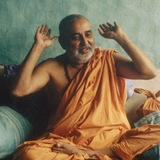
For One Who has Renounced
“A devotee who has renounced worldly life may possess two undesirable traits which do not befit him in this Satsang fellowship. The first is lust, and the second is affection for his relatives. In my eyes, one who possesses these two undesirable traits is like an animal. Of these two, I have an extreme repulsion for one who has excessive affection for one’s relatives. “For this reason, then, a person who has renounced worldly life should not keep even the slightest amount of affection for his relatives…”
[Gadhadã III-19]
The Destruction of the Indestructible Jiva!
Thereupon Shriji Mahãrãj said, “My nature is such that I feel extremely afraid of harming any of the following: firstly, God; secondly, a devotee of God; thirdly, a Brãhmin; and fourthly, one who is meek. Other than these four, I am afraid of no one. This is because even if one were to harm anyone else, one’s body would be destroyed; the jiva would not be destroyed. However, if a person harms one of these four, then his jiva is also destroyed.”
[Vartãl-11]
Offending the Meek Offends God
“That is why if I have upset even one meek person I think, ‘God resides as antaryãmi in all. While staying in one place, He knows what is in everyone’s heart. So, since He must also be present in the heart of the person whom I have upset, I have offended God as well.’ Realising this, I bow down to him, give him whatever he wishes and do whatever is necessary to please him.”
[Gadhadã II-27]
Deliberately Losing to a devotee
“One should also not be pleased by defeating a devotee of God in arguments. On the contrary, one should derive pleasure in deliberately losing to him. One who does engage in an argument and defeats a devotee of God is a sinner worse than one who has committed the five grave sins.”
[Gadhadã III-21]
“One should also not be pleased by defeating a devotee of God in arguments. On the contrary, one should derive pleasure in deliberately losing to him. One who does engage in an argument and defeats a devotee of God is a sinner worse than one who has committed the five grave sins.”
[Gadhadã III-21]
This Satsang is Divine
“Indeed, the inner enemies of lust, anger, avarice, infatuation, matsar, arrogance, etc., will certainly distress one who is unable to behave as the ãtmã. Therefore, if one offers bhakti without attaining ãtmã-realisation, one’s true nature is sure to be exposed in this Satsang fellowship. Why? Because this Satsang is divine, and all these satsangis are exactly like God’s attendants residing in Shwetdwip, Vaikunth and Golok. I, Myself, swear by God and the devotees of God that I realise these satsangis to be the same as the attendants of God residing in the divine, all-transcending Akshardhãm.”
[Gadhadã III-21]
Even those who are Brahmarup must Offer Bhakti
“… Even those who have attained the brahmarup state, like Shukji, must also worship and offer bhakti to Shri Krishna Bhagwãn. Also, as mentioned in the tenth canto, even the likes of Shukji should narrate and listen to the divine incidents of God…”
[Gadhadã II-39]
“… Even those who have attained the brahmarup state, like Shukji, must also worship and offer bhakti to Shri Krishna Bhagwãn. Also, as mentioned in the tenth canto, even the likes of Shukji should narrate and listen to the divine incidents of God…”
[Gadhadã II-39]
Bhakti Develops by Associating with Eminent Sadhus
Sãdhus Muktãnand Swãmi then asked, “By what means can such bhakti coupled with the knowledge of God’s greatness be developed?”
Shriji Mahãrãj replied, “Bhakti coupled with the knowledge of God’s greatness arises in one’s heart by serving and profoundly associating with eminent sãdhus like Shukji and the Sanakãdik.”
[Gadhadã III-5]
Sins are Eradicated on Seeing Faults in Oneself
“Furthermore, one who has already maligned a devotee of God and whose maligning attitude has become established will under no circumstance be able to eradicate that attitude. On the other hand, another person who is in the process of maligning, realizes, 'I have committed a grave sin in maligning God and his devotees; therefore I am extremely vile, and God and his devotees are extremely great.' When one sees others' virtues and sees faults within oneself in this manner, then any sins one may have committed will be eradicated, however grave they may be.”
[Gadhadã III-22]
Whatever a Devotee Wishes for Comes True
“Also, whatever a devotee of God wishes for comes true. Therefore, it is his great indiscretion when he, out of ignorance, desires any object other than God. That is why a devotee of God should consider the pleasures and delights of the 14 realms to be like the excreta of a crow. He should bear strong affection – by thought, word and deed – only towards God and God’s Bhakta. He should believe, ‘If, perhaps, a devotee of God has some desires remaining in him other than those of God, he will still attain the status of Indra or will attain Brahmalok, but unlike worldly people, he will certainly not pass through the cycle of births and deaths or go to narak. If that is so, then how can one describe the greatness of God and the bliss enjoyed by a true devotee of God?’ Therefore, a devotee of God should maintain deep affection only for God.”
[Vartãl-19]
Satsang; the Greatest Spiritual Endeavour
“… This implies that of all spiritual endeavours, satsang is the greatest. But what are the characteristics of one who regards satsang as the greatest spiritual endeavour?” The munis answered according to their understanding, but none could give a precise answer. So Shriji Mahãrãj replied, “One who regards satsang as the greatest spiritual endeavour is profoundly attached only to the Sant of God. For example, if a king who is childless receives a son in old age, then even if that son swears at the king or misbehaves, for example, by pulling his moustache, the king would not find faults in him. Even if the son hits another child or causes problems in the village, still the king would never attribute faults to his child. Why? Because the king is profoundly attached to his son. Likewise, only one who develops such profound attachment for the Bhakta of God has realized satsang to be the most redemptive of all spiritual endeavours.”
[Gadhadã II-54]