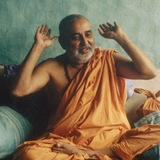
To Remain Undisturbed Amidst Desires
Thereupon Muktãnand Swãmi asked, 'How can one remain composed even under the influence of lust, anger, avarice and fear?'
Shriji Mahãrãj replied, ''I am not the body; I am the ãtmã, which is distinct from the body and is the knower of all.' When such ãtmã-realisation becomes extremely firm, one never loses one's composure. On the other hand, a person without ãtmã-realisation may try many other means, but he cannot remain composed.'
[Gadhadã I-61]
Better of the Two
Thereafter Shãntãnand Swãmi asked, 'There is one devotee who constantly maintains his vrutti on the form of God. There is another devotee who engages in worship and remembrance, and also listens to and engages in discourses and devotional songs related to God. Which devotee of God is the better of the two?'
Shriji Mahãrãj explained, 'He who experiences nirvikalp samãdhi and is not conscious of his body is the better of the two, even if he does not engage in discourses and devotional songs related to God. However, there may be someone who is conscious of his body and gets up from worship of his own accord to eat, drink and perform all bodily activities, yet does not listen to or engage in the discourses and devotional songs related to God. In comparison to him, a person who listens to or engages in discourses and devotional songs is better.'
[Gadhadã I-78]
Limitation of Atma-Realization
Thereafter Brahmãnand Swãmi asked, 'To what extent does ãtmã-realisation actually help at the time of death?'
Shriji Mahãrãj replied, 'When faced with the task of crossing a river, one who knows how to swim can cross it, whereas one who is unable to swim will be left standing. However, when faced with the task of crossing an ocean, both require the aid of a ship. Similarly, a river - in the form of the dualities of cold and heat, hunger and thirst, honour and insult, happiness and misery - may be crossed by a person with ãtmã-realisation; death, however, is like an ocean. In that case, both a person with ãtmã-realisation and a person without it require the help of a ship in the form of faith in God. Therefore, only the firm refuge of God is helpful at the time of death, whereas ãtmã-realisation alone is of no use whatsoever at the time of death. For this reason, one should firmly cultivate faith in God.'
[Gadhadã I-61]
God Assumes a Human Form for Liberation of Jivas
'Nevertheless, when Purushottam Bhagwãn, who transcends both the perishable and the imperishable, assumes a human form and travels in the brahmãnd for the liberation of the jivas, His actions are just like those of all humans. Just as humans possess mãyik swabhãvs such as lust, anger, avarice, infatuation, matsar, jealousy, defeat, victory, fear, grief, arrogance, desires, cravings, etc., God also exhibits the same swabhãvs Himself, but they are all for the liberation of the jivas. So, a true devotee extols the divine actions of God and attains the highest state of enlightenment, whereas a non-believer perceives faults in them.'
[Gadhadã I-72]
Why Vicious Desires Persist?
Nãnã Nirvikãrãnand Swãmi then asked, 'Despite having faith in God, why are not one's vicious desires eradicated?'
Shriji Mahãrãj replied, 'One's vicious desires are not eradicated because one has not fully realised the greatness of God.'
[Gadhadã I-78]
Nãnã Nirvikãrãnand Swãmi then asked, 'Despite having faith in God, why are not one's vicious desires eradicated?'
Shriji Mahãrãj replied, 'One's vicious desires are not eradicated because one has not fully realised the greatness of God.'
[Gadhadã I-78]
God's Infinite Grace
'…Furthermore, the greatness of God is such that within the pore of His each and every hair, countless millions of brahmãnds appear as mere sub-atomic particles. Only when that vast God becomes like a human for the sake of the liberation of the jivas do they have an opportunity to serve Him. If He were to remain exactly the same size as He is, then even the ruling demigods of this brahmãnd, i.e., Brahmã and others, would be incapable of doing His darshan or serving Him. What, then, can be said of mere humans?…'
[Gadhadã I-72]
How to Overcome Adverse Situations
Then Trigunãtitãnand Swãmi asked, 'What means should one adopt when faced with adverse places, times, actions and company?'
Shriji Mahãrãj explained, 'The only way to overcome adverse places, times, etc., is to escape from them by any means possible.'
[Gadhadã I-78]
Then Trigunãtitãnand Swãmi asked, 'What means should one adopt when faced with adverse places, times, actions and company?'
Shriji Mahãrãj explained, 'The only way to overcome adverse places, times, etc., is to escape from them by any means possible.'
[Gadhadã I-78]
Understanding of a Perfect Devotee
'In the same way, God may appear to be as powerless as a human, but only through that form can countless jivas attain liberation. The jivas are incapable of even doing darshan of His form, within whose each and every hair reside countless millions of brahmãnds. So, liberation is not possible through that form. Thus, all actions God performs after assuming a human form are worthy of being extolled. One should not doubt, 'Despite being God, why does He do this?' In fact, to realise all of God's actions and incidents as redemptive is the very dharma of a devotee, and only one who understands this can be called a perfect devotee of God.'
[Gadhadã I-72]
Key to Liberation
Thereafter Prasãdãnand Swãmi asked, 'What is the cause of the jiva's liberation?'
Shriji Mahãrãj answered, 'To do exactly as the Sant says without harbouring any doubts is the only cause of the jiva's liberation.'
[Gadhadã I-78]
Thereafter Prasãdãnand Swãmi asked, 'What is the cause of the jiva's liberation?'
Shriji Mahãrãj answered, 'To do exactly as the Sant says without harbouring any doubts is the only cause of the jiva's liberation.'
[Gadhadã I-78]
Two Types of Faith
Thereafter, Kãkãbhãi of the village Rojkã, asked, 'What are the characteristics of a person who merely has faith in God, without realising His greatness? Also, what are the characteristics of a person who has faith in God coupled with the knowledge of His greatness?'
Shriji Mahãrãj replied, 'A person with only faith still harbours doubts: 'Although I have attained God, will I attain liberation or not?' On the other hand, a person with faith coupled with the knowledge of God's greatness believes, 'From the very day I had the darshan of God, my liberation has been guaranteed. In fact, liberation is also assured to anyone who devoutly does my darshan or accepts my advice. How, then, can there be any doubt regarding my own liberation? I am indeed absolutely fulfilled. Furthermore, whichever spiritual endeavours I do perform, I perform solely to please God.' One with such understanding should be known to have faith in God coupled with the knowledge of His greatness.'
[Gadhadã I-72]