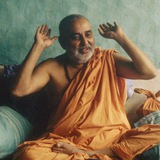
Spiritual Understanding - The Criteria of Greatness
“… So, being a renunciant or a householder is of no significance; rather, he whose understanding is greater should be known as being a greater devotee than the rest.”
[Vartãl-20]
“… So, being a renunciant or a householder is of no significance; rather, he whose understanding is greater should be known as being a greater devotee than the rest.”
[Vartãl-20]
God's Param-Ekantik Sant
“… Of the four types of eminent spiritual people just described, if a person serves one who is like lightening or the vadvanal fire - by thought, word and deed, while staying within the tenets of one's dharma - then bhakti coupled with the knowledge of God's greatness flourishes in that person. Also, one should realise that the person who is like lightening is knows as God's ekantik sadhu - who is in the process of God-realisation. The person who is like the vadvãnal fire is known as God’s Param-Ekãntik Sant – who is perfectly God-realised.”
[Vartãl-3]
Standing in the Defence of a Harassed Devotee
“The scriptures state that if a devotee of God is being killed or harassed by someone, then he who stands in defence of that devotee of God – and in doing so dies or becomes wounded himself – is totally freed from the five grave sins…”
[Gadhadã II-60]
“The scriptures state that if a devotee of God is being killed or harassed by someone, then he who stands in defence of that devotee of God – and in doing so dies or becomes wounded himself – is totally freed from the five grave sins…”
[Gadhadã II-60]
Shriji Maharaj's Propagation of Non-Lust
“Furthermore, in all of the discourses that I deliver, I always strongly propagate observance of the vow of non-lust…”
[Gadhadã II-33]
“Furthermore, in all of the discourses that I deliver, I always strongly propagate observance of the vow of non-lust…”
[Gadhadã II-33]
What is God Like?
Thereupon Shriji Mahãrãj said to the muni-mandal and the devotees, “Everyone please listen to what I have to say. One should first develop a firm conviction of the form of God. What is God like? Well, He, by His own wish, takes birth for the liberation of the jivas. Yet having taken birth, He is still beyond birth. Despite having to die, God is still beyond aging and death. He is also ‘niranjan’, that is to say, He has no blemish of mãyã. In addition, He possesses a definite form and is self-radiant; He is Parabrahma, antaryãmi, the supporter of countless millions of brahmãnds; and He also transcends Akshar. His assuming and discarding of a human body is merely an illusion – like the magic of a wizard. Furthermore, He is the controller of the countless muktas, including Akshar. He is also the lord of all. That Shri Purushottam Nãrãyan, after first taking birth from Dharmadev and Murti, performs austerities in Badrikãshram in the form of Narnãrãyan.
[Amdãvãd-4]
Remaining Within Dharma
“However, when I recently fell ill in Panchãlã, if something serious had happened to Me, then everyone’s firmness would not have remained as it is now. At such a time, one who has intense vairãgya can remain within dharma; or one who has affectionately attached one’s jiva to a person who has intense vairãgya can remain within dharma; or one who keeps contact with Satsang and, realising God to be antaryãmi, behaves according to the niyams that have been prescribed for him can remain within dharma. Except for these, others cannot remain within dharma. ”
[Gadhadã III-29]
The Understanding to Observe Dharma
“… Such a person believes, ‘If I observe dharma, God will be extremely pleased with me, and if I deviate from dharma in any way, then God will be extremely displeased with me.’ If he has this firm conviction within, then that devotee will never falter from dharma in any way. On the other hand, if a person does not have this kind of understanding, then regardless of how much gnãn he may have, or how much bhakti he may offer, he may still deviate from dharma or become bound by worldly objects. This is a fundamental truth.”
[Gadhadã III-26]
Wherein Lies the Greatness of the Sant?
“So then, wherein lies the greatness of the Sant? Allow Me to explain. The greatness of the Sant is not due to wealth or objects or any kingdom; rather, his greatness is due to his bhakti and upãsanã of God. Secondly, the Sant has ãtmã-realisation. It is due to these virtues that he is great.
[Jetalpur-1]
Benefit of developing Enmity with the Mind
“Thus, a person who is wise should definitely develop enmity towards his mind for the sake of his liberation. Thereby, if he conquers his mind, he is sure to benefit; but even if he is defeated by his mind, he will eventually return to the path of realisation, which is also beneficial in the end. Therefore, one who aspires for liberation should most certainly develop enmity towards his mind.”
[Vartãl-1]
Bharat (India) is Incomparable
“The Shrimad Bhãgwat and other sacred scriptures state that it is extremely rare to receive a human birth in Bharat-khand, and that it can be equalled to receiving a chintãmani. In fact, even Indra and other demigods long for a human birth. The vishays, the affluence and opulence, as well as the lifespan of the demigods greatly exceed that of humans, yet they have no means of attaining liberation in their own realms. Only after receiving a human birth in Bharat-khand can one attain liberation. In no other place and with no other body is liberation possible. For this reason, attaining a human birth in Bharat-khand is better than being born in any of the other regions of Mrutyulok. Thus, there is no place in the 14 realms that can compare with Bharat-khand.”
[Bhugol-Khagol - 1]