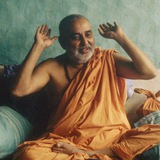
Maintaining the Predominance of Bhakti
“Furthermore, for a devotee of God, if gnãn of the ãtmã, vairãgya or dharma are a hindrance in his bhakti towards God, then he should suppress even them and thereby maintain the predominance of bhakti only. If, however, they are supportive in offering bhakti, then they are fine. Only one who has such an understanding can be called a full-fledged devotee of God.”
[Gadhadã II-26]
How can Someone Without Wisdom Please his Master?
Shuk Muni then asked, “How can one without wisdom and understanding please his master?”
Shriji Mahãrãj replied, “Even though Mulji Brahmachãri and Ratanji are not extremely intelligent, they have an intense yearning for liberation. So they do indeed know how to do whatever pleases God.”
[Amdãvãd-3]
Shuk Muni then asked, “How can one without wisdom and understanding please his master?”
Shriji Mahãrãj replied, “Even though Mulji Brahmachãri and Ratanji are not extremely intelligent, they have an intense yearning for liberation. So they do indeed know how to do whatever pleases God.”
[Amdãvãd-3]
The Poor can Please God through Shraddha
“Furthermore, it is not the case that God’s pleasure is bestowed only on those who offer bhakti with various articles and not upon the poor. Someone may be poor, but if he offers water, leaves, fruits and flowers to God with shraddhã, that is enough to please Him…”
[Gadhadã III-25]
“Furthermore, it is not the case that God’s pleasure is bestowed only on those who offer bhakti with various articles and not upon the poor. Someone may be poor, but if he offers water, leaves, fruits and flowers to God with shraddhã, that is enough to please Him…”
[Gadhadã III-25]
Developing Conviction in the Guru
“Thus, even after attaining this satsang – which is rare for even Brahmã and others – affection for objects other than God still remains because the person has not developed as firm a conviction for the manifest form of God as he has for the non-manifest form of God. That is why the Shrutis state: ‘If a person develops conviction in the guru – who is the manifest form of God – in the same way that he has conviction in the non-manifest demigods, then, as a result, he attains all of the arthas which are described as attainable.’ In fact, when he attains the company of such a Sant, he has, while still alive, attained He who was to be attained after death. That is to say, he has attained that which is called the highest state of enlightenment, or liberation, while being alive.
[Gadhadã III-2]
If a Person Truly Loves God
“Furthermore, if a person truly loves God, he would never develop love for anything else. If there is an object that appears to be dearer to him than God, he would completely discard it. That is true renunciation…”
[Gadhadã II-57]
“Furthermore, if a person truly loves God, he would never develop love for anything else. If there is an object that appears to be dearer to him than God, he would completely discard it. That is true renunciation…”
[Gadhadã II-57]
For One Who has Renounced
“A devotee who has renounced worldly life may possess two undesirable traits which do not befit him in this Satsang fellowship. The first is lust, and the second is affection for his relatives. In my eyes, one who possesses these two undesirable traits is like an animal. Of these two, I have an extreme repulsion for one who has excessive affection for one’s relatives. “For this reason, then, a person who has renounced worldly life should not keep even the slightest amount of affection for his relatives…”
[Gadhadã III-19]
The Destruction of the Indestructible Jiva!
Thereupon Shriji Mahãrãj said, “My nature is such that I feel extremely afraid of harming any of the following: firstly, God; secondly, a devotee of God; thirdly, a Brãhmin; and fourthly, one who is meek. Other than these four, I am afraid of no one. This is because even if one were to harm anyone else, one’s body would be destroyed; the jiva would not be destroyed. However, if a person harms one of these four, then his jiva is also destroyed.”
[Vartãl-11]
Offending the Meek Offends God
“That is why if I have upset even one meek person I think, ‘God resides as antaryãmi in all. While staying in one place, He knows what is in everyone’s heart. So, since He must also be present in the heart of the person whom I have upset, I have offended God as well.’ Realising this, I bow down to him, give him whatever he wishes and do whatever is necessary to please him.”
[Gadhadã II-27]
The Vishays will Never Satisfy Us
“… Similarly, the indriyas have never become satisfied by the vishays, and they never will be. So, now, one should eradicate one’s attachment to the vishays…”
[Gadhadã II-47]
“… Similarly, the indriyas have never become satisfied by the vishays, and they never will be. So, now, one should eradicate one’s attachment to the vishays…”
[Gadhadã II-47]
Turning the Saline to the Sweet
“… Similarly, the great Purush, like the vadvãnal fire, transforms even the ‘salty’ jivas who are like the saline sea water, into ‘sweet’ jivas.”
[Vartãl-3]
“… Similarly, the great Purush, like the vadvãnal fire, transforms even the ‘salty’ jivas who are like the saline sea water, into ‘sweet’ jivas.”
[Vartãl-3]