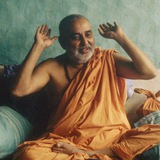
Never Trust the Senses
'… In the same way, if one trusts one's enemies in the form of the indriyas and frees them, not keeping them confined, they will definitely make one fall from the path of God. Therefore, they should never be trusted.'
[Panchãlã-3]
'… In the same way, if one trusts one's enemies in the form of the indriyas and frees them, not keeping them confined, they will definitely make one fall from the path of God. Therefore, they should never be trusted.'
[Panchãlã-3]
Maya Causes Misery and Happiness
'… Similarly, to those who are non-believers, mãyã causes attachment and intense misery, while to a devotee of God, that same mãyã is the cause of intense happiness. Also, the entities that have evolved out of mãyã - the indriyas and the antahkaran, and their presiding demigods - all support the bhakti of God. Therefore, for a devotee of God, mãyã is not a cause of misery; it is a source of great happiness.'
[Loyã-10]
How to Cultivate Vairagya?
'Vairãgya is cultivated when one comes to realise the nature of kãl. What is this nature of kãl? Well, it is to know the process of nitya-pralay, nimitta-pralay, prãkrut-pralay and ãtyantik-pralay, as well as the lifespan of all beings from Brahmã to the smallest blade of grass. After knowing this, if one realises the body, the brahmãnd and all other objects to be subject to the force of kãl, then vairãgya would arise.'
[Loyã-9]
Being and Not Being Conceited
Thereupon Swayamprakãshãnand Swãmi asked a question: 'When is conceit appropriate, and when is it not appropriate? When is humility appropriate, and when is it not appropriate?'
Shriji Mahãrãj replied, 'It is appropriate to be conceited before one who spites Satsang, or speaks derogatorily of God or His great Sant. If a person does speak derogatorily, one should retaliate with words as sharp as an arrow, but in no way should one become humble before a non-believer. In such situations, that is appropriate. On the other hand, it is not appropriate to be conceited before God or His Sant. Before them, putting conceit aside, behaving as a servant of servants and becoming humble is the only appropriate behaviour.'
[Panchãlã-5]
Constituents of Bhakti
'Now, what constitutes bhakti? It is when one becomes brahmarup and performs the bhakti of the manifest form of God…'
[Loyã-7]
'Now, what constitutes bhakti? It is when one becomes brahmarup and performs the bhakti of the manifest form of God…'
[Loyã-7]
Eradicating the Vishays
'… In the same manner, the vishays that have already accumulated in the antahkaran through the indriyas should be eradicated by thinking of oneself as the ãtmã. One should think, 'I am the ãtmã, and the indriyas and the antahkaran have absolutely no relations with me.' With such resolute thinking, by beholding God's form in that chaitanya and through the bliss of one's ãtmã, one should remain fulfilled…'
[Gadhadã II-2]
What Causes Infatuation?
'Therefore, the panchvishays are the cause of infatuation. Moreover, there are three grades of those vishays - superior, average and inferior. Of these, if a person who has obtained superior vishays encounters someone who obstructs him from them, then that person becomes angry on the latter. From that anger, infatuation develops.'
[Gadhadã II-1]
Scriptures that Should be and Should not be Heard
Then Shriji Mahãrãj asked another question: 'Which scriptures should be heard and studied, and which scriptures should not be heard or studied?'
Once again Shriji Mahãrãj replied, 'Scriptures which do not promote God possessing a form and do not describe God's avatãrs, but instead discuss pure Vedãnta and propound a single, formless entity, should never be studied or heard, even if they have been written by someone very intelligent. Also, even though they may be merely devotional songs like those composed by Ranchhod Bhakta, if they describe God's form, they should be sung and heard. Such scriptures should also be studied and heard.'
[Loyã-6]
The Power of God
'… In the same way, Purushottam Nãrãyan is the all-doer, the cause of all, the controller of all; He is extremely attractive, extremely radiant, and extremely powerful; also, He possesses the kartum, akartum and anyathã-kartum powers. If He wishes, He can eclipse all of the muktas of Akshardhãm by His own divine light and prevail alone. Also, if He wishes, He can accept the bhakti of the muktas and reside with them. He can eclipse even Akshar, in the form of the Akshardhãm in which He dwells, and preside alone independently. If He chooses, He is capable of supporting the countless muktas by His own power, without even needing Akshardhãm…'
[Loyã-13]
Aim to Attain God's Abode
'Therefore, keeping this thought in mind, all of you should resolve, 'Now we want to reach only the abode of God; we do not want to be tempted by the vain pleasures of the panchvishays along the way.' So, please keep such a firm resolve. Because what I have told all of you is My principle, please imbibe it firmly in your lives.'
[Panchãlã-1]