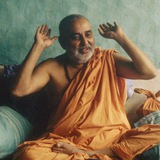
A devotee always has compassion for God and His devotees
“… many verses promote the view that devotees of God who, by gnãn and vairãgya, have shed mãyik influences and have become brahmarup, still have compassion and affection for God and His devotees. On the other hand, one who is not a devotee of God, and who, by ãtmã-realisation and vairãgya alone, has overcome mãyik influences and behaves as the ãtmã has been influenced during the process of God-realisation by the evil influence of those who have only ãtmã-realisation and are devoid of upãsanã of God. Consequently, he does not develop compassion and affection for devotees of God. Just as a foul smell lingers in the air and in fire, similarly, the impressions of evil company, which cannot be overcome by any means, linger within him.”
[Gadhadã III-3]
An extremely difficult feat
“… Of course, continuously engaging one’s vrutti on God is an extremely difficult feat. It is only those whose good deeds from many many lives have ripened who are able to do so. For others, it is very difficult, indeed.”
[Gadhadã II-36]
“… Of course, continuously engaging one’s vrutti on God is an extremely difficult feat. It is only those whose good deeds from many many lives have ripened who are able to do so. For others, it is very difficult, indeed.”
[Gadhadã II-36]
The only means of attaining liberation
“Thus, one who aspires for liberation should recognise God through these characteristics and seek refuge of that God. One should have complete faith in Him. One should perform His bhakti while remaining within the framework of his injunctions. This is the only means of attaining liberation.”
[Vartãl-10]
The Lord of Akshardham is presently sitting in this assembly
“Presently, the lord of Akshardhãm, Shri Purushottam, being born to Dharmadev and Murtidevi – who is also called Bhakti – manifests in Badrikãshram and performs austerities in the form of Shri Narnãrãyan Rishi. It is to denounce the beliefs of the hypocrites, to destroy any traditions of adharma and nurture the traditions of dharma, and to propagate bhakti coupled with dharma, gnãn and vairãgya on this earth in this Kali-yug that Shri Narnãrãyan Rishi was born to Shri Dharmadev and Bhakti in the form of Nãrãyanmuni – who is presently sitting in this assembly.”
[Jetalpur-5]
The experience one will never forget
“… If a person cultivates the gnãn of that form of God in this way, then if he has offered bhakti to that God and has fully experienced the bliss of that gnãn and bhakti as it really is at least once in his jiva, he will never forget it. In fact, regardless of whatever happiness or distress comes his way, he does not forget the experience of that bliss of God’s form…”
[Gadhadã III-37]
The mind is like a child
“Moreover, the mind is like a child. If a child attempts to grasp a snake, or touch a flame or perhaps hold an unsheathed sword, it becomes upset when it is not allowed to do so; and even if it is allowed to do so, it will hurt itself. Similarly, if the mind is not allowed to indulge in the vishays, it becomes upset; and if it is allowed to indulge in them, it turns away from God, and thus becomes extremely miserable…”
[Gadhadã II-23]
Shraddha
“Also, I like one who serves with shraddhã. Conversely, if someone who does not have shraddhã were to bring Me a meal, I would not like the food; or if they were to bring some clothes, I would not like to wear them; or if they were to perform My puja, I would not like that puja. If, however, one offers something with shraddhã, I like it very much.”
[Gadhadã II-52]
Why does a knowledgeable Person not Develop Affection for God?
Muktãnand Swãmi then asked further, “Mahãrãj, one with such extreme indiscretion does not develop affection for God. But what about someone who believes that God is the ocean of all bliss, and that all objects other than God are certainly full of only misery? Despite knowing this, why does he not develop affection for God?”
Shriji Mahãrãj explained, “In either a past life or in this present life, that person has been influenced by extremely unfavourable places, times, company and actions. Due to this, he has performed very intense, sinful karmas that, in turn, have left impressions on his mind. Therefore, despite being able to discriminate between good and bad, he is unable to shun the bad and develop deep affection for God. Moreover, just as the influence of unfavourable places, times, actions and company causes the impressions of sinful karmas to influence the mind, similarly, the influence of extremely favourable places, favourable times, favourable actions and favourable company causes one to perform very intense, pure karmas, the influence of which will destroy the very intense, sinful karmas. Only then does one develop deep affection for God. That is the answer to the question.”
[Gadhadã III-14]
One who Maligns the Satpurush
“…So, one who maligns the Satpurush is a worse sinner than one who has committed the five grave sins…”
[Vartãl-14]
“…So, one who maligns the Satpurush is a worse sinner than one who has committed the five grave sins…”
[Vartãl-14]
Thoroughly Knowing the Bliss of God
“Correspondingly, once a person has thoroughly known in his own mind the bliss of God and the bliss of worshipping God, then even if he can no longer remain within the fellowship and has to leave, he will endure happiness and misery according to his prãrabdha while remembering that bliss; he will not forget it. But what is there to recall for someone who has not known that bliss of God and who has not experienced it? Nothing. Such a person, in fact, is like an animal.”
[Gadhadã III-37]