
💼📈 For a successful dialogue in German in a business negotiation I recommend using clichés, wording that is accepted in a professional speech situation.
⭐️ You would like to ask to have a word
Entschuldigung, ich möchte dazu gern etwas sagen .... - Excuse me, I would like to say something about this ....
Darf ich dazu etwas sagen? - May I say something about that?
Ich würde zu diesem Punkt gern folgendes sagen ... - I would like to say on this subject ...
⭐️ You would like to ask again
Eine Frage bitte - Please, just one question ...
Darf ich bitte kurz nachfragen? - May I ask you a brief question?
Darf ich eine Frage stellen? - May I ask you a question?
Eine kurze Zwischenfrage bitte - Please, a short question...
⭐️ You would like to express your doubts
Ich bin nicht so ganz sicher, dass ... - I am not quite sure that ...
Ich habe da schon noch einige Zweifel ... - I still have some doubts ...
Einerseits, ja, andererseits.... - On the one hand yes, on the other hand ...
⭐️ You would like to ask for information
Können Sie mir sagen, ob...? - Could you tell me ..., if?
Ich wüsste gern, ob ... - I would like to know ... whether...?
Ist Ihre Firma in der Lage ...? - Can your firm in the ...?
Für uns wäre wichtig zu wissen, ob ... - It would be important for us to know ... if ...?
⭐️ You would like to express interest
Wir sind an ... interessiert - We are interested in ...
Ihre Produkte interessieren mich sehr - I am very interested in your products
Es war interessant zu sehen/hören/erfahren, dass... - I was interested to see, hear, find out what...
Wir sind Hersteller von ... und benötigen laufend. - We are producers ... and are in constant need of ...
Wir suchen nach möglichen/potenziellen Lieferanten für ...- We are looking for potential suppliers...
⭐️ You would like to propose an offer to meet
Unser Terminvorschlag für ein erstes unverbindliches Treffen wäre Montag, der... - We offer to have our first non-binding meeting on Monday, the ...
Wie wäre es mit dem 22. August? - What do you say about the 22nd August?
Dürfen wir Sie am 22. August in Ihrer Firma besuchen? - Could we meet you on August 22 in your firm's office?
⭐️ You would like to get an answer in the nearest future
Wir freuen uns auf Ihre baldige Antwort - We would be pleased to hear from you as soon as possible.
Bitte nehmen Sie mit... Kontakt auf / Bitte kontaktieren Sie... - Please contact...
Bitte antworten Sie möglichst umgehend - Please answer as quickly as possible.
Bitte senden Sie Ihr Antwortschreiben an ... - Please send Siehr Antwortschreiben an ...
🔥 Advice from Leo!
Learn these expressions by heart and you will definitely become more confident and leave a good impression on your conversation partner!
❤1👍1
😳🤨 Phrases to express surprise or disbelief.
A batch of useful expressions that are sure to come in handy in everyday life!
🚀 Let's start with the basic phrases:
Bist du sicher? - Are you sure?
Es ist merkwürdig! - That's weird!
Wirklich? - Is it?
Meinst du das im Ernst? - Are you saying that seriously?
Unglaublich! - Unbelievable!
Das kann nicht wahr sein! - This is impossible!
Ich traue meinen Augen nicht - I don't believe my eyes
Das überzeugt mich nicht! - This will not convince me!
Das ist gelogen! - This is a lie!
🤨Express doubt:
Bist du sicher, dass du das schaffst? - Are you sure you can do it?
Glaubst du wirklich, dass das klappt? - Do you really believe you can do it?
Ich kann mir nicht vorstellen, dass wir das schaffen - I can't imagine that we will manage it.
Ich kenne keinen, dem das gelungen ist - I don't know anyone who has managed it.
Ich bezweifle, dass es eine Lösung gibt - I doubt that there is any solution.
😑I am indecisive or indifferent:
Es ist mir egal = I don't care
Es betrifft mich nicht = It doesn't concern me
Vielleicht / Möglicherweise = Maybe
Wahrscheinlich = Probably, probably
Wie du willst = As you wish
Ich weiß nicht, was ich tun soll = I don't know what to do
🇩🇪🏆 And a tip from Leo: Less hesitation and more learning!
❤️ February 14 in Germany
😇 The Feast of All Lovers, like love itself, is elusive. There are dozens of legends about what gave rise to it, but the best known theory has to do with the name of the priest Valentin from the Italian town of Terni (Valentin von Terni).
👑 According to it, Emperor Claudius II, who ruled the Roman Empire in the sixties of the third century, noticed that wars who had families were not as selfless in service, and forbade them to marry.
💒 However, human feelings took their toll: wars fell in love and dreamed of families. But there was no one to marry them - the priests were also afraid of disobeying the emperor - so Valentin of Terni decided to go against the will of the authorities in order to help the legionaries, for which he was executed.
💌 If we accept the theory about Valentine of Terni, it becomes clear why Europe is considered the home of the holiday. Familiar to us in tradition and spirit, Valentine's Day originated in medieval England, not Italy. British poets immortalized the name of St. Valentine and the culture of showing feelings on this February day in their works.
🎊 It's worth noting that on its way to Germany, the holiday made an incredible circle, crossing from island Europe to mainland Europe. To do so, it had to cross the ocean, take root in the United States, and settle in Germany after World War II, along with American soldiers. In 1950, the first ball in honor of Valentine's Day was held in Nuremberg.
How do modern Germans celebrate the holiday? What is the customary gift?
👇 Click the button below to continue reading the article!

👍2
💝 How to say "Thank you!" in German
Danke sehr! - Thank you so much!
Danke schön! - Thank you very much!
Vielen Dank! - Thank you very much! (Literally: a lot of thanks)
Tausend Dank! - A thousand thanks!
Herzlichen Dank! - Thank you very much!
Danke! - Thank you!
Danke dir! - Thank you!
Danke euch! - Thank you!
Danke Ihnen! - Thank you! (respectful).
Danke vielmals! - Thank you very much!
Ich bin dir / Ihnen sehr dankbar! - I am thankful to you!
Das ist nett von dir! - That's very kind of you!
Danke, dass es dich gibt! - Thank you for being there!
Have a great day, everybody! ❣️
👍1
🇩🇪🤔 17 ways to express your feelings about something ⤵️
❓Wie findest du...? - How do you like ...?
❗️Ich finde es... - I find it ...
... interessant - interesting
... leicht - easy
... einfach - simple
... fantastisch - fantastic
... wunderbar - great
... klasse - cool
... super - super
... sehr gut - very good
... toll - great
... nützlich - useful
... langweilig - boring
... schlecht - bad
... furchtbar - frightening, horrible
... schwer - heavy
... dumm / doof / blöd - stupid
... nutzlos - useless
... kompliziert - complicated
🇩🇪 Important phrases to express your opinion
In conversation we often have to express our thoughts, for which we use special constructions like "I think...", "I believe...". Let's look at them in German:
🔸 Ich denke... - I think...
🔸 Ich nehme an... - I suppose...
🔸 Ich vermute... - I suppose...
🔸 Ich behaupte... - I assert...
🔸 Meiner Meinung nach... - In my opinion...
🔸 Meiner Ansicht nach... - In my opinion/view...
🔸 Ich bin überzeugt... - I am convinced...
🔸 Ich bin (mir) sicher... - I am convinced ...
🔸 Persönlich glaube ich... - Personally I think...
🔸 Viele Menschen glauben ... - Many people think ...
🔸 Soweit ich mich erinnere... - As far as I remember...
🔸 Aus meiner Sicht... - From my point of view...
🔸 Zugegebenermaßen... - As recognized...
📬 How to write a business letter in German
Whether you are sending a thank you letter, a proposal or a reminder, your business letters are always a calling card for your business.
They can be used to demonstrate how professional and customer-oriented your company is. Both the content and the form of the letter are crucial.
Examples of business letters are:
📍 Offers (Angebote)
📍Order and inquiry confirmations (Auftrags- und Anfragebestätigungen)
📍Confirmations of receipt (Empfangsbestätigungen)
📍Invoices (Rechnungen)
📍Receipts (Quittungen)
📍Price lists (Preislisten)
📍Sales orders (Bestellscheine)
📍Letters of advertisement (Werbeschreiben an namentlich im Anschriftenfeld genannte Empfänger)
📍Acknowledgments (Bedanken)
In our article, we have prepared a sample thank you letter and offer letter for you, as well as a set of rules for business letters in German and tips on how to write them.
👇 Click on the button below to continue reading!
🎂 Birthday greetings in German
🤷 How do you wish your friend a happy birthday?
⚠️ What is the main rule of German birthday greetings?
🥳 What to wish the birthday boy/girl?
✅ Click on the button below and read our article!
🤷 How do you wish your friend a happy birthday?
⚠️ What is the main rule of German birthday greetings?
🥳 What to wish the birthday boy/girl?
✅ Click on the button below and read our article!
👍1
20 German phrases for all occasions ✌️
Und ob! - You bet!
Kein Wunder! - No wonder!
Von mir aus! - I don't mind!
Wie kommst du drauf? - How did it come to your mind?
Wie kommt denn das? - How is it possible?
Das fehlte gerade noch! - That's not enough!
Auch das noch! - There's more!
Na und? - What's next?
Macht nichts! - Nothing! No problem!
Was denn sonst? - What else could it be?
Bei diesem Vorhaben bin ich mit von der Partie! - I wouldn't mind taking part in this affair!
Nein! Überhaupt nicht! - Not at all!
Nur über meine Leiche! - Only over my dead body!
Nur Mut! - take courage!
Weiter so! Nicht nachlassen! - Way to go!
Schwamm drüber! - Swam over it
Das schaffst du schon! - You can do it all!
Raus! - Get out of here!
Raus mit der Sprache! - Spit it out!
Da bist du an den Falschen geraten! - You've got the wrong man!
📌 Save and remember!
👍1
😳🤨 Phrases for expressing surprise or disbelief.
Another batch of useful expressions that are sure to come in handy in everyday life!
🚀 Let's start with the basic phrases:
Bist du sicher? - Are you sure?
Es ist merkwürdig! - This is weird!
Wirklich? - Is it? / Really?
Meinst du das im Ernst? - Are you saying that seriously?
Unglaublich! - Unbelievable!
Das kann nicht wahr sein! - This is impossible!
Ich traue meinen Augen nicht - I don't believe my eyes
Das überzeugt mich nicht! - This will not convince me!
Das ist gelogen! - That is a lie!
🤨Express doubt:
Bist du sicher, dass du das schaffst? - Are you sure you can do it?
Glaubst du wirklich, dass das klappt? - Do you really believe it will work?
Ich kann mir nicht vorstellen, dass wir das schaffen - I can't imagine that we can do it.
Ich kenne keinen, dem das gelungen ist - I don't know anyone who has succeeded.
Ich bezweifle, dass es eine Lösung gibt - I doubt that there is any solution.
😑Decision or indifference:
Es ist mir egal - I don't care.
Es betrifft mich nicht - It doesn't concern me
Vielleicht / Möglicherweise - Maybe
Wahrscheinlich - Probably
Wie du willst - As you wish
Ich weiß nicht, was ich tun soll - I don't know what to do
🇩🇪🏆 And a tip: doubt less and learn moreN
👍2
🇩🇪🤯 Words with multiple meanings in German
In German, there are many words with two or more meanings between which at first glance there is nothing in common. When translating polysemous words from German, the context is very important, but first you need to remember what the exact meanings of these words are.
✅ The most important of these words are:
die Bank - 1. bench, 2. bank
die Mutter - 1. mother, 2. nut
das Gericht - 1. dish, 2. court
die Scheibe - 1. glass (window), 2. piece/chunk/slice, 3. disk
die Schiene - 1. rail, 2. tire
der Wurf - 1. throw, 2. litter
die Tafel - 1. board, 2. bar (chocolate)
der Stock - 1. stick, 2. floor
der Nagel - 1. nail, 2. fingernail
die Schale - 1. bowl, 2. shell/peel
der Schalter - 1. switch, 2. window (in a bank, in a train station)
der Absatz - 1. paragraph, 2. sale, 3. heel
die Decke - 1. blanket, 2. ceiling
die Blume - 1. flower, 2. foam (beer)
✅ Some words have different meanings, but they have something in common. For example:
das Glas - 1. glass🪟, 2. glass🍷
die Birne - 1. pear, 2. electric bulb
das Eis - 1. ice, 2. ice cream
das Schloss - 1. castle (palace), 2. lock (in the door)
das Tor - 1. gate, 2. goal
das Rad - 1. wheel, 2. bicycle
der Löffel - 1. spoon, 2. rabbit's ear
der Ring - 1. ring💍, 2. (boxing) ring 🥊
das Becken - 1. basin, 2. pelvis (anatomy), 3. cymbals (musical instrument)
das Blatt - 1. leaf (botany), 1. sheet of paper
die Geschichte - 1. history, 2. story
✅ Names and classes of people that have other meanings:
der Hamburger - 1. a Hamburger (a resident of Hamburg), 2. a hamburger
der Läufer - 1. runner, 2. elephant (chess), 3. midfielder (soccer)
die Dame - 1. lady, 2. checkers 3. queen (in chess)
✅ Animals with the second meaning:
die Fliege - 1. fly, 2. butterfly (tie👔)
der Strauß - 1. ostrich, 2. bouquet
der Hahn - 1. rooster, 2. water faucet
der Kater - 1. cat, 2. hangover
die Schlange - 1. snake, 2. queue
Well, it turns out you learned twice as many words today, because each one has 2 or even 3 meanings on the list. Convenient 👌🏻😅
📌P.S. I purposely did not include words that change their meaning depending on the article, for example: die Kiefer - pine, der Kiefer - jaw. That is another story altogether.
🇩🇪 Useful phrases for everyday communication!
📌 Read, memorize, practice in speech!
Ich habe kein(en) Bock darauf! = I don't feel like it! / I'm not in the mood for it!
Das ist echt Spitze! = It's great!
Gott sei Dank! = Thank God!
Es ist mir Wurst/egal. = I don't care.
Wann treffen wir uns? = When will we meet?
Was sagen Sie dazu? = What do you say to that?
Das macht aber nichts! = But it's all right!
Es tut mir Leid. = I am very sorry.
Wie schade! = What a pity!
Leider nicht. = No, unfortunately.
Alles Gute! = All the best!
Schämen Sie sich! = Be ashamed!
Was ist los? = What happened?
Lassen Sie mich in Ruhe. = Leave me alone.
Kennen wir uns nicht? = Do we seem to know each other?
Einen Augenblick bitte. = Just a moment, please.
Meine besten Glückwünsche. = My best wishes.
Fahren Sie so schnell Sie können. = Come as quickly as possible.
Kein Problem. = No problem.
Was du nicht sagst! = Come on!
Das ist ja eine Überraschung! = What a surprise!
Kommt nicht in Frage! = It is out of the question!
Hast du etwas dagegen? = Do you have something against it?
Ich habe nichts dagegen. = I have nothing against it.
Ich drück dir die Daumen! = I'll keep my fingers crossed for you!
Viel Spaß! = Have a good time!
Gute Reise! = Bon voyage!
Gute Besserung! = Get well soon!
Lass dir schmecken! = Help yourself!
Gut geschlafen? = How did you sleep?
Mach's gut! = Good luck!
Alles Gute! = Have a nice day!
Gleichfalls! = Likewise!
All these phrases are easy to remember and easy to understand, try to use some of them in your speech more often and you will reach the level of confident spoken German faster 💪
Want to level up your German? Check out the All-in-One pack! 2 courses + 6 eBooks & 2 checklists to master German faster! It's on discount today!
What are you waiting for? Click the button below!👇
👍2
😢Keine Angst: Fears when learning foreign languages and how to deal with them
Let's talk about fears. You can often hear: "I read well, but I'm afraid to speak," "I'm afraid to call and answer the phone," "I want to change jobs, but I'm afraid my language skills won't be enough." Fear is manifold.
🔥Let's look at the main fears and how to deal with them
😢🇩🇪Fear of appearing stupid.
This fear tends to come first. And it takes up so much space sometimes that some people spend years accumulating vocabulary and perfecting grammar, but are panickedly afraid to say a few simple phrases. Others spend hours writing a short letter, and when they finally send it they worry a lot - what if they've made a bunch of mistakes? And let's not even mention the phone calls - who isn't afraid of them? "It is better to keep silent and have the reputation of an idiot, than to talk and dispel all doubts" - this is what the victims of this fear take for themselves as a rule. They keep silent, like the hero of The Matrix, tortured by evil agents.
❗️🤛🏻How do you fight it? Easier than it looks. Here are a couple of tricks:
(a) Enjoy the process.
Rejoice and enjoy the fact that you have at least some command of the language. It wasn't long ago that you couldn't even do that. Look at communication as a game. Do small things first: order in a cafe, chat with your neighbor about the weather. Praise yourself more often. And if something doesn't work, just try again.
b) don't think about what people think of you.
Instead, focus on the goal. After all, every communication has a purpose, and sometimes that purpose is very simple. Finding directions, filling out a form, or choosing the right product - that's what's important to you, not how you'll be looked at (usually by complete strangers, random people). If you mix up cases or the gender of nouns, no one will die, I've checked. Also - very often it's not as bad as it looks. Germans, for the most part, are friendly and polite, will try to understand and help you.
c) take your time.
It happens that when someone approaches us, we try to respond immediately, but usually it is not necessary. Observe yourself when you speak your native language. Thinking over your answer, picking up a word, asking again - these are all natural pauses or repetitions that are perfectly normal - you're a living person, not an answering machine. So before you start talking, give yourself time to collect your thoughts.
😢🇩🇪 Fear of not getting what you want
⚡️A job interview tomorrow and you're terrified of being rejected because of speech errors?
⚡️Don't want to go to the bakery (Bäckerei) because they will give you Roggenbrötchen instead of Joggenbrötchen again?
⚡️ Afraid of calling the doctor so that you don't get an appointment (Termin) at the wrong time by mixing up the numbers?
Fear of being misunderstood, of not being able to express your thought is the next trap we fall into when the first barriers have already been successfully overcome. Once we begin to use language in any way, we are afraid that it is not enough.
❗️🤛🏻 How do we fight it?
Just take it and do it. It doesn't matter if you get it right away or later, if it's better than others or worse, and from what time you get a noticeable result.
👍🏻When we stop expecting immediate success, we suddenly find that doing becomes easier. The pressure we put on ourselves disappears.
😏 Of course, not everything will work out the first time. You might actually get rejected for a job, but with each rejection your experience will grow, and one day it will be enough. One day you'll get to make a complicated order at a restaurant instead of pointing your finger at the menu, answering business emails quickly, and, without hesitation, solving other tasks that seem so difficult right now.
The important thing is to just keep doing something.
😎Are you experiencing similar fears?
👍3
🥰 Expressing emotions and feelings
Oh, wie schön! - Oh, how beautiful!
Das ist einfach toll! - This is just great!
Das ist aber schön! - It is beautiful!
Ich bin sehr froh, dass... - I am very glad that...
Ich freue mich, dass... - I am glad that...
Das wundert/überrascht mich. - This surprises/pleases me.
Ist schon gut... Stop it already...
Das macht nichts. - That doesn't matter.
Nicht so schlimm. - It is not so bad.
Ich habe das nicht so gemeint. - I did not mean it.
Komisch! - Strange!
Ich mache mir Sorgen. - I'm worried.
Ich habe Angst. - I am afraid.
Das macht mir Angst. - It frightens me.
Das macht mir Sorgen. - It worries me.
Ich fürchte, dass... - I am afraid that...
Ich bin sehr traurig. - I am very sad.
Ich bin enttäuscht. - I am disappointed.
Es tut mir Leid. - I am sorry.
Das ist aber schade! - What a pity!
Das war ein Missverständnis. - There was a
misunderstanding.
Wenn ich das gewusst hätte! - If only I had known that!
Das kann jedem passieren. - It can happen to anyone.
📌 Save it and use it!
💥SLANG VERBS
For chatting and everyday use
abhauen - to run away
copypasten - to copy/paste
daddeln - to play computer games
dissen - to insult
durch sein - to be out of place
durchsumpfen - to party all night
eskalieren - to celebrate
facebooken - surf on Facebook
twittern - send short messages
feisten - to eat greedily
funzen - work
quatschen - to chitchat
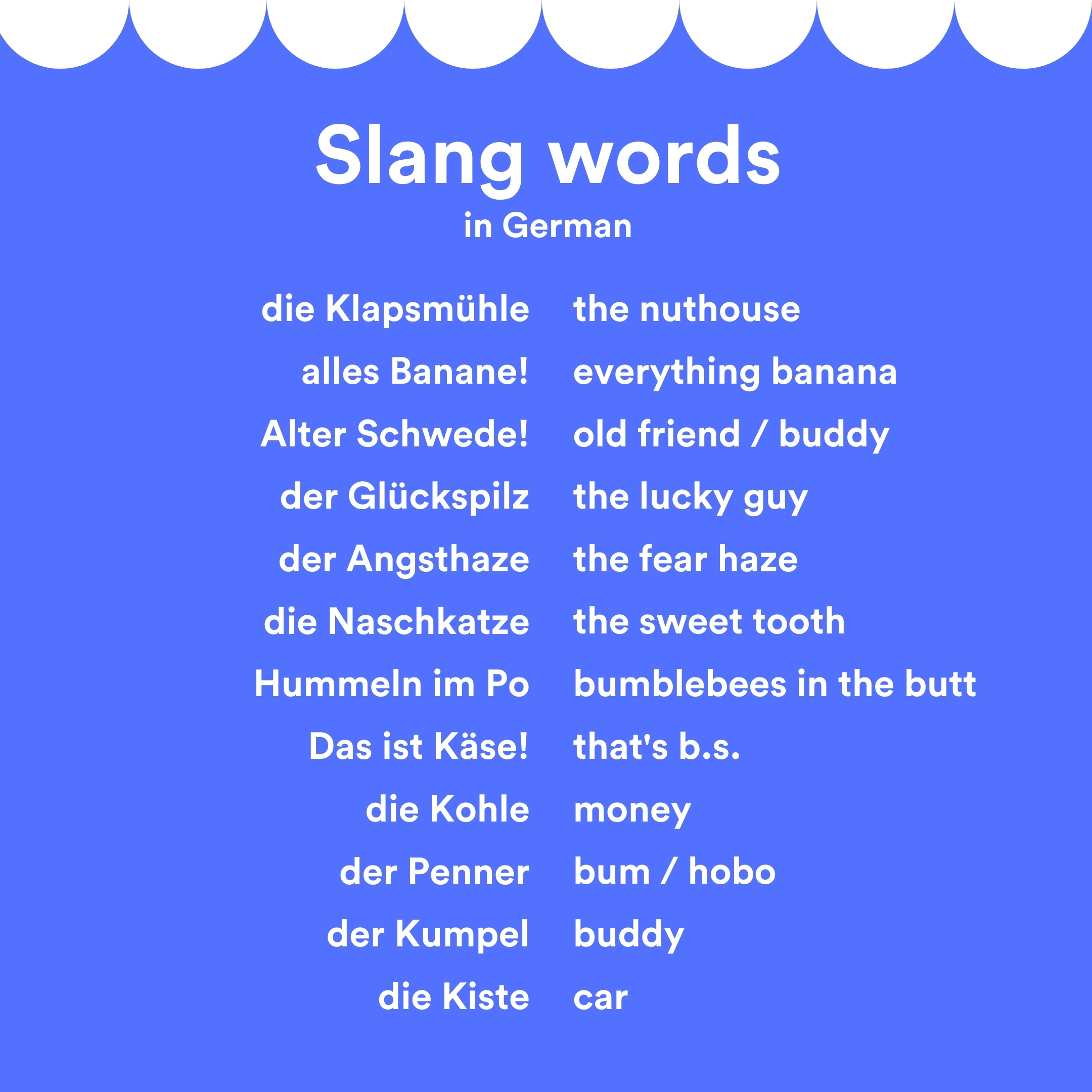
🎁 Bonus words in the picture 👇🏻
💥 Let's work on pronunciation? German tongue twisters🤯
1. Blase blubbernd in Seifenbruhe — bilde bunte Seifenblasen!
2. Brauchbare Bierbrauerburschen brauen brausendes Braunbier.
3. Wenn der Benz bremst, brennt das Benz-Bremmslicht.
4. Plättbrett bleibt Plättbrett.
5. Die Bürsten mit schwarzen Borsten bürsten besser, als die Bürsten mit schwarzen Borsten.
6. Bürsten mit harten Borsten bürsten besonders sauber.
7. Weiße Borsten bürsten besser als schwarze Borsten bursten.
8. Blaukraut bleibt Blaukraut und Brautkleid bleibt Brautkleid. Brautkleid bleibt Brautkleid und Blaukraut bleibt Blaukraut.
9. Wenn der Benz bremst, brennt das Benz-Bremmslicht.
10. Auch freche Fechter fechten mitternachts nicht.
11. Peter pappt das Pappplakat, das Pappplakat pappt Peter.
12. Wachs wächst nicht auf Wachsbäumen.
13. Kasperle kaspert kindisch in kleinen Kastenkapseln.
14. Warmes Wasser wäscht wollende Wäsche wachs weiß, wenn wachsende Wärme Wasser waschwarm werden lässt.
15. Kleine Kinder können keine Kirschkerne knacken.
16. Zwischen zwei Zwetschgenbäumen zwitschern zwei Schwalben.
17. Brautkleid, bleibt Brautkleid. Blaukohl, bleibt Blaukohl.
18. Esel fressen Nesseln nicht- Nesseln fressen Esel nicht.
19. Frau von Hagen,
darf ich’s wagen Sie zu fragen,
wieviel Kragen Sie getragen,
als sie lagen krank am Magen,
im Spital zu Kopenhagen?
20. Was Esel gern afu Wege legen,
fegen Kehrer weg mit Besen.
Feger kehren weg mit Besen,
was Esel gern auf Wege legen.
😉 So how did it go?
🌠🌙 Useful phrases and expressions with the word "Nacht"
die Nacht (die Nächte) - night(s)
bei Nacht = in der Nacht - at night
über Nacht bleiben - to stay overnight
mitten in der Nacht - in the middle of the night
gute Nacht! - Good night!
eines Nachts - one night
eine durchwachte Nacht - a sleepless night
im Dunkel der Nacht - in the gloom of the night
es wird Nacht - the night is falling
es ist Nacht geworden - the night has come
heute Nacht habe ich von dir geträumt - I dreamt of you tonight
bei Nacht und Nebel - in the darkness of the night, in the late hour; under cover of darkness; secretly
durch Nacht und Graus, through the darkness, through the terrors
die Nacht über - at night, during the night, all night
er kommt vor der Nacht nicht heim - he won't come home before night
eine finstere dunkle Nacht - a dark dark night
den Tag zur Nacht und die Nacht zum Tag machen - to turn day into night and night into day, to sleep by day and work by night
nachts - at night
nachts sind alle Katzen grau - all cats are gray at night
je dunkler die Nacht, je schöner der Tag ≈ the darker the night, the brighter the stars
✅ What other interesting expressions do you know?
😨📱What does it mean: "ivd! bb" or learning to read a German text message
You can be great at German, but not understand a basic five-word or even five-letter text message.
🚀Let's go, basic German abbreviations in SMS:
MfG - Mit freundlichen Grüßen (at the end of the official message)
LG - Liebe Grüße (at the end of a private message)
G+K - Grüß und Kuss - Hugs and kisses
www - Wir werden warten - We are waiting for you.
bb - bis bald! - See you soon!
bbb - bis bald, baby! - See you soon, baby!
NEWS - Nur ein wenig sauer. - I am not happy (a little bit angry).
ivd! - ich vermisse dich! - I miss you!
WaMaDuHeu? - was machst du heute? - What are you doing today?
KV - kannste vergessen - Forget it.
sTn - schönen Tag noch - Have a nice day
hdl - hab dich lieb - love ya
gn8 - Gute Nacht - Good night
akla - Alles klar? - Is everything clear?
bd - brauche dich - I need you
braduhi? - Brauchst du Hilfe? - Do you need help?
BSE - Bin so einsam - I am so lonely
DaD - Denk an dich - Thinking of you
DaM - Denk an mich - Remember me
DN! - Du nervst! - You make me nervous!
dubido - Du bist doof - (You) idiot!
DuBiMeiLe - Du bist mein Leben - You are my life.
HAHU - Habe Hunger
HASE - Habe Sehnsucht
Q6 - Komme um sechs Uhr - I'll be there at 6 o'clock
ko20mispa - komme 20 Minuten später - I will come 20 min later
ZDOM? - Zu dir oder zu mir? - Your place or mine?
MaMiMa - Mail mir mal - Write me a letter
RUMIAN - Ruf mich an - Call me
JoN - Jetzt oder nie - Now or never
🇩🇪 Do you shorten your text messages?
👍1
🇩🇪💡German proverbs and their translations
Was du heute kannst besorgen, das verschiebe nicht auf morgen. - Don't put off until tomorrow what you can do today.
Alles zu seiner Zeit. - All things have their time.
Die Zeit heilt alle Wunden. - Time is the best healer.
Ohne Fleiß kein Preis. - You won't catch fish out of the pond without hard work. (Without effort there is no reward.)
Jeder hat sein Päckchen zu tragen. - Each one has his own concerns.
Reden ist Silber, Schweigen ist Gold. - A word is silver, silence is gold.
Die Katze lässt das Mausen nicht. - All you feed a wolf, he still looks into the woods.
Das Ei will klüger sein als die Henne. - The eggs do not teach the hen. (The egg wants to be smarter than the hen.)
Viele Köpfe, viele Sinne. - There are as many heads as there are minds.
Durch Schaden wird man klug. - Mistakes are learned from.
Man lernt nie aus! - You learn for a long time!
Eine Schwalbe macht noch keinen Sommer. - One swallow does not make a summer.
Es ist noch kein Meister vom Himmel gefallen. - No master has yet fallen from the sky.
Lieber ein Ende mit Schrecken als ein Schrecken ohne Ende. - Better a terrible end than a horror without an end.
Wer andern eine Grube gräbt, fällt selbst hinein. - Do not dig a hole for others, you will fall into it yourself.
Man muss die Menschen nehmen, wie sie sind. - You have to take people as they are.
Man soll nie die Bärenhaut verkaufen, bevor man den Bären erlegt hat. - You should never sell the bear skin before you have killed the bear.
Liebe macht blind. - Love is blind.
Ende gut, alles gut. - Ende gut, alles gut. - All's well that ends well.
Morgenstunde hat Gold im Munde. - The early hour has gold in its mouth.
Hochmut kommt vor dem Fall. - Arrogance comes before the fall.
In einer rauher Schale steckt oft ein guter (süßer) Kern. - Beneath the rough rind is often a sweet fruit. / The tree is crooked, but the apples are sweet.
👍1
🤨 Happiness is happiness?
🇩🇪The word das Glück means happiness, luck and fortune in German & it has no plural.
🔥 Here're 20 useful expressions with the word das Glück. Let's go!
Viel Glück! - wish you luck!
sein Glück herausfordern- to try your luck
zum Glück - luckily
auf gut Glück - on good luck
sein Glück machen - make his fortune
sein Glück versäumen - to squander one's good fortune
Reichtum macht das Glück nicht aus - money is not happiness
sein Glück versuchen - to try one's luck
(j-m) Glück wünschen - to wish (someone) happiness, congratulate (someone)
in Glück und Unglück zusammenhalten - to share joy and sorrow.
damit hast du bei mir kein Glück - you won't get anything out of me
vom Glück begünstigt sein - to be a darling of fortune
ein Kind des Glücks sein - to be a spoilt for fortune
das Glück hat ihn verlassen - luck has left him
er hat Glück - he is lucky
er hat kein Glück - he has no luck
du hast Glück gehabt, dass... - you are lucky that...
er hat mehr Glück als Verstand - fools are lucky
jeder ist seines Glückes Schmied - everyone is an artisan of his own luck
Glück bringen - to bring happiness / luck