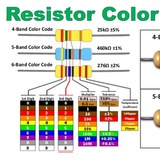
Resistors
The very first component that you should know about is the resistor. It is fairly easy to assume that a resistor, as the name suggests, will resist electricity that flows through it, and you would be correct in that assumption too! Any situation that demands the flow of current to be controlled at a desired level will require a resistor.
Here are two scenarios that better explain what a resistor does. In both cases, we will be turning on a LED:
Scenario 1 – Without Resistor
1. You have power supply on one side.
2. You connect the LED on the other end.
3. The full force of the electricity hits the bulb.
4. This overloads the LED, eventually burning it out completely.
Scenario 2 – With Resistor
1. You have power supply on one side.
2. You connect this to a resistor.
3. The resistor in turn connects to the LED bulb.
4. Electricity flows through the resistor and into the bulb.
5. You can control the amount of electricity that needs to flow to the bulb. As a result, the LED won’t be overloaded
👍19❤9
Common Electrical Engineering Formulas:
1. Ohm's Law: V = I * R
- V: Voltage (in volts)
- I: Current (in amperes)
- R: Resistance (in ohms)
2. Power in a DC Circuit: P = V * I
- P: Power (in watts)
- V: Voltage (in volts)
- I: Current (in amperes)
3. Power in an AC Circuit: P = V * I * cos(θ)
- P: Power (in watts)
- V: Voltage (in volts)
- I: Current (in amperes)
- θ: Phase angle between voltage and current
4. Capacitance: C = Q / V
- C: Capacitance (in farads)
- Q: Electric charge (in coulombs)
- V: Voltage (in volts)
5. Inductance: L = Φ / I
- L: Inductance (in henries)
- Φ: Magnetic flux (in webers)
- I: Current (in amperes)
6. Impedance of a Resistor: Z = R
- Z: Impedance (in ohms)
- R: Resistance (in ohms)
7. Impedance of a Capacitor: Z = 1 / (jωC)
- Z: Impedance (in ohms)
- j: Imaginary unit (√-1)
- ω: Angular frequency (in radians per second)
- C: Capacitance (in farads)
8. Impedance of an Inductor: Z = jωL
- Z: Impedance (in ohms)
- j: Imaginary unit (√-1)
- ω: Angular frequency (in radians per second)
- L: Inductance (in henries)
9. Kirchhoff's Voltage Law (KVL): Σ(Voltage drops) = Σ(Voltage sources)
- The sum of voltage drops across components in a closed loop is equal to the sum of the voltage sources in that loop.
10. Kirchhoff's Current Law (KCL): Σ(Currents entering a node) = Σ(Currents leaving a node)
- The sum of currents entering a node is equal to the sum of currents leaving that node.
👍57❤24👏2🤔1