AB Switch = Air Break switch
ACB = Air Circuit Breaker
VCB = Vacuum Circuit Breaker
MCB = Miniature Circuit Breaker
MCCB = Molded case circuit breaker
MPCB = Motor Protection Circuit Breaker
EMPR = Electronic Motor Protection RELAY
RCCB = Residual Current Circuit Breaker
RCBO = Residual Current Circuit Breaker With Over-Current Protection
ELCB = Earth Leakage Circuit Breaker
HRC = Fuse High Rupture Capacity Fuse
OLTC = On Load Tap Change
SF6 Circuit Breaker = Sulphur Hexafluoride Circuit Breaker
MPDB = Main Power Distribution Board
ACDB = Alternating Current Distribution Board
HT = High tension > Transformer HT Side
LT = Low tension
DO Fuse = Drop Out Fuse
DCDB = Direct current Distribution Board
PDB = Power Distribution Board
PCC = Power Control Center
MCC = Motor Control Centre
MCP = Motor Control Panel
VVVF = Variable Voltage Variable Frequency Drive
VFD = Variable Frequency Drive
DOL = Direct On line
RDOL = Reverse Duty on Line
MLDB = Main Light Distribution Board
SLDB = Secondary Lighting Distribution Board
EMLDB = Emergency Light Distribution Board
CPSS = Construction Power Substation
DSS = Distributed Power Substation
RCC = Remote Control Cables
FCMA = Flux Compensated Magnetic Amplifier
UPS = Un-Interrupted Power Supply
SMF Battery = Sealed Maintenance Free
JB = Junction Box
PB = Push Button
TB = Terminal Box
LCB = Local Control Board
LCS = Local Control Station
SPNDB = Short Circuit Protection Neutral Distribution Board
TPNDB = Phase Three and Neutral Distribution Board
CT = Current Transformer
PT = Potential Converter
SCIM = Squirrel Cage Induction Motor
ACVS = Air-conditioning and Ventilation System
FDA = Fire Detection & Alarm
PCS = Pull Cord Switch
ZSS = Zero Speed Switch
BSS = Belt Sway switch
NO = Normally opened
NC = Normally Closed
TEFC = Total Enclosed Fan Cooled
TESC = Totally Enclosed Surface Cooled
GI Bus bar = Galvanized Iron Bus Bar For Farthing
PLC = Programmable Logic Controller
DCS = Distributed Control System
MPI = Multi Point Interface
DP = Distributed parameters
SCADA = Supervisory and Data Acquisition
HART = Highway Addressable Remote Transducer
HMI = Human Machine Identifier
MMI = Man Machine Identifier
VDU = Visual Display Unit
RIO = Remote input Output
TCP / IP = Transmission Control Protocol – Internet Protocol
CFC =Continuous Function Chart
SFC = Sequential Function Chart
PID Control = Proportional Integral And Derivative Control
RAM = Random Access Memory
ROM = Read Only Memory
PROM = Programmable Read Only Memory
EPROM = Erasable Programmable Read Only Memory
EEPROM = Electrically Erasable Programmable Read Only Memory
😍😍🙏👍👍👍
👍40❤9🤔3👏1
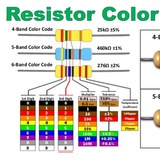
Resistors
The very first component that you should know about is the resistor. It is fairly easy to assume that a resistor, as the name suggests, will resist electricity that flows through it, and you would be correct in that assumption too! Any situation that demands the flow of current to be controlled at a desired level will require a resistor.
Here are two scenarios that better explain what a resistor does. In both cases, we will be turning on a LED:
Scenario 1 – Without Resistor
1. You have power supply on one side.
2. You connect the LED on the other end.
3. The full force of the electricity hits the bulb.
4. This overloads the LED, eventually burning it out completely.
Scenario 2 – With Resistor
1. You have power supply on one side.
2. You connect this to a resistor.
3. The resistor in turn connects to the LED bulb.
4. Electricity flows through the resistor and into the bulb.
5. You can control the amount of electricity that needs to flow to the bulb. As a result, the LED won’t be overloaded
👍19❤9
Common Electrical Engineering Formulas:
1. Ohm's Law: V = I * R
- V: Voltage (in volts)
- I: Current (in amperes)
- R: Resistance (in ohms)
2. Power in a DC Circuit: P = V * I
- P: Power (in watts)
- V: Voltage (in volts)
- I: Current (in amperes)
3. Power in an AC Circuit: P = V * I * cos(θ)
- P: Power (in watts)
- V: Voltage (in volts)
- I: Current (in amperes)
- θ: Phase angle between voltage and current
4. Capacitance: C = Q / V
- C: Capacitance (in farads)
- Q: Electric charge (in coulombs)
- V: Voltage (in volts)
5. Inductance: L = Φ / I
- L: Inductance (in henries)
- Φ: Magnetic flux (in webers)
- I: Current (in amperes)
6. Impedance of a Resistor: Z = R
- Z: Impedance (in ohms)
- R: Resistance (in ohms)
7. Impedance of a Capacitor: Z = 1 / (jωC)
- Z: Impedance (in ohms)
- j: Imaginary unit (√-1)
- ω: Angular frequency (in radians per second)
- C: Capacitance (in farads)
8. Impedance of an Inductor: Z = jωL
- Z: Impedance (in ohms)
- j: Imaginary unit (√-1)
- ω: Angular frequency (in radians per second)
- L: Inductance (in henries)
9. Kirchhoff's Voltage Law (KVL): Σ(Voltage drops) = Σ(Voltage sources)
- The sum of voltage drops across components in a closed loop is equal to the sum of the voltage sources in that loop.
10. Kirchhoff's Current Law (KCL): Σ(Currents entering a node) = Σ(Currents leaving a node)
- The sum of currents entering a node is equal to the sum of currents leaving that node.
👍57❤24👏2🤔1