
'Big News In Global Crypto Policy' As FATF Kicks The Can Towards October
Less than half of the countries who adhere to Financial Action Task Force (FATF) anti-money laundering and countering the financing of terrorism standards have implemented the body’s crypto sector policing protocols – but the body does not yet seem overly concerned and aims to look into this in more detail in October 2021.
The FATF completed its latest plenary session today and remarked in an official release that it had completed its second 12-month review of the implementation of its revised standards on virtual assets and virtual asset service providers (VASPs), such as crypto exchanges.
The report’s authors concluded that “many jurisdictions have continued to make progress in implementing these revisions,” which were introduced back in 2019. The FATF said that 58 out of 128 reporting jurisdictions self-reported the implementation of the revised FATF standards – although this number included six nations that have completely banned crypto exchanges from operating on their territories.
The private sector, it added, has “made progress in developing technological solutions to enable the implementation of the much-maligned Travel Rule.
But the body conceded:
“The majority of jurisdictions have not yet implemented the FATF’s requirements. This disincentivizes further investment in the necessary technology solutions and compliance infrastructure.”
And it claimed that these “gaps in implementation” meant that the world was still a long way from introducing “global safeguards to prevent the misuse of VASPs for money laundering or terrorist financing.”
The body concluded:
“The lack of regulation or implementation of regulation in jurisdictions can enable continued misuse of virtual assets through jurisdictional arbitrage.”
In a press conference, the FATF President Marcus Pleyer appeared relatively unconcerned – and suggested that the next plenary session, slated for October 2021, would deal with the matter in more detail.
Pleyer was speaking after revealing that Malta – a base for some crypto-related firms – had been placed on the FATF grey list. The latter is a list of nations that the FATF claims should be placed under “increased monitoring” measures. Grey-listed countries are instructed to proactively work with the FATF “to address strategic deficiencies in their regimes to counter money laundering, terrorist financing and proliferation financing.”
Malta, which was placed on the list along with Tahiti, the Philippines, South Sudan, is home to a “large number of serious issues,” the FATF head said, including “money laundering issues,” “anonymous shell companies,” and links to “serious organized crime.”
A journalist asked Pleyer if the decision to place Malta on the list had anything to do with crypto regulation (or lack thereof). But the FATF chief answered in the negative, instead stating that the October plenary would deal with crypto policing in more detail.
He stated that the FATF was “now helping countries and the private sector to implement” the standards it issued in 2019 and would “issuance guidance in October” – confirming that crypto policing-related issues were “not an issue” for Malta at this stage.
In the crypto industry, many welcomed the news, pointing out that the “volume of feedback” the FATF had received on consultation papers had forced the body to essentially kick the can down the road.

While the crypto market is sagging these days, it's time to find new method of earning money.
If you want to know big profit coin signal early then don't forget to join LikeThatCoin channel🚀
- I recommend you to follow this channel !
- The signals have 95% accuracy
- They are limited to members
- This link is only open for 24 hours
👇👇👇
https://t.me/likethatcoin
If you want to know big profit coin signal early then don't forget to join LikeThatCoin channel🚀
- I recommend you to follow this channel !
- The signals have 95% accuracy
- They are limited to members
- This link is only open for 24 hours
👇👇👇
https://t.me/likethatcoin
Telegram
LikeThatCoin
💎 LikeThatCoin Signal Group 💎
Our crypto signals earn 2 to 15x profit. 💵💵💵💵💵 2 Signals per month. Always free, no premium. Follow our signals for massive gains. 💪👀
Official Website:
www.likethatcoin.com
Our crypto signals earn 2 to 15x profit. 💵💵💵💵💵 2 Signals per month. Always free, no premium. Follow our signals for massive gains. 💪👀
Official Website:
www.likethatcoin.com
Bitcoin and Ethereum Can Coexist With DeFi Bridging the Two
While some of the most active members of Bitcoin (BTC) and Ethereum (ETH) communities never stop fighting over technology and money, among other things (including memes), these both blockchain-powered networks still can coexist, according to the Bitcoin 2021 conference participants speaking to Cryptonews.com. And decentralized finance (DeFi) might play a role here.
The conference, held earlier this month in Miami, USA, proved to be a major event, with thousands of people attending, as well as a number of well-known speakers from both within and outside the Cryptosphere.
Among the questions discussed between a few of the industry insiders and Cryptonews.com was that of the Bitcoin-Ethereum turbulent dynamics.
But the two are not necessarily as intertwined as some may think – rather, they exist parallel to each other.
"Comparing ETH and BTC directly is like comparing apples to oranges," according to Zeeshan Feroz, Chief Growth Officer at crypto payments company MoonPay.
In the opinion of Matthew Gundrum, the marketing director for cryptocurrency payroll service Bitwage, “people don't realize that ETH and BTC are trying to do two separate things and, therefore, can coexist.”
Both of these networks have seen a “dramatic adoption” in 2021 so far, which “will show no slowing in the next decade,” despite occasional hiccups along the way, he said.
Meanwhile, William Zielke, Chief Marketing Officer at crypto payments provider BitPay, said that while BTC remains the most popular crypto used by their consumers for purchases, representing almost 72%, ETH has grown to almost 10%.
“Both have strong perceptions as fast, secure, and modern digital assets. And, both work very well as a payment option,” said Zielke, who also noted that “unfortunately, both have high fees during peak periods.”
Also, bitcoin has certainly been receiving more institutional interest as of late, while interest in ETH is also growing.
MicroStrategy, for example, adopted BTC as their primary treasury reserve because “Bitcoin’s technical characteristics make it an ideal, diversified corporate treasury holding,” according to David Shafrir, co-founder and President of GDA Capital, the capital markets arm of the GDA Group of Companies.
"In the medium term, I think BTC will continue to grow as a treasury asset and solidify its position as the most widely used cryptocurrency. ETH on the other hand, I think, will grow into its boots in the medium term. Use-cases for ETH will continue to expand, driven by the NFT market for one," Feroz added.
And DeFi is changing the game also.
“More recently, institutional investors are increasingly gravitating towards Ethereum, primarily to participate in DeFi applications, such as “yield farming,” and a few whale institutional wallets are now dominating the capital pools of many of these platforms,” Shafrir said.
DeFi leverages smart contracts automatically executing code residing on blockchains, mostly Ethereum. So, while individual wallet metrics continue to improve, new money continues to enter the DeFi market from funds, trading firms, and centralized yield platforms “that are providing the bulk of the liquidity.”
New applications are constantly being built on Ethereum, resulting in traditional financial markets becoming “far more sophisticated in their understanding of the potential of cryptocurrencies as an asset class,” Shafrir said, adding that one only needs to look at the number of bridges being built to Ethereum from other blockchain platforms, such as Corda.

Bitcoin and Ethereum Correct Gains, ETC Keeps Rallying
☄️Bitcoin price tested USD 36,500 and started a downside correction.
☄️Ethereum also corrected lower from USD 2,250, XRP rallied above USD 0.70 before trimming gains.
☄️ETC rallied almost 29%, and BTG gained nearly 17%.
Bitcoin price followed a bullish path above the USD 35,000 resistance zone. BTC even broke USD 36,000 and spiked above USD 36,500. It is currently (04:36 UTC) correcting gains, but the bulls might remain active near USD 35,000.
Besides, most major altcoins are trading above key support. ETH extended its rally above USD 2,200 before the bears appeared near USD 2,250. XRP/USD rallied above USD 0.70 and USD 0.72 before correcting gains.
Bitcoin price
There was a steady increase in bitcoin price above the USD 35,000 resistance zone. BTC even broke USD 36,000, but it struggled to gain strength above USD 36,500. As a result, there was a downside correction below USD 36,000. On the downside, the previous resistance near USD 35,000 might provide support. The next major support is now forming near the USD 34,200 zone.
An initial resistance is near the USD 36,000 zone. The first major resistance is near USD 36,500, above which the price might rise towards the USD 38,000 level.
Ethereum price
Ethereum price outperformed bitcoin and it climbed above USD 2,150. It even climbed above USD 2,200 and tested the USD 2,250 hurdle. The price is now correcting gains and trading below USD 2,150. An initial support is near the USD 2,100 level, below which the price might test USD 2,050.
If there is a fresh increase, the price might face resistance near USD 2,200. The main resistance is now forming near the USD 2,250 level.
BNB, LTC, DOGE, and XRP price
Binance Coin (BNB) climbed higher above the USD 300 resistance. BNB tested USD 315 and it is now correcting gains. An immediate support is near USD 292, but the key breakdown support sits at USD 280. On the upside, the price could gain bullish momentum if there is a daily close above the USD 300 level.
Litecoin (LTC) extended its upward move above the USD 142 resistance. However, the bulls struggled near the USD 150 resistance. It is now correcting gains and trading near USD 142. If there are more losses, the price might test the USD 135 support zone in the near term.
Dogecoin (DOGE) climbed further above the USD 0.265 resistance. It tested USD 0.275 before trimming gains. DOGE is now consolidating near the USD 0.250 support. If there are more losses, the bears might test the USD 0.220 support.
XRP price extended its rally above the USD 0.700 level. The price even spiked above USD 0.720 before the bears appeared near USD 0.735. XRP is now trading below USD 0.700, but the bulls might remain active near the USD 0.650 support zone.
Other altcoins market today
Many altcoins gained over 8%, including ETC, BTG, QTUM, ZEN, DCR, ZEC, FIL, VET, EGLD, SHIB, WAVES, OMG, and TEL. Out of these, ETC rallied by 29%, almost touching USD 62, before correcting lower. As reported, the Ethereum Classic network will undergo a hard fork to implement the Magneto upgrade, scheduled for late July, the team announced. The upgrade will include Ethereum Berlin upgrade features, and therefore certain Ethereum Improvement Proposals that will tackle the network’s security and gas fees.
Overall, bitcoin price is correcting gains from the USD 36,500 resistance. As long as BTC is stable above USD 35,000 and USD 34,000, there are chances of a fresh increase.
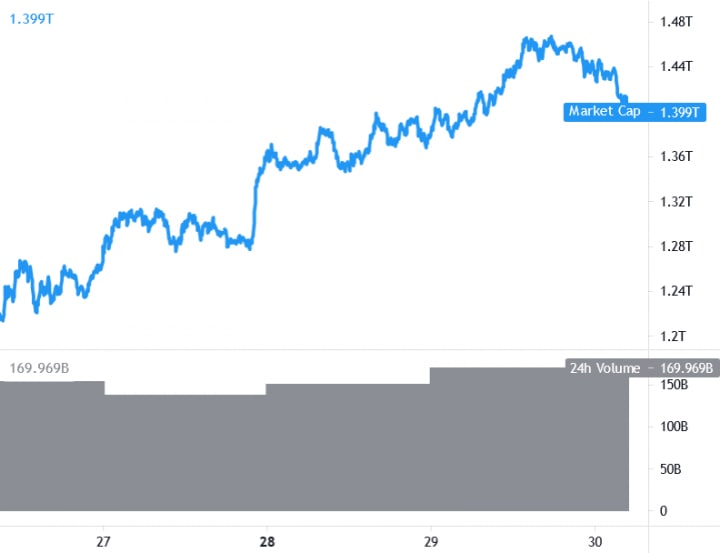
Total market capitalization:
South Korea’s 4 Biggest Crypto Exchanges to Adopt FATF’s Travel Rule
The “big four” South Korean crypto exchanges have signed a Memorandum of Understanding (MOU) deal that will see them jointly implement the Financial Action Task Force (FATF)’s Travel Rule.
The group of exchanges, which comprises the market-leading Upbit and Bithumb, as well as Korbit and Coinbit, are all thought to be on course to beat a September 24 deadline to obtain regulatory approval from the Financial Services Commission (FSC), which will conduct spot-checks of trading platforms in the coming weeks.
The Travel Rule essentially means that crypto trading platforms must share transaction identifying information with one another, and with financial institutions and obliged entities – and must be able to guarantee the accuracy of the data they share with one other. Data such as national security or identity numbers must be shared, along with customers’ and recipients’ real names, in a measure designed to remove anonymity and reduce the risk of money laundering.
The four exchanges, per KBS, will look to launch their Travel Rule compliance solutions before the year is out.
“This is just another example of the big four’s exceptionalism,” a senior official at a rival trading platform told Cryptonews.com. The official, who asked not to be named and for the name of their exchange to be withheld, added:
“They are trying to show that they are going above and beyond in order to impress the FSC.”
Meanwhile, regulators are also busy, and have vowed to “crack down” on “fake accounts” at crypto exchanges. A number of (mainly smaller) South Korean exchanges allow customers to use so-called “hive” or “honeycomb” accounts, designed to obscure or conceal the identity of their users. Seoul has vowed to stamp this out, and has ruled that all crypto traders will have to make use of real name-verified wallets linked to commercial, domestic bank accounts as of September 24.
Per EDaily and Asia Kyungjae, the FSC has briefed financial institutions on the dangers of such accounts, and the steps they could take to stamp them out. The regulator has also built a “risk management system for cryptoasset business operators” that will allow it to “continuously investigate fake accounts” and request that financial sector companies “take countermeasures” when they identify such accounts.
Financial companies will be given the power to suspend transactions they believe are connected to “fake accounts.”
And South Korean banks are also set to examine exchanges’ coin listing policies as part of their risk assessment tests, Yonhap reported. Banks have been told to conduct risk management checks on crypto exchange partners before agreeing six-month real name banking deals.

ETH 'Unlikely' To Become 'Popular Currency' But It Still Can Compete With BTC
Generally speaking, it is highly unlikely that ethereum (ETH) will become a "popular currency," but it still may compete with bitcoin (BTC) in the long run, according to the crypto venture firm Dragonfly Capital.
The firms' General Partner Kevin Hu and Junior Partner Celia Wan wrote in their recent report that as institutional investors are investing in BTC as its store-of-value narrative begins to go mainstream, their understanding of Ethereum and ETH is "convoluted," especially when notions such as decentralized finance (DeFi) and non-fungible tokens (NFTs) are added to the mix.
While an ETH bull may argue that if the Ethereum network becomes ubiquitous and fees stabilize, ETH can become a popular currency, "that is highly unlikely and stablecoins are fundamentally much better at both functions even if Ethereum does become a dominant platform," the author said, adding that "as a medium of exchange and unit of account, ETH is unlikely to succeed."
Even though ETH has five times the market capitalization of ERC-20 stablecoins, their total on-chain volume already exceeds that of ETH (USD 10bn vs USD 8bn a day), with off-chain volumes showing an even larger difference.
However, since it is used as collateral in DeFi, as a non-sovereign store-of-value, ETH may still have a chance at taking some potential market share.
"In the long run, it is conceivable that ETH can even compete with Bitcoin on the dimensions of scarcity, durability, and unforgeability," Hu and Wan noted.
As the reasons behind this statement they give:
EIP-1559 will lead to the stabilization of ETH’s monetary policy and inflation will likely be cut in half;
Ethereum 2.0's security model will eventually be "almost just as battle-tested" as Bitcoin’s, and a proof-of-stake consensus mechanism will likely increase the security guarantees of Ethereum if ETH is sufficiently valuable;
if Ethereum and DeFi become the "financial layer of the future," ETH may remain as one of the major collaterals because it was the first collateral at scale and the DeFi ecosystem was built around it.
All this being said, the authors find it possible for ETH to take 10% of BTC's market share if Ethereum and DeFi continue to grow. If BTC's potential market capitalization is around USD 4.7trn - USD 14.6trn, then ETH’s potential monetary value could be at USD 0.5trn - USD 1.5trn, they said.
Additionally, the Dragonfly Capital partners noted that ETH is set to "become a capital asset in addition to a consumable commodity which should have a profound effect on ETH’s value accretion,"
"Even if other tokens such as stablecoins may replace Ethereum in the future as alternative forms of payments, ETH will still be used by network validators for staking and receiving rewards. Therefore, ETH will likely accrue value from demand like a consumable commodity and cash flows like a capital asset," they said.
Also, the venture capitalists argued that the current DeFi ecosystem on Ethereum has formed a positive feedback loop, where users both bring the liquidity-based network effect to DeFi and benefit from a liquid DeFi market.
"Furthermore, DeFi protocols’ composability and interoperability with each other have created a lock-in effect for Ethereum, making it hard for other Layer 1’s and side-chains to compete," they concluded.
The authors also provided a very rough estimate when it comes to ETH's potential valuation: between USD 3.7trn and USD 4.7trn "in the distant future."
At 16:12 UTC, the market capitalization of ETH stood at USD 247bn. ETH traded at USD 2,119 and was up by almost 1% in a day and 6.5% in a week. At the same time, the market capitalization of BTC was USD 631bn. The cryptocurrency traded at USD 33,661, or by 1% higher than a day ago, trimming its weekly losses to less than 3%.

🎙AMA Announcement
Gimme The Coin will host an AMA Session with Pruf in Gimme The Coin + Pruf chat.
⏱START 3PM UTC 05.07.2021
Prepare your best questions and be ready to participate in time, see you soon.
Please make sure to follow Telegram group @pruftalk.
🌐Website - https://pruf.io
Gimme The Coin will host an AMA Session with Pruf in Gimme The Coin + Pruf chat.
⏱START 3PM UTC 05.07.2021
Prepare your best questions and be ready to participate in time, see you soon.
Please make sure to follow Telegram group @pruftalk.
🌐Website - https://pruf.io
Hope in S Korea as Ruling Party Says ‘Let’s Institutionalize Crypto’
There may be fresh hope for the South Korean crypto sector as the ruling Democratic Party launched a crypto task force – with the new body talking in relatively upbeat terms about the industry and the need to “institutionalize” crypto with potentially groundbreaking legislation.
Despite the regulatory Financial Service Commission (FSC)’s relatively strict and inflexible position on policing the crypto industry – measures that could leave the nation with just four crypto exchanges in September this year – the Democratic Party appears to be having second thoughts.
Earlier this year, senior government ministers began talking about the need to “crack down” on an “overheated” crypto market.
The FSC sparked ire when its Chairman Eun Sang-soo spoke about the need for older, wiser heads to “lead” younger people out of the dangers of crypto investment. Eun’s comments led to a slew of petitions calling for his resignation. And the Democratic Party, which goes to the polls in a general election in spring 2022, has become all too aware that its core support – younger voters – have become increasingly crypto-keen. Some claim that crypto investment is “no longer optional” for the 20-39 age group.
But spiraling real estate prices, a sluggish stock market, and a stagnant, coronavirus pandemic-hit job market have left many railing at the government, accusing it of sidelining and demonizing the crypto sector at a time when all other money-making avenues have been closed off to them.
Opposition politicians have gleefully seized the chance to criticize the government for its policies, with the main opposition party claiming Seoul has “neglected” the crypto industry and investors – and one even claiming that lax security policies have allowed North Korean hackers to raid some USD 310m worth of crypto from South Korean wallets in the past two years.
The Democratic Party has thus apparently responded by creating its own task force – intent on softening the regulator’s stance and proposing progressive legislation.
Per EDaily, as well as News1 and EToday, the task force is comprised of MPs, some of whom worked on South Korea’s first piece of crypto-specific legislation back in 2019.
One of these MPs remarked, at a press conference:
“I know that the Financial Services Commission has a negative view on cryptocurrency, but as the market is growing, the number of participants in the sector is increasing.”
Another claimed that the task force was prepared to “discuss” the issue of delaying the start of crypto taxation rules. The South Korean parliament has already agreed to begin taxing crypto profits at a flat rate of 20% as of January 1 next year. But a private member’s bill is on the table from an opposition MP who wants the measure delayed until 2023. The ruling party’s task force stated that it was ready to assess the value of the bill.
The task force also spoke about introducing a system that would grant crypto-related firms the same kind of business rights that are enjoyed by other companies in the nation. Currently, crypto exchanges and other service providers are legally classified in the lowest rung of enterprises, putting them on a legal par with nightclubs and karaoke venues.

S Korean Regulator to Banks: Stop Grumbling About Crypto Market Risk
A leading South Korean regulatory chief has repeated calls for banks to stop complaining about absorbing crypto exchange-related risks and accept that any partnerships they undertake with trading platforms must be done so at their own peril.
As previously reported, banks in South Korea have stated with increasing certainty that they think only four trading platforms – almost certainly the “big four” of Upbit, Bithumb, Korbit and Coinone will beat a government-imposed September 24 deadline. After this date, all crypto exchanges will need to register with the Financial Services Commission (FSC), adopt anti-money laundering (AML) protocols, obtain data security management accreditation and find banking partners who offer wallet-liked, real-name authenticated fiat on/off ramp accounts if they want to keep operating.
Banks have called on regulators to soften their stance after the FSC said that banks would be made to undertake 100% of the risk involved with taking on an exchange client. That would in effect mean that should an AML violation take place on a partner exchange, the bank would be held accountable, and the same could also be true of a hack or a case of fraud.
Banks claim that exchanges themselves should be made to accept blame, or that another solution should be found – claiming that their overseas business could be placed under threat should AML violations be detected on partner exchanges. Concerns such as these have led to a growing number of major banks simply ruling out the notion of partnering with trading platforms. So far, Woori, KEB Hana, Kookmin and BNK Busan have claimed they will not consider crypto-related business – leaving only Shinhan, NongHyup and K-Bank yet to comment.
The soon-to-be-launched Toss Bank has also been coy on the matter of crypto banking partnerships.
And the FSC chairman Eun Sang-soo has asked banks to stop talking about the matter. After earlier this month stating that “it would be good for banks to stop bringing up this matter,” Eun yesterday doubled down on the sentiment.
KBS quoted Eun as stating:
“If casinos are suspected of money laundering, banks are required to report this matter to the regulatory Financial Intelligence Unit. Banks have all accepted this, so why are they still just talking about crytpoassets?”
Eun added banks should not complain about being burdened with responsibility for exchanges, adding that managing risk was “the job of the banking sector.”
Meanwhile, after the ruling Democratic Party said earlier this week that it was considering a measure that would see a 20% levy on crypto trading profits delayed, a second proposal to delay the tax to 2023 is set to hit the National Assembly.
Another MP – this time a ruling party MP – has launched a private member’s bill in a bid to postpone the introduction of the tax, meaning that traders would be able to continue to operate tax-free until well after the next general election.
Per Newsis, the MP in question, Noh Woong-rae, stated that the move would “ease the burden” on crypto investors and would “support more stable growth in the cryptoasset market,” which he added, “is only in its infancy.”
Another bill, from an opposition MP, has already been put before the house, with the Democratic Party’s new crypto taskforce claiming that it was discussing adding its support to the motion. Consolidating the bill with Noh’s measure could potentially help the party save face – and drive up cross-party support.

In 2021, the World Central Data Bank of the Cryptocurrency Equivalent (WCDBCE) is launching free mining of the new cryptocurrency equivalent. All you have to do is buy EUR AA. Using your EUR AA, you can purchase the equivalent of 100 types of cryptocurrency including, Bitcoin Litecoin, Dogecoin equivalent at a price 50% lower than the exchange price at the time of purchase. Follow the link below to see more information.
link to the site https://cutt.ly/cmWnXP3
link to the site https://cutt.ly/cmWnXP3
Square To Enter Crypto Hardware Market With Bitcoin First Wallet
Twitter CEO Jack Dorsey-led payments company Square confirmed it aims to build a bitcoin (BTC) first hardware wallet "to make bitcoin custody more mainstream."
"We have a lot of questions and issues to reconcile and we’ll start with this product direction: bitcoin first, global distribution, multisig to achieve “assisted-self-custody,” and prioritizing mobile use," Jesse Dorogusker, Hardware Lead at Square, wrote in a Twitter thread today.
The company is now building a dedicated team.
"We’re hiring key roles in hardware, software, security, and business," Dorogusker said, adding that they will "continue to ask and answer questions in the open" when it comes to developing their hardware wallet.
Dorsey revealed that Square is considering making a hadware wallet for BTC on June 4 this year.
"If we do it, we would build it entirely in the open, from software to hardware design, and in collaboration with the community," he said back then.
The CEO also confirmed today that they plan to integrate their wallet with smartphones and the code for the wallet is going to be open source.
Moreover, Dorsey noted that Square is looking into a feature that would allow users to auto-invest in BTC.
The two biggest players in the hardware wallet industry are now Ledger and Trezor.

📢We are now onboarding the Core Token platform on Core Blockchain!
In preparation of the Core Blockchain and the Ping Exchange going live, we are excited to inform you that the pre-sale of CTN will stop at 11 August 2021.
⏱🚀Don't hesitate and take advantage of the opportunity when you can still get CTN for an extremely advantageous price, because after the launch, the forecast is clear "UP ONLY"!
❗️BUY: coretoken.net
🔻Current price of CTN is € 0.07 / $ 0.083 (which is according to many opinions undervalued with a huge potential for a +10x increase due to natural high demand in the Core Ecosystem and third party use case integrations)
Livestreams:
🌐Showcase with the founders
https://youtu.be/Um3hTjSvDPI
🔥Ting and Meeting
https://youtu.be/hcXhv5pcCsU
〽️Ping Exchange
https://youtu.be/W_0CYAFRHEA
💥Read the article: https://medium.com/core-group/a-brief-and-technical-introduction-of-core-token-2dbacddbcc98
✅COMMUNITY👥
INFO: t.me/coregroupcc
CHAT: t.me/coregroupchat
TWITTER: twitter.com/CoreGroupCC
Holding The World To Ransom: Top 5 Online Gangs
Roberto Musotto, Research fellow, Edith Cowan University, Brianna O'Shea, Lecturer, Ethical Hacking and Defense, Edith Cowan University, and Paul Haskell-Dowland, Associate Dean (Computing and Security), Edith Cowan University.
On the internet, nobody knows you’re a dog!
These words from Peter Steiner’s famous cartoon could easily be applied to the recent ransomware attack on Florida-based software supplier Kaseya.
Kaseya provides software services to thousands of clients around the world. It’s estimated between 800 and 1,500 medium to small businesses may be impacted by the attack, with the hackers demanding USD 50m (lower than the previously reported USD 70m) in exchange for restoring access to data being held for ransom.
The global ransomware attack has been labelled the biggest on record. Russian cybercriminal organisation REvil is the alleged culprit.
Despite its notoriety, nobody really knows what REvil is, what it’s capable of or why it does what it does — apart from the immediate benefit of huge sums of money. Also, ransomware attacks often involve vast distributed networks, so it’s not even certain the individuals involved would know each other.
Ransomware attacks are growing exponentially in size and ransom demand — changing the way we operate online. Understanding who these groups are and what they want is critical to take them down.
Here, we list the top five most dangerous criminal organizations currently online. As far as we know, these rogue groups aren’t backed or sponsored by any state.
DarkSide
DarkSide is the group behind the Colonial Pipeline ransom attack in May, which shut down the US Colonial Pipeline’s fuel distribution network, triggering gasoline shortage concerns.
The group seemingly first emerged in August last year. It targets large companies that will suffer from any disruption to their services — a key factor, as they’re then more likely to pay ransom. Such companies are also more likely to have cyber insurance which, for criminals, means easy moneymaking.
DarkSide’s business model is to offer a ransomware service. In other words, it carries out ransomware attacks on behalf of other, hidden perpetrator/s so they can lessen their liability. The executor and perpetrator then share profits.
Groups that offer cybercrime-as-a-service also provide online forum communications to support others who may want to improve their cybercrime skills.
This might involve teaching someone how to combine distributed denial-of-service (DDoS) and ransomware attacks, to put extra pressure on negotiations. The ransomware would prevent a business from working on past and current orders, while a DDoS attack would block any new orders.

Tax Haven Citizenship Loophole for US Crypto Folk May Not Stay Open for Long
A Russian ex-pro sailor has been touting a tax haven investment program for American crypto traders who are looking for legal loopholes to help them escape paying capital gains tax on their profits. But the program could have a shelf life if global regulators succeed with plans to come down harder on tax havens.
The program is named Plan B Passport, and is fronted by a Russian expat who lives in America, the former professional sailor Katie Ananina (26). The company’s system works thusly: American bitcoin (BTC) and altcoin traders pay into investment projects in one of seven tax haven countries that all waive crypto capital gains levies for investors.
Explaining the project in an interview with CNBC, Ananina said that paying to fund business ventures, buy up real estate, buying government bonds, or just making a direct donation to state coffers could be enough to see some nations reciprocate with a passport, allowing Americans to slip through the crypto capital gains tax net.
This all comes at a heft financial cost, though. Ananina claimed that the cost of obtaining a passport was typically between USD 100,000 and USD 150,000, although there are some extras to bolt on to that – plus her own cut.
“It’s basically a donation into the sustainable growth fund of the country. So, clients make a USD 100,000-150,000 donation, plus some due diligence fees, government fees and then USD 20,000 for my legal fees,” she told the network.
The nations in question are Portugal, Saint Kitts and Nevis, Antigua and Barbuda, Dominica, Vanuatu, Grenada, and Saint Lucia.
The former Russian national sailing team member explained her own motivation for developing the project, stating:
“If the government starts affecting me, I will take all of my crypto and go elsewhere. I was smart enough to figure out that USD 200 worth of bitcoin would be worth USD 100,000 at some point. I don’t think the government should have 40% of that.”
Tax haven nations have come under increasing scrutiny from global regulators in recent months, however – suggesting that there is at least a chance that Ananina’s solution proves to be a temporary fix.
This month, the G20 has signaled its willingness to join forces in an effort to stop multinational companies using tax havens to avoid paying hefty tax bills of their own, reported the Guardian. Although the G20 nations have signed an agreement, it is thus far short on details. That could change later this year, with the G20 determined to follow up with concrete measures.
And per the Economic Times, initiatives like these are already having some limited effect, with many major financial advisors now dissuading their clients from investing in nations that are flagged as tax havens on international lists.
And there are indications that some nations are keen to escape international tax haven listings. Malta was recently placed on the Financial Action Task Force (FATF)’s grey list. The country has drafted in regulators to help work with the FATF on ways to escape the list, reported The Times of Malta. A dwindling number of nations apparently seem to be happy to accept the kind of sanctions often imposed on tax havens by the United States and its intentional community allies.

✔️ Looking for 100x returns on your stake? SWAPP Staking Pool 3 is now live. Stake over 5 years to get crazy APYs. Scrape interest every epoch!
✔️ Swapp is democratizing the data industry, putting the power over consumer data where it belongs: In the hands of each individual consumer. Powering this newly decentralized data industry is our blockchain-driven infrastructure which is open to users ranging in size from individual consumers up to institutional players. Listed on CoinMarketCap Today! ✔️
🔥 STAKE YOUR TOKENS FOR CRAZY APYS 🔥
✅ SWAPP Staking Pools: https://dapp.swapp.ee/?w=0xde121Cc755c1D1786Dd46FfF7e373e9372FD79D8
📊 Holders: 3220+
🛡 AUDITED by RD Auditors and ChainConsulting 4x
🦎 Listed in CoinGecko & LiveCoinWatch, CoinMarketCap
💡 Our links: 💡
WEBSITE -> https://swapp.ee
TWITTER -> https://twitter.com/SwappFi
TELEGRAM -> https://t.me/SwappToken
🚀 BUY IT NOW 🚀
[UNISWAP] -> https://v2.info.uniswap.org/token/0x8cb924583681cbfe487a62140a994a49f833c244
ETHERSCAN -> https://etherscan.io/token/0x8cb924583681cbfe487a62140a994a49f833c244
CoinGecko -> https://www.coingecko.com/en/coins/swapp
CoinMarketCap -> https://coinmarketcap.com/currencies/swapp-protocol/
X (formerly Twitter)
Swapp Protocol ® (@SwappFi) on X
OFFICIAL SWAPP PROTOCOL TWITTER / Available on #eth #bsc #cronos / Data Monetization & Privacy w/ SwappID https://t.co/9lPt3LWKp1
China Releases e-CNY Whitepaper, Says Cryptos Have No Value & Pose Risks
The central People’s Bank of China (PBoC) released a digital yuan, e-CNY, whitepaper, in order to "explain the background, objectives, and visions" and to "seek public comments."
At the same time, the central bank once again criticized decentralized cryptoassets, such as bitcoin (BTC), claiming that they don't have intrinsic value, are volatile, and require "huge energy consumption."
"They can hardly serve as currencies used in daily economic activities," the PBoC said, adding that cryptoassets are mostly speculative instruments and pose a potential risk to financial security and social stability.
The bank also stressed that "global stablecoins" "will bring risks and challenges to the international monetary system."
Meanwhile, per the PBoC, during an e-CNY pilot, as of June 30, the token has been applied in over 1.3m scenarios, covering utility payment, catering service, transportation, shopping, and government services.
"More than 20.87m personal wallets and over 3.51m corporate wallets had been opened, with transaction volume totaling 70.75m and transaction value approximating RMB 34.5bn USD 5.3bn," the bank said. It also revealed that smart contracts were used to make the e-CNY programmable.
The PBoC defined e-CNY as the digital version of fiat currency issued by this bank – “a value-based, quasi-account-based and account-based hybrid payment instrument, with legal tender status and loosely-coupled account linkage.”
E-CNY’s features are given as follows:
it is the fiat currency issued by the central bank, same as the physical form of RMB, and is China’s legal tender;
it is mainly a substitute for cash in circulation, and will coexist with physical RMB; as long as there is demand for the physical RMB, the PBoC will neither stop supplying it nor replace it via administrative order;
it adopts a centralized management model and a two-tier operational system: the right to issue e-CNY belongs to the state, with the PBoC being at the center of the e-CNY operational system, but the authorized operators and other commercial institutions exchange and circulate e-CNY to the public;
it is a retail CBDC, issued to the public, and it mainly serves domestic retail payment demands;
in the future digital retail payment system, e-CNY and funds in the electronic account of authorized operators are inter-operable, and both constitute cash in circulation.
E-CNY carries and pays no interest, and payments through e-CNY wallets are settled upon payment. Furthermore, e-CNY does not charge authorized operators for exchange and circulation services, and the operators do not charge individual clients for the exchange of e-CNY either.
It also follows the principle of “anonymity for small value and traceable for high value.” The bank claims that the system collects less transaction information than traditional electronic payment, and that it does not provide information to third parties or other government agencies “unless stipulated otherwise in laws and regulations.”
The bank said it will explore pilot cross-border payment programs and “will work with relevant central banks and monetary authorities to set up exchange arrangements and regulatory cooperation mechanisms on digital fiat currency in line with the principle of “no detriment,” “compliance,” and "interconnectivity"."

BlockFi Runs into ‘Security’-related Regulatory Problems in New Jersey
Regulators appear set to continue ramping up their scrutiny of the crypto industry – with BlockFi, the major American crypto lending business, served with a cease and desist order by the Attorney General (AG) of New Jersey.
The AG is reportedly set to accuse BlockFi of breaking state securities laws. Per Forbes, which claimed to have obtained a copy of a draft press release from the AG’s offices, the Acting Attorney General Andrew Bruck was quoted as stating:
“Our rules are simple. If you sell securities in New Jersey, you need to comply with New Jersey’s securities laws. No one gets a free pass simply because they’re operating in the fast-evolving cryptocurrency market. Our Bureau of Securities will be monitoring this issue closely as we work to protect investors.”
Zac Prince, the BlockFi founder and CEO, was initially quoted as responding:
“The company has no knowledge of any impending actions with the New Jersey Attorney General’s office. We maintain great relationships with the New Jersey regulators and other state and federal regulators.”
But later, via the official BlockFi Twitter account, the firm confirmed that it had “received an order from the New Jersey Bureau of Securities regarding BlockFi Interest Account (BIA) operations in the state of New Jersey.”
BlockFi added that it “has been engaged in an ongoing dialogue with regulators to help them understand our products, which we believe are lawful and appropriate for crypto market participants.”
The firm has conceded, though that the order calls for BlockFi to stop accepting new BIA customers located in New Jersey as of July 22, 2021.
But, it added,
“BIA is not a security, and we therefore disagree with the action by the New Jersey Bureau of Securities. All aspects of the BlockFi platform continue to be accessible to our clients in New Jersey. We will continue to engage with all relevant authorities to protect our clients’ interests and ensure that our products remain available.”
Jake Chervinksy, the General Counsel at Compound (COMP), urged the crypto community to wait and see exactly what the cease and desist order highlighted before rushing to conclusions, writing on Twitter that until then “we have no idea if this is a major crypto problem, just a BlockFi problem or nothing at all.”
Matthew Ballensweig, the Director and Head of Lending at Genesis Trading, also called for restraint, opining that there was “likely nothing near-term coming from this other than more regulatory uncertainty.”
He added:
“I can’t imagine this will have any impact on crypto borrow rates for now. New Jersey depositors will just lend elsewhere.”
Some suggested that uniswap (UNI)-related controversies may be at play – with the token falling under increased scrutiny in recent weeks.

European Commission Clarifies What It Means By 'Anonymous Crypto Wallets
The European Commission (EC) confirmed that their planned new set of legislative proposals concerns cryptoasset accounts provided by Virtual Asset Service Providers (VASPs), such as exchanges, but not non-custodial privacy wallets, such as Wasabi or Samourai.
"Indeed, open-source, non-custodial wallets, will not be covered by the prohibition," a spokesperson at the EC told Cryptonews.com.
This is because the anti-money laundering (AML) framework is based on actors "that are the gatekeepers of our financial system and must apply AML rules to protect it from illegal funds" - and in the case of cryptoassets, the VASPs, including financial entities providing virtual assets (VA) services, per the spokesperson.
"But this requirement does not apply to unhosted wallets that are retained by the users themselves," the spokesperson added.
As reported yesterday, the EC announced "an ambitious package" of legislative proposals. The proposed reform would extend EU AML/financing of terrorism (CFT) rules to the entire crypto sector, require all service providers to conduct due diligence on their customers, enable full traceability of crypto transfers, and prohibit 'anonymous crypto asset wallets.'
This proposal is related to the Financial Action Task Force (FATF) regulations. According a July 20 'proposal for a Regulation of the European Parliament and of the Council on information accompanying transfers of funds and certain cryptoassets',
"this proposal is consistent with the latest amendments to the recommendations of the FATF, and in particular in relation to the expansion of the scope of entities subject to AML/CFT requirements to include virtual asset service providers and the mitigation of risks deriving from their activities."
Therefore, they argue, Payment Services Providers (PSPs) that are involved in the transfer of funds have already had the duty for several years now to include information on the sender and the beneficiary of each transfer with every transfer of funds, as well as "to keep this information available to competent authorities."
These duties on sharing information in the context of wire transfers are often called the travel rule. Over the last years, due to growing concerns of money laundering and terrorism financing risks in connection to virtual assets, international standards setters, and particularly the FATF, decided to “align the regime of transparency” already developed for payments services providers for transfer of funds to VASPs processing transfers of virtual assets.
Thus, it says that,
“The present proposal aims at introducing in EU law these new requirements of the VASPs, by providing an obligation for these actors to collect and make accessible data concerning the originators and beneficiaries of the transfers of virtual or crypto assets they operate.”
Meanwhile, the US has seen its fare share of a debate concerning so-called "unhosted wallets."
It all started in December 2020, when concerns arose that the then-Treasury Secretary Steven Mnuchin would spearhead a set of self-hosted wallet-related regulations in the final weeks of the Donald Trump administration - potentially jamming it through "without congressional review, and without meaningful industry engagement."
Numerous industry insiders, crypto fans, as well as politicians raised their voices against it. American crypto exchanges as well started a fightback against the proposals that would seek to force US trading platforms to report certain transactions to a state-appointed monitor, and apply the same kind of Financial Crimes Enforcement Network (FinCEN) regulations that it requires conventional financial institutions to follow, namely to report all transactions above a certain monetary worth.
👋🏼 Welcome to the official Telegram group of GoMeat!
We just launched our presale on Hydra chain. Read more about us below 👇🏼
About the Marketplace
🔸 The GoMeat marketplace is an On-Demand service connecting specialty (halal & kosher) retail stores with consumers through the GoMeat apps and website
🔸 GoMeat has and continues to help currently offline meat stores become a part of the online GoMeat marketplace
🔸 GoMeat has been in business since 2019 with 200+ stores (till May 2021), 6000+ orders placed and $300k+ gross volume generated in 2020 alone
🚀Pre-sale has begun! Join now to secure yourself a 20% early-adopter bonus! 25% soft-cap ALREADY reached.
🔹 Limited supply of only 500,000 GOMT tokens available during pre-sale
🔹 Soft cap of $500k
🔹 Cap/Person: 6,000 GOMT during pre-ICO
—> Ensuring a healthy supply distribution without whales
🔹 Token Value: 1 GOMT = $2.50 USD
💰 How to buy GOMT
🔸 Payment Options: ETH, BTC, LTC, HYDRA, USDC, USDT, BUSD, BNB, DAI, PAX
—> Sign up for KYC now: gomeat.io/icopanel/login
🔥 DEFLATIONARY Economy
🔸All unsold tokens will be burnt!
🔸 Company share burnt to match supply ratio
🔸 3% of GoMeat revenue will be burnt starting with the quarter following ICO completion
🔸 Burn rate will increase to 8% of gross volume once $3M annual turnover is reached!
🔹𝗧𝗲𝗹𝗲𝗴𝗿𝗮𝗺 : https://t.me/GoMeatToken
❓ Our Website: https://gomeat.io
📑 Whitepaper: bit.ly/35zZKjl
🛍 To buy GOMT: gomeat.io/icopanel/login
👉 Follow us on Twitter: https://twitter.com/GoMeatToken
Telegram
GoMeatToken (GOMT)
A blockchain based on-demand fresh meat, groceries & food App. Transparency, traceability & Digitalisation. Empowering the specialty meat industry. Buy GOMT now!
https://twitter.com/GoMeatToken
https://twitter.com/GoMeatToken
Amazon Set to Hire a Digital Currency Lead As They're 'Inspired' By Crypto
E-commerce giant Amazon is dipping its finger deeper into the crypto and blockchain worlds as it posted an ad looking to hire a new executive to oversee their digital currency strategy.
The position is for a 'Digital Currency and Blockchain Product Lead' who "wants to innovate on behalf of customers within the payments and financial systems" of Amazon.
The company's Payments Acceptance & Experience team is looking for an "experienced product leader" who will work on developing Amazon’s Digital Currency and Blockchain strategy and product roadmap. They will be required to work closely with teams across Amazon to develop the roadmap "including the customer experience, technical strategy and capabilities as well as the launch strategy."
This person will also be required to leverage their expertise in cryptocurrency, blockchain, Distributed Ledger, and central bank digital currencies (CBDCs) in order to "develop the case for the capabilities which should be developed, drive overall vision and product strategy, and gain leadership buy-in and investment for new capabilities."
While a Bachelor's Degree is a basic qualification, MBA or equivalent experience is preferred. Also needed are a minimum of ten years of experience in product or program management, product marketing, business development or technology, as well as a deep understanding of the digital / cryptocurrency ecosystem and related technologies, among other qualifications.
Based on this post alone, it is not clear if Amazon is thinking about or plans to launch its own digital currency, or how that would look like.
“We’re inspired by the innovation happening in the cryptocurrency space and are exploring what this could look like on Amazon. We believe the future will be built on new technologies that enable modern, fast, and inexpensive payments, and hope to bring that future to Amazon customers as soon as possible,” an Amazon spokesperson told Cryptonews.com, without elaborating any further.
In February this year, Amazon indicated that it was prepared to explore the world of “digital currencies” by launching what appeared to be a Mexico-based pilot project.
In a job posting for a Software Development Manager, the firm said that it was seeking to “build a tech team to build innovative payment products for customers in emerging markets,” and that they "are looking for a leader to help us launch a new payment product starting with Mexico as our initial launch country" - a product that would "enable customers to convert their cash into digital currency."
The company made no mention of blockchain technology or cryptoassets at the time.