
✨ Must-know vocabulary ✨
Welcome to today's vocabulary boost! 🌟 Mastering high-impact words can instantly elevate your English fluency and confidence. These powerhouse terms appear everywhere—from books to conversations—so let's unlock their secrets together! 📚✨
✍️ "Ubiquitous" - meaning present everywhere. Example: "Smartphones have become ubiquitous in modern society."
✅ "Ubiquitous" comes from Latin "ubique" (everywhere) + "sedere" (to sit)—imagine sitting everywhere! 🌍
🎯 Use this word to describe anything that seems to be everywhere you look!
✍️ "Mellifluous" - meaning sweet-smelling or sweet-sounding. Example: "The mellifluous music filled the concert hall."
✅ Think of "honey-like" sound—mellis (honey) + flūere (to flow)! 🍯
🎯 Perfect for describing voices, music, or even scents that are pleasing to the senses.
✍️ "Susurrus" - meaning a whispering or rustling sound. Example: "The susurrus of leaves in the wind was mesmerizing."
✅ From Latin "susurrare" (to whisper)—it literally sounds like what it means! 👂
🎯 Use this poetic word for gentle, continuous sounds around you!
💡 Memory Hack: Create mental stories! Picture honey flowing (mellifluous), smartphones everywhere (ubiquitous), and leaves whispering (susurrus). Your brain remembers visuals better than definitions! 🧠🔗
Every great speaker knows that the right word makes all the difference. Keep learning, keep growing! 🌟
___________________________________
💡 Save this post so you don't forget it!
⏰ Stay tuned!
✅ Follow us:
|Telegram | Instagram | YouTube
❤17
✨ B1 vocabulary list with example sentences ✨
📚 Ready to supercharge your English? Today we're diving into essential B1 vocabulary that will help you express yourself more confidently! These words are perfect for everyday conversations, work, and social situations. Let's explore some key terms with practical examples!
✅ Arrange - to put things in a specific order or plan
We need to arrange the meeting for next Tuesday.
✅ Consider - to think about something carefully
She's considering applying for a job in London.
✅ Available - able to be obtained or used when needed
Can you let me know if the car will be available on Saturday?
💡 Memory Hack: Connect new vocabulary to your own experiences! When learning "available," think about checking if your favorite coffee shop is open, making the word more memorable and easier to recall.
🌟 Keep practicing these words and watch your English confidence soar!
___________________________________
💡 Save this post so you don't forget it!
⏰ Stay tuned!
✅ Follow us:
|Telegram | Instagram | YouTube
❤12
✨ Useful English phrases for daily conversation ✨
Ready to level up your daily English conversations? 💬 Mastering useful phrases helps you sound natural and confident in everyday chats! 🚀
✍️ How are you doing today? – A friendly way to start any conversation 😊
✅ Could you help me with…? – Perfect for asking for assistance politely 🙏
🎯 What do you think about…? – Great for showing interest and sparking discussions 💭
💡 Pro tip: Practice these phrases in front of the mirror or with a language partner daily! Consistency builds muscle memory for fluent speech 🌈
🌟 Keep practicing and soon you'll be chatting like a native!
___________________________________
💡 Save this post so you don't forget it!
⏰ Stay tuned!
✅ Follow us:
|Telegram | Instagram | YouTube
❤11
✨ Basic English grammar rules ✨
🌟 Welcome to your quick grammar boost! Today we're diving into the foundation of English communication - basic grammar rules that will transform your writing and speaking. 📚 Mastering these simple patterns will give you confidence in expressing yourself clearly!
✅ Rule 1: Subject-Verb Agreement
The subject and verb must match in number - singular subjects take singular verbs, plural subjects take plural verbs.
✍️ She walks to school every day.
✍️ They walk to school together.
✅ Rule 2: Use Articles Correctly
We use 'a' for singular countable nouns (begin with consonant sounds), 'an' for singular countable nouns (begin with vowel sounds), and 'the' for specific or previously mentioned nouns.
✍️ I saw a cat.
✍️ An apple a day keeps the doctor away.
✍️ The book you lent me is amazing.
✅ Rule 3: Sentence Structure (Subject + Verb + Object)
A complete sentence needs at least a subject and a verb, and often an object to express a complete thought.
✍️ John reads books.
✍️ The dog barks loudly.
💡 Pro Tip: Think of grammar rules as building blocks! Start with simple sentences, then add complexity. When in doubt, read your sentence out loud - your ear can often catch errors your eye misses!
🌟 Keep practicing these basics, and watch your English fluency soar higher every day!
___________________________________
💡 Save this post so you don't forget it!
⏰ Stay tuned!
✅ Follow us:
|Telegram | Instagram | YouTube
❤16🤗2
Adjectives related to sports: 🏆
1. Athletic 💪
2. Competitive 🔥
3. Energetic ⚡
4. Vigorous 🏃
5. Agile 🤸
6. Fit 💪
7. Enduring 🛡️
8. Powerful 🦍
9. Skillful 🎯
10. Dynamic 🌪️
11. Strategic 🧠
12. Disciplined ⚖️
13. Tenacious 🐕
14. Determined 🎯
15. Focused 🔍
@ingliztiliuzz
1. Athletic 💪
2. Competitive 🔥
3. Energetic ⚡
4. Vigorous 🏃
5. Agile 🤸
6. Fit 💪
7. Enduring 🛡️
8. Powerful 🦍
9. Skillful 🎯
10. Dynamic 🌪️
11. Strategic 🧠
12. Disciplined ⚖️
13. Tenacious 🐕
14. Determined 🎯
15. Focused 🔍
@ingliztiliuzz
❤16🥰1😍1
✨ Must-know vocabulary ✨
Mastering essential vocabulary is like building a strong foundation for your English skills 📚✨ Whether you're chatting with friends or writing an email, knowing key words makes all the difference 💪🔥 In this quick lesson, we'll cover some must-know vocabulary that will level up your English instantly!
✅ Essential Daily Verbs: These action words appear everywhere in English conversations 🎯
1. I need to finish this project by tomorrow.
2. She decided to take a break after work.
3. We should check the schedule before planning.
✅ Important Adjectives: Descriptive words that add depth to your expressions 🌟
1. The meeting was extremely productive and engaging.
2. This is a really challenging problem to solve.
3. He gave a very clear and helpful explanation.
✅ Powerful Connectors: Words that link ideas smoothly and make you sound fluent 💡
1. Firstly, let me explain the main point; secondly, I'll give you an example.
2. Although it's difficult, we can still succeed.
3. On the other hand, the alternative approach might work better.
💡 Memory Hack: Link new vocabulary to things you already know! Think of "productive" as "pro" (like professional) + "duct" (like conduct business) = getting things done efficiently 🔥 This visual connection makes it easier to remember and use correctly!
🌟 Keep practicing these words daily and watch your confidence soar!
___________________________________
💡 Save this post so you don't forget it!
⏰ Stay tuned!
✅ Follow us:
|Telegram | Instagram | YouTube
❤9⚡4🔥2
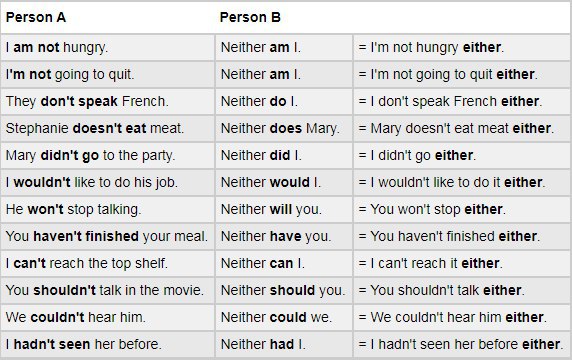
🔴 NEITHER
❇️Neither is used to show agreement with negative statements.
👉Neither + Auxiliary + Subject (pronoun)
📍The Auxiliary needs to agree with the verb tense in the original statement.
📍It is similar to using either at the end of a sentence, although Neither is more commonly used, especially in spoken English.
A: I don't understand Spanish.
B: Neither do I. (= I don't understand Spanish either.)
A: I cannot swim.
B: Neither can I. (= I can't swim either.)
Sometimes people respond Me Neither instead of Neither + Auxiliary + Subject though this is very informal spoken English.
❤16⚡2🏆2🦄2😎2🤔1🤩1😍1💯1😭1🫡1
#Elementary texts
Clean Hands
Elizabeth washes her hands every day. She likes to wash her hands. She washes her hands with soap and water. She uses soap and water to wash her hands. She uses warm water and soap. She washes her hands for 30 seconds. After 30 seconds she stops washing her hands. She turns off the water. She dries her hands on a clean towel. Every few hours she turns on the water and washes her hands. Elizabeth has very clean hands. She does not have many germs on her hands. Germs cannot live on her clean hands.
@ingliztiliuzz
🥰8🤝8👍4❤3😐3🎄3🔥1😇1🫡1
✨ Basic English grammar rules ✨
LESSON:
Welcome to your quick grammar boost! 🌟 Mastering basic English grammar rules will transform your writing and speaking instantly. Let's dive into three essential rules that every English learner must know! 📚
1. Subject-Verb Agreement ✍️
The subject and verb must match in number - singular subjects take singular verbs, plural subjects take plural verbs ✅
She walks to school every day.
They walk to school every day.
2. Proper Use of Articles 🎯
Use "a" before consonant sounds, "an" before vowel sounds, and "the" for specific or previously mentioned nouns 📖
I saw a cat.
She is an engineer.
The book on the table is mine.
3. Sentence Structure - SVO 📝
Most English sentences follow the Subject + Verb + Object pattern, making them clear and easy to understand ✨
John reads books.
The dog chases the ball.
💡 Pro Tip: Think of grammar rules like building blocks - each one supports the next! Practice them daily by underlining subjects and verbs in sentences, or create your own examples as you learn new vocabulary words.
Master these fundamentals and watch your English fluency soar to new heights! 🌈
___________________________________
💡 Save this post so you don't forget it!
⏰ Stay tuned!
✅ Follow us:
|Telegram | Instagram | YouTube
🥰10❤6🤝3🎄3👍2😐2😇1🫡1
⭕️ English usage⭕️
🤔Which is correct?
1⃣ After the theatre we had supper and went to a nightclub; then we finally went home.
2⃣ After the theatre we had supper and went to a nightclub; after all we went home.
3⃣ Both
1⃣ – 🦄
2⃣ – 🕊
3⃣ – 🐳
@ingliztiliuzz
@ingliztiliuzgroup
🤔Which is correct?
1⃣ After the theatre we had supper and went to a nightclub; then we finally went home.
2⃣ After the theatre we had supper and went to a nightclub; after all we went home.
3⃣ Both
1⃣ – 🦄
2⃣ – 🕊
3⃣ – 🐳
@ingliztiliuzz
@ingliztiliuzgroup
🕊18🦄9🐳5🤝5❤2🥰2😐2🎄2😇1🫡1🆒1
✨ Academic vs informal English vocabulary ✨
🌟 Welcome to today's lesson on mastering different types of English vocabulary! Today we'll explore the key differences between Academic and Informal English vocabulary, and why knowing when to use each is crucial for effective communication.
📚 Understanding the Differences
Academic English Vocabulary:
✅ Formal terminology used in scholarly writing, research, and professional contexts
✅ Precise and technical terms that convey specific meanings
✅ Often derived from Latin and Greek roots
Informal English Vocabulary:
✅ Casual language used in everyday conversations
✅ Colloquialisms, slang, and contractions
✅ Flexible and adaptable to different social contexts
✍️ Key Examples:
1. Academic: "The investigation revealed significant correlations between variables." vs Informal: "The study showed they're related."
2. Academic: "Utilize the methodology outlined in the previous section." vs Informal: "Use the method we talked about before."
3. Academic: "Subsequent research should address these limitations." vs Informal: "We should look into these problems next time."
🎯 When to Use Each:
✅ Academic English for essays, research papers, presentations, and professional communication
✅ Informal English for conversations with friends, casual emails, and everyday social media posts
💡 Memory Hack: Think of Academic English as your "professional uniform" - always appropriate for formal settings, while Informal English is your "casual wear" - perfect for relaxing with friends!
Remember: mastering both opens doors to success in every context! 🌟
___________________________________
💡 Save this post so you don't forget it!
⏰ Stay tuned!
✅ Follow us:
|Telegram | Instagram | YouTube
🤝8🎄4❤3🥰3😐2👍1😇1🫡1
I forgive you for an apology I was never given because my closure was never tied to single one of your words. It was dependent on my willingness to let go.
Good morning😊
Good morning😊
🤝14❤5😐4🥰2😇2🫡2🎄2
✨ English expressions for speaking fluently ✨
Ready to sound like a native speaker? 🌟 mastering English expressions is your secret weapon for fluent communication! 💬 Boost your confidence and flow naturally with these power phrases that make conversations smooth and engaging! 📖
✍️ Let's Start a Sentence Differently: Instead of beginning with "I think" or "I believe", try stronger expressions like:
I think we should consider this option → Perhaps we should consider this option
I believe this is the right path → In my view, this approach offers the best solution
✅ Bridge Ideas Seamlessly: Use linking expressions to connect your thoughts smoothly:
The meeting was long. We need better planning → Speaking of the meeting, the lengthy duration highlights the need for better planning
I like this restaurant. The food was good → Apart from enjoying the atmosphere, I must commend the excellent cuisine
🎯 End with Impact: Wrap up your points with powerful closing phrases:
That's just my opinion → I'd love to hear your thoughts on this
Anyway, let's move on → What are your experiences with this?
💡 Memory Hack: Create an "Expression Bank" 📱 - save these phrases as you encounter them in movies, podcasts, or books. Practice replacing 1-2 basic expressions in your daily conversations with these sophisticated alternatives!
🌟 Keep practicing these expressions daily and watch your fluency soar to new heights!
___________________________________
💡 Save this post so you don't forget it!
⏰ Stay tuned!
✅ Follow us:
|Telegram | Instagram | YouTube
🤝11🥰4❤3😐3🎄2😇1🫡1
This media is not supported in your browser
VIEW IN TELEGRAM
🤝12🥰4❤2👍2😐2🫡2🎄2😇1
Here's a list of common words along with their more advanced synonyms:
Begin: Commence
End: Conclude
Smart: Intelligent
Happy: Content
Sad: Melancholy
Big: Enormous
Small: Minute
Tired: Fatigued
Pretty: Beautiful
Ugly: Unattractive
Rich: Affluent
Poor: Impoverished
Angry: Irate
Calm: Serene
Fast: Swift
Slow: Languid
Hard: Difficult
Easy: Simple
Funny: Hilarious
Serious: Solemn
Old: Ancient
New: Novel
Loud: Vociferous
Quiet: Hushed
Difficult: Challenging
Friendly: Amiable
Enemy: Adversary
Beautiful: Exquisite
Scared: Terrified
Courageous: Valiant
@ingliztiliuzz
🤝13❤10🥰4👍2🫡2
I looked up the word in the dictionary.
She always looks up to her older sister.
Don't give up on your dreams!
He gave up smoking last year.
We ran out of milk this morning.
Time has run out for the project.
_______
💡 Save this post so you don't forget it!
⏰ Stay tuned!
✅ Follow us:
|Telegram | Instagram | YouTube
Please open Telegram to view this post
VIEW IN TELEGRAM
🥰12🤝6❤5👍2🫡1
You _____ be late again, or I will call the police! 😠
Anonymous Quiz
27%
can't
23%
must not
33%
shouldn't
16%
mustn't
❤8🤝8😁4🥰2🫡2🏆1
She _____ have finished her homework by dinner time.
Anonymous Quiz
51%
should have
26%
might have
15%
could have
7%
may have
🥰7❤4🤝3🫡2😁1
It's very important that you _____ the door locked when you leave. 🔒
Anonymous Quiz
65%
keep
10%
keep the
11%
keeping
14%
kept
❤8🥰4🤝4🫡2