
📥 NOTICE TO ALL MEMBERS 📥
━━━━━━━━━━━━━━━━━━━━
Bot removed more than 800 inactive users from the channel
Whenever you are reading any post on this channel; please hit ☛ "👍 or any emoji on the posts, it take's No time to click but this helps us to support our work.
THANKS ALL MEMBERS
━━━━━━━━━━━━━━━━━━━
™ @ingliztiliuzz
━━━━━━━━━━━━━━━━━━━━
Bot removed more than 800 inactive users from the channel
Whenever you are reading any post on this channel; please hit ☛ "👍 or any emoji on the posts, it take's No time to click but this helps us to support our work.
THANKS ALL MEMBERS
━━━━━━━━━━━━━━━━━━━
™ @ingliztiliuzz
Improve Your English🌙
Which is correct "for a while" or "in a while"?
Both are correct. Both are unspecific amounts of time.
for a while = duration of action
in a while = duration before action starts
I’ll be working for a while. - duration of action
(for another five hours)
Of course you can wait here for a while. -duration of action
(for an hour)
Are you okay Dan? You’ve been on the toilet for a while. - duration of action
(for 45 minutes)
In a while my parents are coming over. - duration before action starts
(They will arrive in an hour.)
Two people getting together to write a book is like three people getting together to have a baby. One of them is superfluous. George Bernard Shaw
Homes of Animals
▪️ bee ==== hive
🔺 spider ==== web
▪️ mouse ==== hole
🔺 rabbit ==== burrow
▪️ ant ==== hill
🔺 sheep ==== pen
▪️ pig ==== sty
🔺 bird ==== nest
▪️ cow ==== cattle shed
🔺 dog ==== kennel
▪️ lion ==== den
🔺 horse ==== stable
@ingliztiliuzz
▪️ bee ==== hive
🔺 spider ==== web
▪️ mouse ==== hole
🔺 rabbit ==== burrow
▪️ ant ==== hill
🔺 sheep ==== pen
▪️ pig ==== sty
🔺 bird ==== nest
▪️ cow ==== cattle shed
🔺 dog ==== kennel
▪️ lion ==== den
🔺 horse ==== stable
@ingliztiliuzz
IELTS test in India – May 2019 (Academic Module)
Writing test
Writing task 1 (a report)
We were given a graph showing the numbers of migrant workers in four countries: Canada, Australia, New Zealand and the US. We had to write a report and make comparisons where relevant.
Writing task 2 (an essay)
Computer games and films containing violence are popular today. Some people think that these are harmful for our society and the government should ban them. Others argue that such games and films are fine for entertainment. Discuss both views and give your opinion.
Speaking test
Interview
– What is your full name?
– Can I see your ID?
– Where are you from?
– Do you work or study?
– What do you study?
– Do you like your college?
– Would you make any changes in your college? Why?
– Do you like painting?
– What kind of pictures would you like to draw?
– Do you think that having pictures at home is good?
– Would you like it if someone drew your picture?
– What kind of shoes do you like to wear?
– How often do you buy shoes?
– Do you have a favourite pair of shoes?
Cue Card
Describe a family business you know. Please say
– What is it?
– How did you come across it?
– Who are their customers?
Discussion
– What are advantages and disadvantages of a family business?
– Why do some people like to work in large scale businesses?
– What are the reasons that many businesses fail in their first year?
– What are the qualities of a good business person?
– Why do some people like to start their own businesses?
Model answer
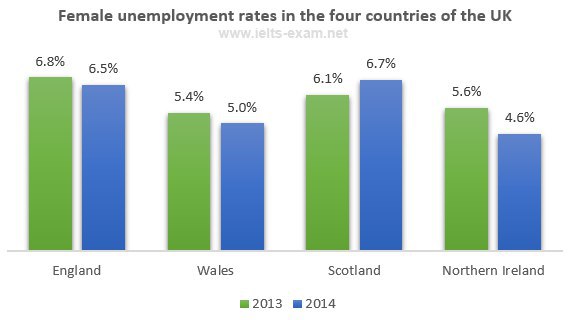
The bar chart shows the unemployment rates among women in the countries that make up the United Kingdom, both in 2013 and in 2014. There has generally been a small decrease in female unemployment rates from 2013 to 2014, except in Scotland.
In 2013, 5.6% of women in Northern Ireland were unemployed. The only country with a smaller percentage of women unemployed was Wales, with a rate of 5.4%. Both countries saw a decrease in the percentage of unemployed women in 2014. In Northern Ireland, the percentage fell to 4.6% and in Wales it fell to 5%.
England had the greatest percentage of unemployed women in 2013, with 6.8%. However, this decreased by 0.3% in 2014. Lastly, Scotland was the only country which had an increasing percentage of unemployed women. In 2013, it had 6.1% of women out of work. This increased to 6.7% in 2014, making it the country with the highest female unemployment rate of the four countries.
(160 words)
IELTS Writing Task 1 Essential Information
Below are 7 essential facts about Task 1. Many students worry about these small details instead of focusing on what really matters- improving your performance. These facts will help you understand what the test is and how it is scored so that you can move on to improving your performance.
1. People doing the Academic test will write a report on a data set, map, or process. People doing General Training will write a letter.
2. You must write 150 words or more.
3. You should spend around 20 minutes on this part of the test.
4. Task 1 is worth 1/3 of your total mark on the Writing test.
5. You will be assessed in four areas:
Task Achievement (25%)
Coherence and Cohesion (25%)
Lexical Resource (25%)
Grammatical Range and Accuracy (25%)
6. The most important thing is that you can demonstrate that you can clearly communicate in English.
7. The key to doing well is to know exactly what the examiners want and giving it to them.
This is one of the most common questions my students ask me and it is always interesting to hear how many different opinions there are.
Unfortunately, there is some really bad advice and misconceptions surrounding this question. The two worst pieces of advice I’ve heard are ‘You don’t have to write 250 words in writing part 2, 10% below this is OK.’ and ‘You should write as much as possible to get a good mark.’ These two statements are simply wrong and will lead to lost marks.
What happens if I write under the word count?
The only advice you should listen to is this- If you want to answer the question properly, you must write at least 250 words in part 2 and at least 150 words in part 1. If you write less than these totals you will lose marks under ‘Task Achievement’ because you haven’t answered the question properly.
IELTS examiners have to sit and count all of your words for this reason. It is really heart breaking when a good candidate produces a great answer and only writes 249 words in part 2. Unfortunately, we have to mark them down.
Should I write more words to get a good mark?
No! This is a bad idea for a few reasons.
Firstly, you only have a set amount of time to answer both questions. Time management is one of the most important things to learn in the IELTS writing exam. If you spend too much time on one question you are sacrificing marks on the other part.
Secondly, you are more likely to make grammar mistakes if you keep writing over the word limit and this will bring your overall mark down.
Finally, you are being judged on quality, not quantity. Focus on making your answer the best it can be, rather than the longest it can be. Remember you should allocate time to planning and checking, as well as writing.
How many words should I write?
In the exam you won’t have time to count all your words. I therefore suggest that you aim to write about 10% over what you are expected to write. In other words aim to write around 160-170 words for task 1 and 270-280 words for task 2. If you aim for this amount, you are far more likely to go over the required word limit.
How do I know how many words I have in the exam?
As stated before, you won’t have time to count all of your words, but there are other ways to judge this. I advise my students to download the official IELTS writing answer sheets, print them out and practice using these. All of the answer sheets are the same size; therefore you will be able to see how much of the sheet you use for the required word limit.
Practicing with the official answer sheets will also familiarise you with the test and you will not get any surprises on test day.
Are all words counted the same way?
Unfortunately, no! Hyphenated words like ‘First-class’ or ‘State-of-the-art’ count as one word only. Contractions like ‘I’ll’ or ‘we’re’ also count as one word. (Ideally you should not be using contractions in academic essays).
Words like ‘a’ ‘an’ and ‘the’ are always counted towards the word limit.
Punctuation is not included in the word count.
Can I copy words from the question?
You can copy single words, but you can’t copy whole parts of the question. You should never copy full sentences from the question. Repeating the question will mean the examiner subtracts these words from your word count and is therefore the same as writing nothing at all. You are being judged on your ability to paraphrase using synonyms, so try to master this skill and you will avoid copying.
Can I repeat sentences?
Again, simply repeating yourself will lead to the examiner not counting these words. Some students try to repeat themselves if they are running out of time. It is always better to write something new than repeat the exact words again.
IELTS Writing Task 1 Charts Checklist
When looking at an IELTS writing task 1 chart question, you should ask yourself 10 quick questions before you write your answer.
☝️What kind of chart is it? (Line, pie, bar)
☝️What does the title say about the chart? (Read it carefully)
☝️What information is contained on both axes?
☝️What are the units of measurements? (Age, %, amount etc.)
☝️What groups are compared?
☝️What is the time period? (Past, present or future)
☝️What is the most obvious thing that the data shows you? (General increase or decrease?)
☝️What is the most important or significant piece of information displayed?
☝️Can any comparisons be made? (Between groups or charts if more than one)
☝️Is it a static chart or dynamic chart? (Static- one time period. Dynamic- over a period of time)
@ingliztiliuzz
5 Common Task 1 Mistakes That Stop You Getting Over a Band 6
After marking hundreds of Task 1 essays I noticed that most students make the same mistakes. Below are the 5 most common mistakes and how you can fix them and improve your writing.
Not Writing a Clear Overview
The overview is a short paragraph that tells the reader 2 or 3 of the most significant things about the chart, graph, table etc. It should contain no data and instead describe the main features in general terms more...
Writing About Everything
Every Academic Task 1 question states ‘Summarise the information by selecting and reporting the main features...’. ‘Summarise’ means that you only mention the main points, or as the question states ‘the main features’ more...
Over-complicating the Question
The examiners know that you have never seen the graph or chart before and that you only have 20 minutes to write about it, so they are not expecting miracles more...
Not Organising Ideas Logically
The most logical way to organise a Task 1 essay is:
Paragraph 1- Introduction
Paragraph 2- Overview of main features
Paragraph 3- Details of main features 1
Paragraph 4- Details of main features 2 more...
Describing Data Incorrectly
Describing general trends and changes in data requires very specific grammar structures and vocabulary. more...
Would you like to know more...?
We are going to post something new, unusal facts and rules about writing part one... 😊Next post will be published As soon as ☝️it gets 100 👍
We are going to post something new, unusal facts and rules about writing part one... 😊Next post will be published As soon as ☝️it gets 100 👍
Collocations "of"
📜 Noun ➕ of ➕ the story 📜
🔆Side ➕ of ➕ the story
one person’s opinion of what happened in a situation, especially sb who has been accused of doing something wrong
📖 We've all read about it in the papers, but before we make any judgments I think we should hear his side of view.
🔆Part ➕ of ➕ the story
some, but not all
📖 Some crucial facts have been missed out. We've only heard part of the story.
🔆Moral ➕ of ➕ the story
practical lesson about what to do or how to behave.
📖 The main lesson or moral of the story is that crime doesn't pay.
🔆Point ➕ of ➕ the story
the purpose or aim of a story
📖 I couldn't make much sense of the story. In fact, I couldn't see the point of it at all.
@ingliztiliuzz