International students of the
Pre-University Preparatory Programms took part in the Day of the Russian Language, dedicated to the 150th anniversary of the of the Russian linguist Dmitry Ushakov, the Year of the Russian Language in the CIS countries and the Year of the Teacher.
Foreign students reading poems by Russian poets at the Institute of Philology and Journalism of Lobachevsky University.
Scientists at Lobachevsky University come close to unraveling memory impairment in post-COVID syndrome
The results of the study were published in the journal Scientific Reports by Nature.
The new coronavirus infection COVID-19 causes metabolic disorders in the brain, including a decrease in the synthesis of glutamate and gamma-aminobutyric acid, which can lead to disruption of brain rhythms.
Scientists from the Department of Neurotechnology at the Institute of Biology and Biomedicine of the UNN suggested that the impairment of the cognitive functions of the brain occurs as a result of infection of glial cells - astrocytes involved in the formation of brain rhythms, which leads to metabolic disorders and depression of glutamate synthesis.
The scientists' hypothesis was confirmed by their mathematical model of a neural network with the generation of quasi-synchronous rhythmic discharges mediated by the activity of glial cells.
Sergey Stasenko, Associate Professor of the Department of Neurotechnologies:
“The model predicted that neural network coherence disruption in infected astrocyte function could be interspersed with intervals of normal rhythm or complete lack of synchronization.”
Increased anxiety and memory impairment remain the most severe consequences of SARS-CoV-2 infection. We hope that the model we have developed and the results obtained will be able to clarify the processes that occur in the body after a COVID-19 infection, in particular, those associated with memory impairment in post-COVID syndrome.”
Telegram
Университеты РФ
Ученые ННГУ приблизились к разгадке нарушения памяти при постковидном синдроме
Результаты исследования опубликованы в журнале Scientific Reports издательства Nature.
Новая коронавирусная инфекция COVID-19 вызывает нарушения метаболизма в мозге, в том…
Результаты исследования опубликованы в журнале Scientific Reports издательства Nature.
Новая коронавирусная инфекция COVID-19 вызывает нарушения метаболизма в мозге, в том…
On April 26, 2023, was held the first round table "The Genesis of Cultures in the News Space of Russia and China".
Alexander Lychagin (Head of the Department of Oriental Languages and Cultural Linguistics of Institute of International Relations and World History) and Konstantin Kemaev (Deputy Vice-Rector for International Affairs and Networking) made an introductory speech.
Xi'an Electrotechnical University (西安电子科技大学), a partner university of UNN, co-organized the round table.
During this event, the participants discussed:
- cultural aspects of Russia and China and their influence on these countries;
- soft power policy;
- trade and economic relations between Russia and China
Komarova Tatyana Dmitrievna - Associate Professor of the Department of Oriental Languages and Cultural Linguistics at IMOMI and Head of the Asia-Pacific Center acted as a moderator of the discussion part of the Round Table.
Special thanks to our non-replaceable translator - Maxim Luppov !
Thank you all for participating!
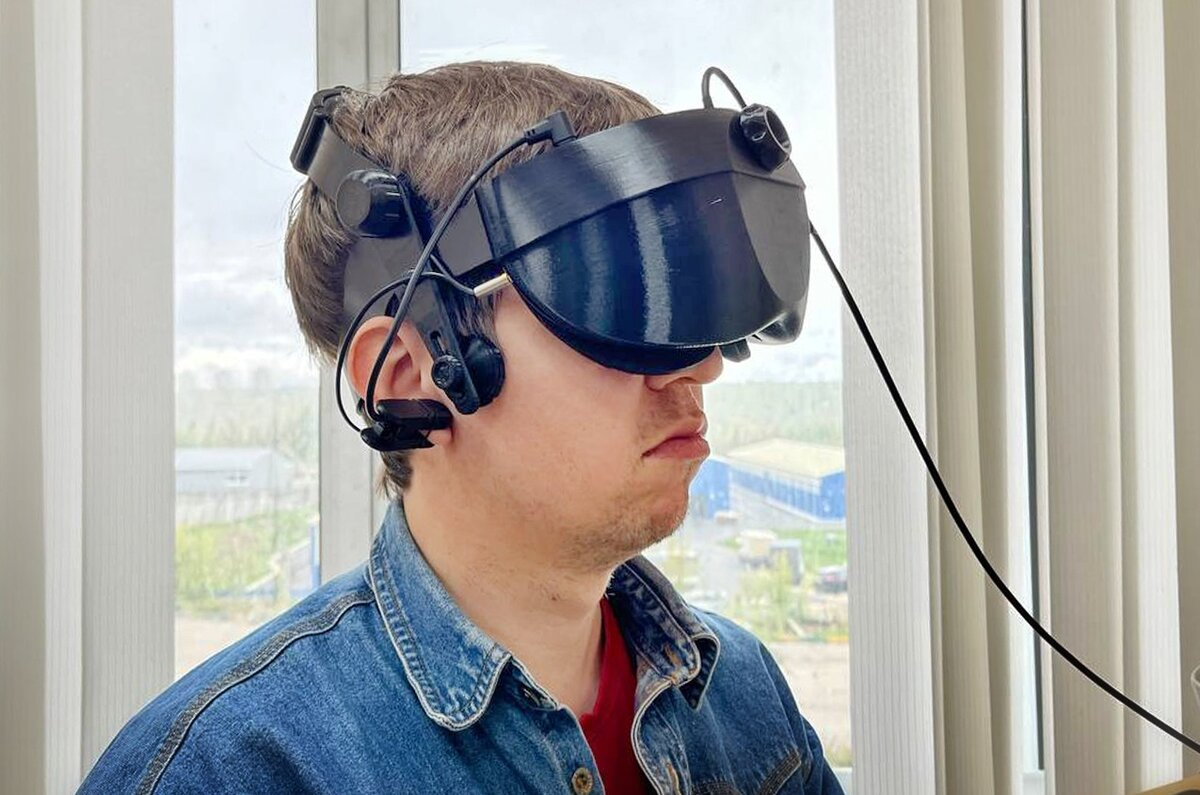
Device for adjusting optimal brain function developed at Lobachevsky University
A wireless software and hardware system for adjusting the optimal functioning of the brain has been developed by Lobachevsky University psychophysiologists. It also comprises special goggles, headphones, EEG sensors and pulse oximeters. The main mode of operation is adaptive neurostimulation.
The first samples of the device, called NeuroOptima, are already being used in federal clinics in the Nizhny Novgorod region for cognitive rehabilitation of adults affected by stroke and in children with attention deficit hyperactivity disorder (ADHD).
"Based on the amplitude of brain activity rhythms, unique audio-visual content (tonal sounds and light of a specific frequency) is generated in real time. Over the course of a session, sound shifts from high frequencies to low frequencies. Light is perceived by the brain as patches of colour - first of red shades and then increasingly cooler shades. When a person hears a flute-like sound and sees a blue, silvery glow, the brain cells are already working in optimal mode," explains Sofia Polevaya, Head of Psychophysiology Department at the UNN Faculty of Social Sciences.
For the best effect, researchers have added the patient's own heart rhythm to these harmonics. This beat is generated using data from pulse oximeters. According to the scientists, such neurostimulation is only possible in people with a normal alpha rhythm (8-13 Hz), which is absent in people with depression, brain pathologies, children with anxiety disorders and ADHD.
"If there is no alpha rhythm, we can work with the theta rhythm. When its peak frequency coincides with pulsations of the transmitted light, it is possible to "pump up" the brain in just a few sessions, obtaining new harmonics already in the alpha range," comments Sofia Polevaya.
The results of research on alpha rhythm restoration and preparation of a person for neurorehabilitation were presented by Nizhny Novgorod scientists in the international scientific journal Life.The researchers are planning to look for ways to fine-tune the brain even further and develop new modes of neurostimulation, taking into account an individual's age and the presence of pathologies.
The research was supported by a grant from the Russian Science Foundation. Together with scientists from the UNN Psychophysiology Department, a team of researchers from the Institute of Cell Biophysics of the Russian Academy of Sciences, headed by Dr. Alexander Fedotchev, author of the adaptive neurostimulation concept, worked on the project. Madin company acted as a business partner.
The clinical base for the project was provided by the Centre for Mental Health at the Privolzhsky Research Medical University and the Volga District Medical Centre.