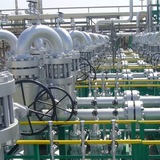
How crude oil is refined in a distillation unit
#viral
#trending
#facebookviral
#explorepage
#technicalknowledge
#learnsomethingnew
#engineeringlife
#dailyknowledge
#hindipost
#indianknowledge
Super SEPARATOR
A vertical separator in a geothermal well separates geothermal fluid (a mixture of steam, water/brine, and particles) by utilizing gravity and centrifugal force inside a vertical pressure vessel. Steam rises, water falls, and solid particles are deposited or removed, producing dry steam for the turbine and residual water (brine) for reinjection.
Process Stages
Inlet Flow: High-pressure geothermal fluid (a mixture of steam, hot water, and minerals) from the well flows into the separator tangentially (against the wall) at high velocity.
Initial Separation (Centrifugal Force): This tangential flow creates a vortex inside the separator, utilizing centrifugal force to push water droplets and solid particles toward the vessel wall.
Phase Separation (Gravity):
Vapor: Because of its lighter density, vapor moves to the top center of the separator and flows out toward the turbine as dry vapor.
Water (Liquid/Brine): The separated water droplets and minerals will fall to the bottom of the separator.
Solids: The solid particles will separate and settle to the bottom, or be cleaned through a special chimney.
Product Release:
Dry Steam: Ejects from the top of the separator to drive the turbine.
Water (Brine): Ejects from the bottom of the separator and is reinjected into the geothermal reservoir through an injection well to maintain reservoir pressure.
Advantages of Vertical Separators
High separation efficiency, especially for large flow rates (up to 99.9%).
Slimmer design (relative to horizontal separators).
Ideal for separating fluids at low to medium pressures.
#EPCprojeck
#Mechanicalpiping
#Pipinginsulationpainting
#Electricalinstrumentation
#Processcommisioning
#Civilengineering
#Pressure Vessels - Pressure Vessels
A simple and useful explanation about the most important types of industrial containers and their basic components.
#Roller_Vessels #️: They are commonly used in industries because their shape helps to distribute stress (pressure) evenly across the walls of the vessel, making it ideal for medium to high pressure applications.
#Ball_bowls⚪: Usually used to store gases under high pressure, their shape provides ideal stress distribution from all directions, reducing the required thickness of the walls.
The substance is selected based on operating conditions such as temperature, pressure, and nature of the substance stored (corrosion or not). Common items include:
Carbon Steel
Stainless Steel
Exotic Alloys
Body (Shell): Main part, can be cylinder, spherical or cone shaped.
Head: ends, often half spherical, oval, or flat.
Nozzles: designated slots for liquids and gases, and meters.
Supports: Includes legs, skirt, or saddle to securely attach bowl.
Internal pressure in the vessel leads to:
Hoop Stress
Longitudinal Stress
The forces are designed to ensure safety.
Patrolling inspections are carried out to ensure there are no defects or corrosion, using NDT techniques such as:
Ultrasonic Testing
Radiographic Testing
Storage tanks for gases and liquids such as: propane, ammonia, LNG.
Reactors in chemical industries.
Heat Exchangers at energy plants and refiner
🎯 Industrial Valves: Types, Uses, And Global Standards
🔧 Valves are vital components of all industrial piping systems. Choosing it correctly ensures operational efficiency, safety, and compliance with organizational standards.
---
🔍 1. Gate Valves (Gate Valves)
📚 Standards: API 600, ASME B16.34
✔️ Job: Complete opening and closing - not suitable for organization (Throttling)
✔️ Treadmill: Live - very low pressure
✔️ COMMON USES:
oil and gas lines
Water distribution systems
petrochemical plants
✔️ Advantages: good grip, simple design
✔️ Defects: slow to operate, corrosion when using in flow control
---
🔍 2. Globe Valves
📚 Criteria: BS 1873, ASME B16.34
✔️ Job: organize and adjust flow
✔️ Treadmill: S shaped - leads to significant pressure loss
✔️ COMMON USES:
Boiler Feeding Systems
Steam & Cooling Circuits
Fuel systems
✔️ Advantages: precision control, effective tightening
✔️ Disadvantages: high pressure loss, heavier than other valves
---
🔍 3. Ball Valves
📚 Standards: API 608, ISO 17292
✔️Function: Quick closure at 90° rotation angle
✔️Types: floating ball or axle-loaded
✔️ COMMON USES:
Natural Gas Lines
Automated air systems
Hydrocarbonate lines
✔️ Advantages: Integrated design, fast operation, excellent grip under high pressure
✔️ Defects: not suitable for organization - risk of seat corrosion
---
🔍 4. Butterfly Valves
📚 Standards: API 609, ISO 5752
✔️Function: Quick opening/closing and limited organization
✔️Designs: Lug type, Wafer, Double/Triple displacement
✔️ COMMON USES:
Heating, ventilation and air conditioning (HVAC) systems
Water treatment plants
Fire protection systems
✔️ Advantages: lightweight, economical, fast operation
✔️ Disadvantages: less compulsion (unless there is displacement)
---
✅ Criteria for selection of industrial valves
📌 Based on API RP 615, ISA 75, and MSS-SP
🔸Middle type: liquid, gas, abrasive liquid or corrosive liquid
🔸 Pressure and temperature: according to ASME pressure rating (Class 150 - 2500)
🔸 Operating method: manual, antenna, electric, hydraulic
🔸 Required Referee Score: 70-2 ANSI/FCI Standard
🔸 Installation direction and available space
🔸 Easy to maintain and access
---
🌍 The most important approved global standards:
ال API - American Oil Institute
ين ASME - American Society of Mechanical Engineers
ISO - International Organization for Standard Unification 📘
📘 MSS-SP - Manufacturers Standards Unification Society
📘 DIN/EN - European and German standards