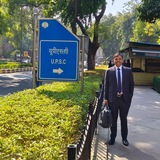
Which of the following Commission recommended to setting up Public Service Commission in India in 1923
Anonymous Quiz
27%
Hunter Commission
18%
Simon Commission
45%
Lee Commission
9%
Hartdog Commission
Ramanuja (Bhakti Movement Saint)
It was in the eleventh or twelfth century that Ramanuja preached unity of God under the name of Vishnu in Southern India. He proclaimed the love of God as the way to salvation. It is said that Ramanuja had to fly from the kingdom of the Chola king into Mysore, that he received converts from all classes of the people in that land. Ramanuja established hundreds of Vaishnava monasteries before he died.
It was in the eleventh or twelfth century that Ramanuja preached unity of God under the name of Vishnu in Southern India. He proclaimed the love of God as the way to salvation. It is said that Ramanuja had to fly from the kingdom of the Chola king into Mysore, that he received converts from all classes of the people in that land. Ramanuja established hundreds of Vaishnava monasteries before he died.
Kabir
Kabir was a disciple of Ramananda. Kabir conceived the lofty ideal of uniting Hindus and Muslims in the worship of one God. “The city of the Hindu God,” he said, “is in the east (Varanasi), and the city of the Muslim God is in the west (Mecca), but search your hearts, and there you will find the God both of Hindus and Muslims.” “If the Creator dwells in tabernacles, whose dwelling is the universe?” Kabir’s teachings known as Kabir Chaura are preserved in Varanasi, and his followers are still numerous in the Deccan, Central India, and Gujarat.
Kabir was a disciple of Ramananda. Kabir conceived the lofty ideal of uniting Hindus and Muslims in the worship of one God. “The city of the Hindu God,” he said, “is in the east (Varanasi), and the city of the Muslim God is in the west (Mecca), but search your hearts, and there you will find the God both of Hindus and Muslims.” “If the Creator dwells in tabernacles, whose dwelling is the universe?” Kabir’s teachings known as Kabir Chaura are preserved in Varanasi, and his followers are still numerous in the Deccan, Central India, and Gujarat.
Nimbarka
Nimbarka was a younger contemporary of Ramanuja, who also rendered great service to the spread of Bhakti movement. He wrote Vedanta-Parijatasourabha, a commentary on the Brahma Sutra, in simple language.
Nimbarka also wrote Dasa Sloki, which deals with three realities (tri-tattava) —Brahma (Krishna), soul (Chit) and matter (Achit).
Nimbarka declared that the individual soul is a part of Brahma, both in the state of ignorance and in that of knowledge or emancipation Nimbarka attached great importance to attainment of knowledge and devotion.
Though Nimbarka belonged to the South, he spent most of his life at Braja near Mathura in the north. To him Gopala Krishna, along with Radha and Gopies, is God. He propounded the Radha Krishna cult, one of the most popular and influential cults of India. The doctrine propounded by Nimbarka has much to commend itself from the point of view of philosophy, religion and ethics.
Chaitanya Mahaprabhu
Chaitanya also known as Sri Gauranga, was a popular Vaishnava saint and reformer from Bengal. He was born of Brahman parents at Nadia. After his education he became a teacher. At the age of 25 he took to monastic life at the feet of Kesava Bharti. Some time later he went to Puri, where many disciples gathered round him.
He visited various religious places located in the southern and western parts of the country like Pandharpur, Som Nath, Dwarka etc. and preached his teachings there. He also paid a pilgrimage to Vrindaban, Mathura and other places in the north. However, he finally settled down at Puri and stayed there till his death in 1533.
Chaitanya believed in one supreme being, whom he called Krishna or Hari. Chaitanya held that the presence of the God could be realised through love, devotion, song and dance. He attached great importance to the inner and esoteric way of realisation, which he believed could be attained through a guru alone.
The essence of Chaitanya’s teachings has been beautifully summed by Krishnadas Kaviraj thus: “If a creature adores Krishna and serves his Guru. he is released from the mashes of illusion and attains to Krishna’s feet”, and leaving these (i.e. temptations) and the religious systems based on caste (the true Vaishnava) helplessly takes refuge with Krishna”. Chaitanya denounced caste system and believed in universal brotherhood of man.
He was opposed to the domination of the priests and the outward forms and ceremonies of religion. To him’ love ‘alone could lead a man to Hari. He originated the Sankirtan, or service of song and the institution of celibacy among monks or gosains. He wrote Shiksha Ashtak in which he gave the cream of the Shastras
Raut Nacha Dance
Raut Nacha is a dance performed by yadava/yaduvanshis, a caste which considers them to be descendants of Krishna. For them it is as a symbol of worship to Krishna. They perform the dance at the time of 'dev udhni ekadashi'. It is believed that it is time of awakening of Gods after brief rest according to Hindu pancang (calendar). The dance is a close resemblance of Krishna's dance or raas Lela.
Raut Nacha is a dance performed by yadava/yaduvanshis, a caste which considers them to be descendants of Krishna. For them it is as a symbol of worship to Krishna. They perform the dance at the time of 'dev udhni ekadashi'. It is believed that it is time of awakening of Gods after brief rest according to Hindu pancang (calendar). The dance is a close resemblance of Krishna's dance or raas Lela.
The Sarabandi (no tax) campaign of 1922 was led by (1996 CSE)
Anonymous Quiz
8%
Bhagat Singh
40%
Chittaranjan Das
11%
Rajguru
41%
Vallabh Bhai Patel
Satya Shodhak Samaj organised
Anonymous Quiz
13%
A movement for upliftment of tribals in Bihar
10%
A temple entry movement in Gujarat
73%
An anti caste movement in Maharashtra
3%
A peasant movement in Punjab
👏1
The Montague chelmsford proposal were related to
Anonymous Quiz
8%
Social reforms
12%
Education reforms
18%
Reforms in police administration
63%
Constitutional reforms