
Binance will donate $ 1.5 million to help victims of the coronavirus epidemic in China
Cryptocurrency companies have expressed their willingness to provide assistance to the people of China amid the outbreak of coronavirus 2019-nCoV. So, the Binance exchange will donate 10 million yuan ($ 1.44 million).
“It is unrealistic to transfer money in cryptocurrency to final recipients in Wuhan,” wrote Changpen Zhao, CEO of Binance, in response to a call from Matthew Graham, CEO of Sino Global Capital. - Binance has allocated 10 million yuan to help victims of the coronavirus. We did not advertise this information, but the Binance charity has been active for the past few days. We still need help to organize on-site logistics. ”
Zhao later said that the Binance team has contacted China's largest e-commerce and logistics companies. The exchange ordered about 70,000 medical masks from other countries, but was faced with the fact that all masks were sold out in nearby regions, and so far only 8,000 could be found. The problem of sending them to Wuhan, which became the epicenter of the disease, also remains relevant.
In addition, on January 25, Krypital marketing service announced the launch of a charity initiative to purchase medical supplies. To do this, the company will launch a system on the blockchain, which is supposed to improve the efficiency and transparency of the process.
Previously, Binance collected donations for the restoration of Notre Dame Cathedral in France, much of which was destroyed by fire.
Twitter Added New Bitcoin Emoji, Next Step For Unicode
Twitter CEO and major Bitcoin supporter Jack Dorsey posted a message on his account in which he introduced a new emoji for the first cryptocurrency. Also, the symbol of bitcoin Dorsey posted in the description of his profile on Twitter.
From now on, the bitcoin symbol will always appear on Twitter when the user uses the hash tag and adds the word “bitcoin” or “BTC” after it.
In the message, Dorsey also mentions the Unicode character encoding standard, thus urging its creators to follow the Twitter example and introduce a special character for bitcoin.
The new feature has generated significant interest from community members. For example, TRON blockchain project director Justin Sun, Binance exchange CEO Changpen Zhao, and Lightning Labs co-founder Elizabeth Stark, who also asked if anyone had sent a proposal to add a character to Unicode, had already decided to use it.
Altsbit crypto exchange closes after breaking its wallets
Altsbit cryptocurrency exchange, which suffered from a hacker attack last week, announced its closure.
Initially, it was reported that “almost all assets in BTC, ETH, ARRR, and VRSC were stolen”. In an update on his website, Altsbit writes: “Fortunately, a decent portion of the coins were in cold storage.” These funds will be used to pay partial compensation to users.
Total was stolen:
- Bitcoin (BTC) - 6,929 out of 14,782;
- Ethereum (ETH) - 23,210 of 32,262;
- Pirate Chain (ARRR) - 3 924 082 of 9 619 754;
- Verus Coin (VRSC) - 414 154 out of 852,726;
- Komodo (KMD) - 1,066 out of 48,015.
Users holding funds in the specified cryptocurrencies should contact the exchange for compensation. The payment will begin on February 10 and will last until May 8, after which the platform will completely stop its work, and a refund will not be possible.
Responsibility for what happened was allegedly claimed by the hacker group LulzSec. “We guarantee that Altsbit did not have sufficient precautions. Next in line are many more. Notification for exchanges: Better increase security, ”she wrote on Twitter.
Earlier, LulzSec was associated with several high-profile hacks, including Sony Pictures in 2011. Several of its members were arrested.
Ex-NASDAQ and Visa employees will make crypto trading more profitable
Ex-employees of NASDAQ, Visa, Morgan Stenley and several other companies have joined forces to solve the problem of price disruptions in the global digital asset market, CoinDesk reports.
The project is called Apifiny. Its development, according to representatives of the initiative, has been ongoing for 18 months. As part of the project, experts built the ExOne platform, which is focused on solving the problems of low liquidity of digital asset exchanges.
According to the developers, when building the site, technical solutions were borrowed from the classic market. A number of traditional solutions, despite their application in the off-chain format, present certain advantages for working in the world of digital assets.
“These marketplaces are highly fragmented and surprisingly inefficient. If an investor goes to one marketplace, the application that he sees on it can be very different from another - presented at an alternative marketplace. ” - commented on the problems of modern trading floors focused on digital assets, the former vice chairman of NASDAQ David Wilde, also involved in the construction of the project.
According to the expert, the discrepancy of information in applications may become an obstacle for investors who are accustomed to gaining access to relatively stable quotes in the consolidated market. Bitcoin and other cryptocurrencies, as noted by David Wilde, do not have a similar price consistency; Real-time bets can vary by thousands of dollars from one market to another.
The problem of the difference in the data provided to crypto investors, in his opinion, is that the buyer risks agreeing to a deal that is obviously unprofitable for him (in the absence of all the necessary information).
Using technical solutions ExOne specialists intend to eliminate the problems presented. The result of the work of the project team should be the possibility of organizing more interconnected and consolidated trade.
A number of specialists who previously held high positions in large companies are working on the project. The latter include former director of retail operations at Morgan Stanley, former head of design at Kraken Connie Wong, and former head of Visa's global network product support division, Ben Rab.
Recall, it became known earlier that JPMorgan initiated a discussion on the possibility of merging with the Ethereum startup ConsenSys.
Binance reports on adding support for 15 fiat currencies through Simplex service
Binance Exchange this Friday announced the addition of support for 15 fiat currencies as part of a plan to increase the availability of digital assets.
The integration was carried out through the Israeli service Simplex. Thanks to this, support for new fiat currencies appeared on Binance and the possibilities for depositing in previously available ones were expanded, including the Russian ruble, Swiss franc, Korean won, Australian dollar, Polish zloty, and South African rand.
All fiat currencies presented will be available for an exchange for the main crypto assets, for example, Bitcoin, Ethereum, XRP, as well as partially among themselves.
According to CoinDesk, fiat currencies account for a small share in the total trading volume of Binance. The average trading volume of the platform over 30 days amounted to $ 3.55 billion, of which $ 3.5 million fell on pairs with fiat. The vast majority of this volume falls on the US dollar.
Binance began working with Simplex in January 2019, allowing users to purchase cryptocurrencies using bank cards for euros, US and Canadian dollars, as well as Japanese yen.
The standard commission for a transaction through Simplex is quite large: it is 7% and may vary depending on the size of the payment. Binance declares that if the user uses the same currency that is offered by the service, he will not be charged a 2-3% fee for conversion, which is used in some other deposit methods.
Also today, KuCoin exchange added support for the Russian ruble through Simplex.
Ripple IPO will help increase the price of XRP
At the World Economic Forum in Davos the other day, Ripple CEO Brad Garlinghouse said many cryptocurrency firms are likely to have an IPO this year. He also said that Ripple would be among them. Also, Garlinghouse expects his company to be a winner. Some began to express their doubts on Twitter that the upcoming IPO of the giant Ripple would be beneficial for the price of XRP and for those who invested in this coin. However, some in the XRP community is positive about this news, believing that XRP investors will benefit from it. “IPO Ripple will help increase the price of XRP” An XRP supporter, known on Twitter as “Steven Bull From the Diep” (about 15.5 thousand subscribers), is one of those who support the idea of Ripple going public. In a recent tweet, he outlines several specific reasons why he believes that publicly placing Ripple will increase the price of XRP. He believes that Ripple will receive more funds to expand its network, hire the best talents and solve real problems that only XRP can handle. IPO Ripple Survey Investor @XrpMr has offered its subscribers a survey regarding the announced IPO Ripple. He invites the community to express their views on whether they think the IPO will be good for XRP, bad for him, or they can also say “I have no idea.”
At the moment, about 4,500 people have voted. 65.9 percent believe that the IPO will positively affect the market value of the XRP coin. 13.6 percent believe that the price of XRP will not rise after it. Just over 20 percent chose the option “I have no idea.”
Norwegian Air may start selling tickets for cryptocurrency this spring
Clients of one of the largest airlines in Europe Norwegian Air will soon be able to pay with cryptocurrency. This was in a conversation with a local publication by the CEO of the Norwegian Block Exchange (NBX), Stig Kjos-Mathisen, whose trading platform developed a payment solution for the airline.
“Everything is ready for us,” he said. NBX will provide access to the system to customers this year, perhaps already in early spring.
Chios-Mathisen is the son-in-law of Björn Chios, founder and CEO of Norwegian Air. Since the launch of NBX in 2019, they have planned to use the exchange infrastructure in the sale of airline tickets.
In September, one of Norway's oldest banks acquired 16.3% in NBX, presumably for $ 1.6 million. The beta version of the exchange for a limited number of customers was launched in September, and now it is ready to accept new users.
Norwegian Air Shuttle was founded in 1993. It is the largest airline in Scandinavia and the third largest low-cost airline in Europe.
What cryptocurrencies will be accepted for paying for tickets is unknown. According to media reports, the son of the founder of Norwegian Air, Lars Ola Kyos, acquired Bitcoins for $ 400,000 in 2017, shortly before reaching a maximum price.
The virtual world of Decentraland on the Ethereum blockchain launched two and a half years after the ICO
The virtual world of Decentraland, the participants of which are invited to buy land and property on the blockchain for real money, started on Thursday after two and a half years in development. The project raised $ 24 million during an ICO in 2017.
According to Bloomberg, many MANA token holders now seek to profit from trading goods and services in the virtual community. Since the beginning of the year, the price of the token has doubled, as compared to the ICO price, however, it is still significantly lower than the highs of 2018.
According to the NonFungible data tracker, virtual land is also in demand - the amount of transactions has already exceeded $ 1 million. As a result, Decentraland's assets have become the most reversible non-interchangeable token (NFT) on the Ethereum blockchain. Unlike centralized games and virtual worlds, where the service operator is the owner of the items, in Decentraland the ownership of each participant is fixed in the Ethereum blockchain using NFT tokens, which they control themselves.
With the launch of Decentraland, users were given access to a set of development tools for creating interactive 3D scenes on their land without the need to write code. A marketplace has also been launched where users can trade LAND NFT tokens.
Decentraland is managed by a decentralized autonomous organization that owns assets for settlements with developers and public lands, such as roads and squares.
Decentraland spent about half of the funds raised through the ICO to pay for the services of more than 30 developers who were preparing the project for launch. Today, thousands of participants, including dozens of creative studios, create content in the virtual world, more than a third of which have already been built up, Bloomberg writes.
“We see that land close to our content is already growing in value. Recently, many people wanted to build nearby, ”said Polygonal Mind CEO Daniel Garcia, whose company creates arcade games, art galleries, shops and transportation systems for Decentraland landowners.
LocalBitcoins trading volumes hit their lowest levels since 2013
Bitcoin trading volumes on the LocalBitcoins peer-to-peer platform continue to decline and have recently reached a seven-year low.
According to CoinDance, during the week ending February 22, only 3,144 BTC were exchanged through the platform. This value is comparable to June 2013, when the company just started bidding.
After the peak of the crypto market passed, the trading volumes of LocalBitcoins began to grow slightly at the beginning of 2019, however, the company made several less popular decisions, which forced many users to turn their backs on it. Last year, LocalBitcoins eliminated the possibility of exchanging cryptocurrencies in person, which was one of the most valuable features of the platform. Later, user identification requirements were tightened.
At the same time, competition in the retail OTC retail space is becoming increasingly fierce. Another major player is the Paxful platform. Binance Exchange is also developing its own peer-to-peer trading business. Recently, she launched P2P trading in the web version of the Binance.com trading platform, previously adding support for the Russian ruble.
Demand for LocalBitcoins services remains high in selected markets experiencing difficult economic conditions, such as Argentina and Venezuela. Argentina updated its own record when converted to local currency in December and has not slowed down since then. At the same time, at least part of the activity in Latin America is associated with the activities of local crime syndicates.
Bitcoin drops below $ 7,700 amid a collapse in global financial markets
The price of bitcoin has reached a new local minimum below $ 7,700 at the same time as the resumption of a downward movement in global financial markets.
At the time of publication, Bitcoin is trading around $ 8,000, shortly before being at $ 7,684.70 paired with Bitstamp. During the day, the decrease was 10%.
The fall of cryptocurrency occurs simultaneously with a sharp decline in traditional markets. March 9, trading in Brent oil opened with a collapse of more than 30%. Such bidders have not seen since 1991. Asian stocks went down for oil. In addition, Dow Jones Industrial Average futures fell by 4.2%, S&P 500 futures - by 4.5%, Nasdaq Composite futures - by 4.4%. In the Forex markets, the dollar soared to 73 rubles, the euro - to 83 rubles.
At the same time, a steady increase in the amount of computing power and mining complexity continues to be observed in the bitcoin network. The next recount of complexity will take place in 4 hours. According to estimates, the value will reach a new maximum, rising by more than 7%. Poolin mining pool data indicates that some popular miners, such as AntMiner S9 and Avalon 851, at the current price of bitcoin and competition, are no longer profitable for many owners and can be disabled.
The index of greed and fear of crypto investors for the first time since the end of last year dropped to mark 17, which corresponds to the description of "extraordinary level of fear."
Global finance expert and eternal adversary of bitcoin Nuriel Rubini, commenting on today's market movements, writes: “Bitcoin has declined by 8%, more than global capital. This is another confirmation that Bitcoin is not a good hedge against high-risk assets when market participants seek to get rid of risks. In fact, in such periods, it falls more than high-risk assets. ”
Most altcoins lose 10-15% each. The exceptions among the largest market assets were Chainlink and Bitfinex UNUS SED LEO's own token - they are still kept in the green zone.
The segment's capitalization fell to $ 225 billion. Over the past two days, it has decreased by 15%.
Bitcoin price holds above $ 5k amid the widespread stock market decline
On Tuesday, March 16, the price of bitcoin was above the level of $ 5000, while the US stock market saw its worst day since 1987. Traditional markets closed 13% lower than the day before, but the main cryptocurrency calmly continued its lateral movement.
The price of bitcoin moves inside a narrow channel, limited by resistance at the level of $ 5600- $ 5750 and support around $ 4800- $ 4900.
The 4-hour chart shows a clear bullish divergence, which implies the formation of the bottom in the short term and the impulsive price increase. However, for the formation of a trend reversal, a similar divergence should appear on older timeframes, that is, on the daily chart. Another sign of an imminent reversal may be testing lower levels and the formation of a double bottom on low timeframes.
Recently, there has been a massive sale on the stock market, which leads to the fact that the index of fear and greed has reached an extreme value. Traders and investors are already comparing the recent collapse with the legendary market corrections that took place in 1929, 1987 and 2000.
There is a sale of shares at a discount of 30-40%, with individual shares falling by about 70%.
History knows such landslides. Coronavirus, of course, is a unique case, however, markets tend to move according to a certain pattern, which is associated with human psychology.
When the bubbles burst, the initial drop is usually between 35-50%, after which a rebound is observed. This bounce is often called the “dead cat jump” or the “bull trap” that makes investors believe that everything is working out.
Historical data show similar movements. During the 2000 Dot.com bubble, the Nasdaq 100 index fell 40%, after which an upward momentum was observed for 3-4 months.
In January 2018, Bitcoin showed a similar drop immediately after its bubble burst in December 2017. The price fell from $ 19700 to $ 10800, which corresponds to a decrease of 45% from the beginning of the year. After that, bitcoin rose from $ 10800 to $ 17000 before the bearish trend continued.
Since the stock market already has a sale within 30-40% and a bearish bearish momentum is observed, it will not be surprising if a rebound occurs in the coming weeks. Such short-term growth in the stock market will allow the cryptocurrency market to turn green.
This assumption is supported by the fact that recently all markets have shown a positive correlation with each other. Gold and bitcoin fell significantly, due to the fact that investors sought liquidity in order to cover losses in the stock market.
Of course, all this does not prove that the cryptocurrency market has reached its bottom. However, bullish divergence allows us to expect a short-term rally, the main objectives of which will be the levels of $ 5600- $ 5800 and $ 6000-6100. If these zones are not overcome, then we should expect to test of the lower support levels located in the region of $ 4800, $ 4200 or even $ 3750.
Bottom formation takes time, and in the current economic instability, it is impossible to predict how long this period will last and when the coronavirus will eventually leave the stage.
Correlation between Bitcoin and S&P 500 reaches two-year high - Santiment Analysts
https://twitter.com/santimentfeed/status/1241041938444251140
Analysts have linked the strengthening of BTC and the stock indicator with a crisis that hit the global economy.
Traditional markets now mainly show negative dynamics. The weakening of business activity was the result of a panic in the camp of investors caused by the spread of coronavirus. Even the collapse in energy prices did not force the global economy to move to growth.
Researchers believe that in the face of uncertainty, many players prefer to invest capital as carefully and evenly as possible. That is why we are seeing an increase in the correlation between the first cryptocurrency and one of the leading business activity indices.
Digital dollar expelled from coronavirus pandemic bill
The digital dollar was excluded from the latest version of the bill aimed at stimulating the American economy against the backdrop of the coronavirus pandemic.
Earlier, the US Democratic Party planned to include a digital dollar wallets system in the bill, which will be managed by federal reserve banks. It was assumed that the system will be used to make payments to residents of the United States who meet certain criteria.
The updated version of the bill “On Supporting Workers and Families” already has 1,400 pages, but the digital dollar clause was removed from it. This scenario has already been allowed, because the creation of a digital dollar raises a number of questions, including the need to develop appropriate infrastructure.
The previous version of the document said that payments can be made not in digital dollars, but using checks. This part of the bill has also been amended, since it is now planned to implement an advance tax refund through the Ministry of Finance.
The regulation on the digital dollar is still contained in another bill, which is also associated with financial assistance to certain economic entities. However, a source familiar with the situation said that, most likely, information about the digital dollar will be removed from this document.
🔥Sensorium Galaxy Senso Token Listed On Kucoin🔥
Sensorium Galaxy is a social virtual reality universe with its own unique vibes, nightclubs and hangouts featuring world-class DJs and non-stop entertainment.
Starting March 20, the Sensorium Galaxy Senso Token is listed on Kucoin and will be available to businesses as a means of payment for generating content and services on the platform. The token can already be used for exchanging and giving exclusive access to entire planets and purchasing in-game Avatar profile pics.
Just some of the features of the Sensorium Galaxy platform:
⚡️ Brand new entertainment experience
⚡️ Global media platform
⚡️ Multi-user online journey in social VR
⚡️ 3D scanning and motion capture
⚡️ Neuroevolutionary artificial intelligence
The platform has already received an investment influx of over $70 million. The Senso Token is built on the ERC20 Ethereum network standard and is now available for trading on the Kucoin exchange.
Don’t miss your chance to sign up to dive into a galaxy of entertainment and untold opportunities and start trading.

Europe is experiencing an increase in the use of fintech applications in connection with the coronavirus pandemic
The world is fighting the coronavirus using distance, isolation, and even total blocking tactics. According to the independent advisory company deVere Group, in the current conditions in Europe, the use of fintech applications has increased by 72%.
James Green, manager of the deVere Group’s European division, said that “the world has changed in the last few days.” It affected how we interact, live, work and handle finances.
“A new era with digitalization and technology has already begun. Demand for video calling platforms - Google Hangouts, Skype, FaceTime and Zoom, etc. is growing rapidly, as the number of people working remotely is growing.
Recently, Zoom Video Communications has shown remarkable results, since since mid-February its shares have grown by 32%. It started when the markets started to fall. ”
According to James Green, after the 2008-2009 crisis. there was a void between what traditional financial services companies offer and what customers now expect.
Green says customers now want immediate 24-hour access to and manage their money, as well as a more “personalized” service with lower costs.
According to him, the situation with the coronavirus pandemic could accelerate the adoption of innovative technologies and fintech applications in general.
Over the past three years, the company has developed and implemented a range of innovative fintech applications, including deVere Catalyst, a low-cost investment and savings application that, according to Green, “eliminates the hassle of investing” and allows you to achieve “long-term financial goals” even despite the fact that users have very little investment experience.
“This new era was marked by a stunning leap in the use of our fintech applications among existing customers and a sharp increase in interest in products from potential customers,” says Green.
James Green also made an important conclusion:
“Financial technology is the engine of the so-called Fourth Industrial Revolution, which is becoming an increasingly dominant part of our lives; and the situation with coronavirus proves this. ”
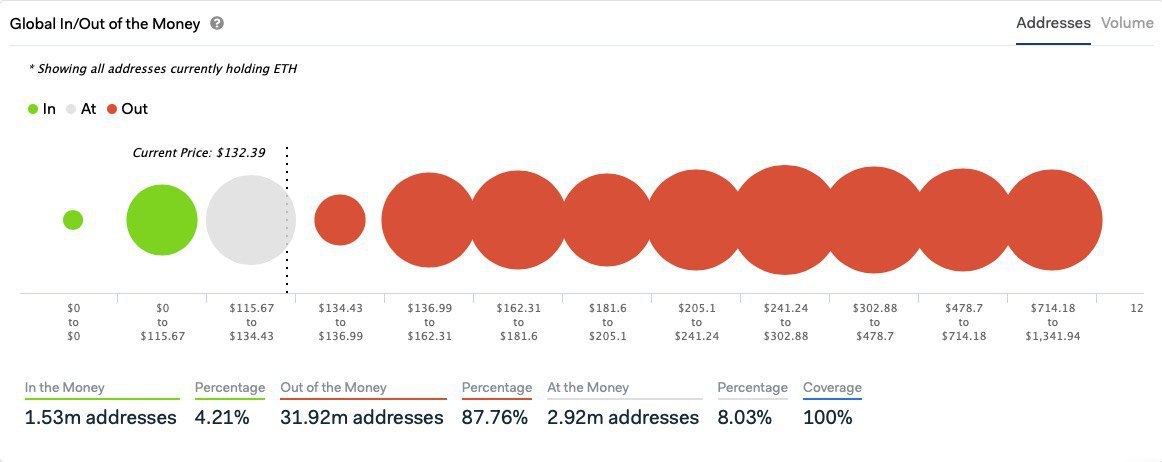
The share of unprofitable Ethereum addresses reached 88%, an increase of 18% over six months
The estimated number of Ethereum holders who are losing out on their investments is currently 88%. This is written by Cryptoslate with reference to IntoTheBlock company data.
As shown in the image below, only 12% of ETH investors at current price levels have a profit or near-zero result. In the near future, their share may become even lower, analysts admit, pointing to one of the metrics in the blockchain.
The indicator is calculated as the estimated average cryptocurrency purchase price relative to the current spot price.
Ethereum is currently trading around $ 130, setting a price high above $ 1,400 at the beginning of 2018 and a minimum of about $ 80 in December of that year. Thus, most investors in ETH with a positive balance, most likely, purchased cryptocurrency either at recent lows, or even before its rise in 2017.
At the same time, 4 million ETH addresses, or about 10% of the total, received their coins when cryptocurrency was trading between $ 714 and $ 1,340.
IntoTheBlock also notes a decrease in the number of large transactions with a volume of more than $ 100,000, which may serve as another bearish signal.
According to the authors, the indicator of the number of large transactions often serves as a harbinger of major changes in the cryptocurrency rate.
Last October, the share of unprofitable Ethereum addresses was estimated at 70%.
Coin Metrics: Bitcoin Cash and Bitcoin SV halvings did not answer how Bitcoin will behave
Coin Metrics researchers analyzed Bitcoin Cash and Bitcoin SV halvings last week and drew parallels between the upcoming cryptocurrency halving in May.
As a result of halving the rewards to the miners, the BCH and BSV hashes immediately after these events fell noticeably (up to 73%). And although to date these indicators have recovered somewhat, they are still 50% less than the average levels in 2020.
This, in turn, led to the fact that the number of confirmations necessary to consider transactions final was doubled. For comparison, analysts say that bitcoin during the previous halving in 2016 did not experience a similar drop in the hash rate, although its short-term stagnation was still observed.
Increased time to create new blocks and a decrease in rewards to miners also led to a decrease in BCH and BSV emissions, which immediately after halving fell significantly below the expected levels of about 1.75%. Subsequently, the situation stabilized somewhat.
Emission volatility is because BCH and BSV have a different mechanism for recalculating complexity from BTC: if bitcoin changes after 2016 mined blocks, then BCH and BSV recalculate after each block based on the average for the last 144 blocks.
With the drop in complexity and hash rate, the time spent by new blocks in BCH and BSV networks increased to about 30 minutes. So, in the days following after the Halving, instead of the expected 144, 55 and 54 blocks were found, respectively.
The BCH example, however, shows that recalculating the complexity after each block helps to fix this situation quickly:
Despite all these factors, Coin Metrics noted that in the days following after halving days, BCH and BSV did not observe price movements beyond the normal behavior of the rest of the market.
Nevertheless, if we talk about the upcoming halving of bitcoin, then it is extremely difficult to predict exactly how the network will behave and how this will affect the price, analysts conclude.
Binance cryptocurrency exchange announced the liquidation of a batch of BNB tokens for $ 52.5 million
The administration of the Binance cryptocurrency exchange reported on the quarterly liquidation of the BNB token party (Binance Coin).
The platform “burned” coins for a total amount of up to $ 52.5 million. In total, 3,373,988 tokens were liquidated, the blog of the trading platform says.
Note that Binance has taken similar steps earlier. For example, in April last year, during the transition from Ethereum to its own Binance Chain network, the exchange “burned” 5 million BNBs of the ERC20 standard.
The statement on the trading platform emphasizes that the liquidation of tokens in April 2020 was the largest in the history of Binance.
The administration also notes:
“Burning reflects activity on the margin, futures and spot markets of Binance, as well as among partners who used BNB from January to March. This is the largest BNB burning in both tokens and fiat. ”
Under the quarantine regime introduced in many countries because of the coronavirus pandemic, interest in cryptocurrencies has grown sharply. As a result, the traffic of crypto exchanges, including Binance, significantly increased.
At the end of March, Binance Coin jumped in price by almost 50%, the capitalization of this altcoin is now holding above $ 2.469 billion.
The crypto exchanges Binance US, FTX and OKCoin offer the lowest trading commissions in the spot market
According to a new study by The Block analyst Larry Chermak, Binance US, FTX, OKCoin, bitFlyer Japan and Poloniex are by far the cheapest spot cryptocurrency exchanges.
Chermak analyzed trading commissions on the top 20 cryptocurrency exchanges and concluded that FTX is the cheapest exchange for retail traders, while Binance US and OKCoin are the least expensive exchanges for large traders.
Coinbase, bitFlyer EU, Bitstamp, and Gemini are some of the most expensive spot exchanges for retail traders, although Gemini offers the lowest commissions to large traders.
Binance used to be one of the least expensive crypto exchanges, but now it offers fairly high commissions to large traders. For retail traders - who are the target audience of Binance - the exchange is still inexpensive.
The second crypto fund Andreessen Horowitz raised $ 515 million - $ 65 million more than planned
U.S. venture capital firm Andreessen Horowitz raised $ 515 million for its second fund, which focuses on investments in cryptocurrency projects and blockchain startups. Initially, the company planned to raise $ 450 million. Fortune reports.
“Very rarely, new large computer paradigms appear, and we think that the blockchain is comparable to cloud and mobile technologies for the Internet,” said Chris Dixon, one of the fund’s leaders. He added that he expects the soon debut of many new blockchains, including those projects in which Andreessen Horowitz previously invested.
Andreessen Horowitz was one of the first large venture capital companies to actively invest in bitcoin and blockchain. In January 2014, co-founder Mark Andreessen noted the virtues of digital money in an article for The New York Times.
Since then, Andreessen Horowitz has invested in Bitcoin, Ethereum, and other cryptocurrency projects such as Maker DAO, Compound, and Celo. The company is also an investor in Coinbase, Protocol Labs and Anchorage.
Katie Hown, who is the co-director of the company's first crypto fund, which raised $ 350 million in 2018, refused to disclose its performance, noting that the fund is betting on long-term investments.