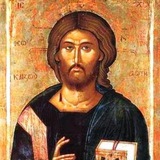
"God is Intellect and transcends the creatures that in His Wisdom He has created; yet He also changelessly begets the Logos as their dwelling-place, and, as Scripture says (cf. John 14:26), sends the Holy Spirit to endow them with power. He is thus both outside everything and within everything. " ✝️ St. Nikitas Stithatos
St. Aristobulus (Mar 16), brother of the Apostle Barnabas and numbered among the Seventy Apostles, was made the first bishop of Britain by the Apostle Paul. There he endured the torments and malice of the pagans who smote him, dragged him through the streets, mocked him and jeered at him. Aristobulus remained steadfast in the Gospel and helped convert many.
Such was the Apostle Aristobulus' influence amongst the Brythonic Celts that a region was named after him: Arwystli. This region later became a small medieval British kingdom, and continues to this day as a district (known as a cantref) in the county of Powys, Wales.
Pray unto God for us, O holy Saint Aristobulus, well-pleasing to God: for we turn unto you who are the speedy helper and intercessor for our souls. Amen.
“I know for certain, that before I was humbled I was like a stone lying in deep mire, and He that is mighty came and in His mercy raised me up and, indeed, lifted me high up and placed me on top of the wall. And from there I ought to shout out in gratitude to the Lord for His great favours in this world and forever, that the mind of man cannot measure.”
✝️ The Confession of Saint Patrick (Mar 17), Enlightener of Ireland
✝️ The Confession of Saint Patrick (Mar 17), Enlightener of Ireland
As I arise today, may the strength of God pilot me, the power of God uphold me, the wisdom of God guide me. May the eye of God look before me, the ear of God hear me, the word of God speak for me. May the hand of God protect me, the way of God lie before me, the shield of God defend me, the host of God save me. May Christ shield me today. Christ with me, Christ before me, Christ behind me, Christ in me, Christ beneath me, Christ above me, Christ on my right, Christ on my left, Christ when I lie down, Christ when I sit, Christ when I stand, Christ in the heart of everyone who thinks of me, Christ in the mouth of everyone who speaks of me, Christ in every eye that sees me, Christ in every ear that hears me. Amen
✝️ Prayer of St Patrick, Bishop of Armagh and Enlightener of Ireland (March 17)
✝️ Prayer of St Patrick, Bishop of Armagh and Enlightener of Ireland (March 17)
Saint Patrick, the Enlightener of the Irish (Mar 17), "was seized from his native Britain by Irish marauders when he was sixteen years old. Though the son of a deacon and a grandson of a priest, it was not until his captivity that he sought out the Lord with his whole heart.
In his Confession, the testament he wrote towards the end of his life, he says, 'After I came to Ireland - every day I had to tend sheep, and many times a day I prayed - the love of God and His fear came to me more and more, and my faith was strengthened. And my spirit was so moved that in a single day I would say as many as a hundred prayers, and almost as many at night, and this even when I was staying in the woods and on the mountain; and I would rise for prayer before daylight, through snow, through frost, through rain, and I felt no harm.'
In his Confession, the testament he wrote towards the end of his life, he says, 'After I came to Ireland - every day I had to tend sheep, and many times a day I prayed - the love of God and His fear came to me more and more, and my faith was strengthened. And my spirit was so moved that in a single day I would say as many as a hundred prayers, and almost as many at night, and this even when I was staying in the woods and on the mountain; and I would rise for prayer before daylight, through snow, through frost, through rain, and I felt no harm.'
After six years of slavery in Ireland, he was guided by God to make his escape, and afterwards struggled in the monastic life at Auxerre in Gaul, under the guidance of the holy Bishop Germanus. Many years later he was ordained bishop and sent to Ireland once again, about the year 432, to convert the Irish to Christ.
His arduous labours bore so much fruit that within seven years, three bishops were sent from Gaul to help him shepherd his flock, "my brethren and sons whom I have baptized in the Lord - so many thousands of people," he says in his Confession. His apostolic work was not accomplished without much "weariness and painfulness," long journeys through difficult country, and many perils; he says his very life was in danger twelve times.
When he came to Ireland as its enlightener, it was a pagan country; when he ended his earthly life some thirty years later, about 461, the Faith of Christ was established in every corner."
—from Orthodox Daily Posts for Inspiration on Facebook
When he came to Ireland as its enlightener, it was a pagan country; when he ended his earthly life some thirty years later, about 461, the Faith of Christ was established in every corner."
—from Orthodox Daily Posts for Inspiration on Facebook
"Forgive me, a sinner."
On Forgiveness Sunday, the last Sunday before Great Lent, we remember the expulsion of Adam and Eve from Paradise.
As their descendants, we have become heirs of death and corruption-- and in need of forgiveness.
We enter the season of the fast forgiving one another so that God will forgive us. "If you forgive men their trespasses, your heavenly Father will forgive you; but if you do not forgive men their trespasses, neither will your heavenly Father forgive you your trespasses." + Matthew 6:14
Clean Monday (Greek: 'Καθαρά Δευτέρα'), marks the start of Great Lent. We now begin the holy period of prayer, fasting, abstinence and almsgiving.
Many people clean their homes on this day, and in some places families even fly kites, a longstanding Greek tradition, symbolic of Christ’s Resurrection.
Many people clean their homes on this day, and in some places families even fly kites, a longstanding Greek tradition, symbolic of Christ’s Resurrection.
Saint Edward the Holy and Right-believing Martyr, King of England (Mar 18/ Mar 31) was, according to an early source, "a young man of great devotion and excellent conduct. He was completely Orthodox, good and of holy life. Moreover, he loved above all things God and the Church. He was generous to the poor, a haven to the good, a champion of the Faith of Christ, a vessel full of every virtuous grace."
However, the time of Edward’s reign were full of upheaval. The root of the trouble were nobles who coveted the lands which King Edward’s father, King Edgar, had given to the monasteries.
In all the turmoil King Edward stood firm together with the archbishop in defense of the Church and the monasteries. For this reason some of the nobles decided to remove him and replace him with his weaker younger brother, Ethelred. They seized their opportunity on March 18, 979, aided by Ethelred's stepmother, Queen Etheldritha.
After the murder, the queen ordered that the king’s holy body be seized and hidden in a hut nearby. In obedience to her command, the servants took the body by the feet and threw it ignominiously into the hut, concealing it with some mean coverings.
In the hut a lived a woman blind from birth whom the queen used to support out of charity. While she spent the night there alone with the holy body, suddenly, in the middle of the night, a wonderful light appeared and filled the whole hut. Struck with awe, the poor woman cried out: "Lord, have mercy!" At this, she suddenly received her sight, which she had so long desired. And then, removing the covering, she discovered the dead body of the holy king. The present church of St. Edward at Corfe stands on the site of this miracle.
In the hut a lived a woman blind from birth whom the queen used to support out of charity. While she spent the night there alone with the holy body, suddenly, in the middle of the night, a wonderful light appeared and filled the whole hut. Struck with awe, the poor woman cried out: "Lord, have mercy!" At this, she suddenly received her sight, which she had so long desired. And then, removing the covering, she discovered the dead body of the holy king. The present church of St. Edward at Corfe stands on the site of this miracle.
Edward's body was hastily buried at Wareham were it lay for a year before being disinterred. According to the life of Oswald, Edward's body was found to be incorrupt when it was disinterred. The body was taken to the Shaftesbury Abbey, a nunnery with royal connections which had been endowed by King Alfred the Great and where Edward’s grandmother Ælfgifu had spent her latter years.
Edward's remains were reburied with lavish public ceremony. In 1001, Edward's relics, for by now he was reckoned a saint, were translated to a more prominent place within the nunnery at Shaftesbury.
St Edward’s holy relics were hidden during the dissolution of the monasteries in the reign of King Henry VIII. The relics were rediscovered at the abbey in 1931 and are today enshrined in the Orthodox Church of St Edward the Martyr in Brookwood, Surrey.
☦️ The Lenten Prayer of St Ephraim the Syrian
Lord and Master of my life! Take from me the spirit of laziness, despair, lust of power and idle talk. (prostration)
But give rather the spirit of chastity, humility, patience and love to Your servant. (prostration)
Yes, O Lord and King! Grant me to see my own sins and not to judge my brother, for You are blessed unto ages of ages. Amen. (prostration)
O God, cleanse me a sinner! (bow 12 times)
O Lord and Master of my life! Take from me the spirit of laziness, despair, lust of power and idle talk. But give rather the spirit of chastity, humility, patience and love to Your servant.
Yes, O Lord and King! Grant me to see my own sins and not to judge my brother, for You are blessed unto ages of ages. Amen.(prostration)
"The tradition of praying a sundown coincides with the time of lighting the lamps, before the time of electricity. This was a definite transition time in ancient times, something we have lost in our electrical power world where there is no need to change what we are doing because of the setting of the sun. But, this transition required a definite change of activity in the days before electricity.
In the Church at this time of day, as the sun sets, we traditionally gather in the Church to give thanks for all the blessings our Lord has granted us this day. This prayer service begins with the psalm of creation (Psalm 103(104))."
www.orthodoxprayer.org/Hours.html
In the Church at this time of day, as the sun sets, we traditionally gather in the Church to give thanks for all the blessings our Lord has granted us this day. This prayer service begins with the psalm of creation (Psalm 103(104))."
www.orthodoxprayer.org/Hours.html