🔻 Trump Threatens to Cut GM Subsidies
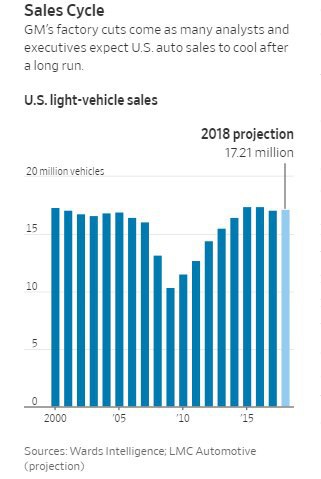
President Trump on Tuesday threatened to cut subsidies for General Motors Co., including for electric cars, a day after the company said it was planning to cut up to 14,800 jobs in the U.S. and Canada and end production at several North American factories.
“Very disappointed with General Motors and their CEO, Mary Barra, for closing plants in Ohio, Michigan and Maryland. Nothing being closed in Mexico & China. The U.S. saved General Motors, and this is the THANKS we get!” Mr. Trump tweeted.
GM has lobbied federal lawmakers to extend a $7,500 income-tax credit that hundreds of thousands of buyers have qualified for since the Obama administration established the credit as an incentive to get more electric vehicles on the road.
The provision has allowed GM to keep the post-credit starting price of its Chevrolet Bolt electric car at around $30,000. GM has said it expects to hit the 200,000 sales mark in coming months
🔻 The World’s Priciest Property Market Is Getting (a Bit) Cheaper
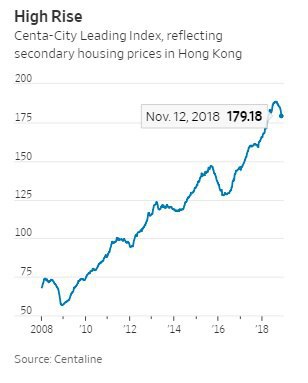
Hong Kong apartments have been an excellent investment: Prices have tripled in the past decade. A tiny flat, slightly bigger than a parking space, can go for as much as $1 million in the city’s most expensive areas. But the market that only ever seemed to go up has started to turn lately. A housing-price index compiled by property agent Centaline has dropped 5% from its August peak. What matters more for the property market are the economic outlook and financial conditions locally and in mainland China. Hong Kong’s equity benchmark has fallen around 20% since mid-January. Meanwhile, buyers from mainland China may also be tightening their purse strings as the Chinese economy decelerates.
The sliding yuan is another negative factor—it has dropped around 10% since March against the Hong Kong dollar, which is pegged to its U.S. counterpart. Property markets in other popular destinations for Chinese home buyers have also slowed recently: Housing prices in Sydney, for example, have dropped 7% from a year ago.
How bad could things get? Hong Kong property prices fell by around 13% during the previous downturn in 2015 and 2016, which was triggered by a surprise yuan depreciation and stock-market meltdown in China.
🔻 Trade War Paradox in the United States
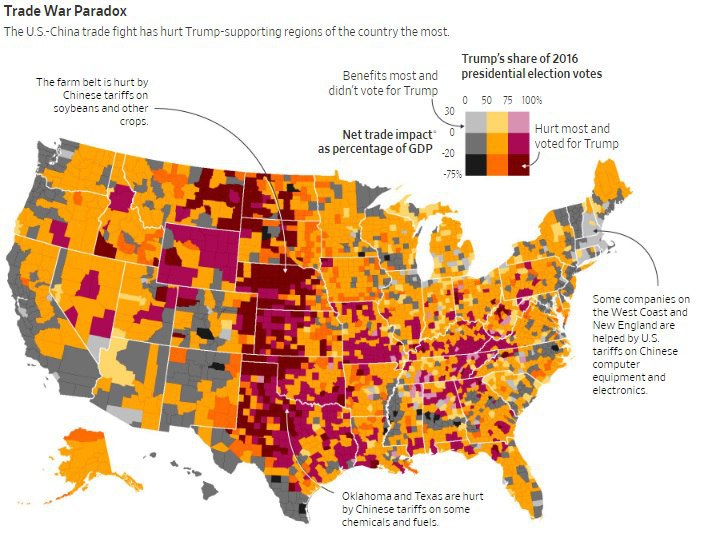
The U.S.-China trade war has hurt Trump-supporting regions of the country the most. However other benefit the most. More details can be seen of the graph below.
The U.S.-China trade war has hurt Trump-supporting regions of the country the most. However other benefit the most. More details can be seen of the graph below.
🔻 Tariff Bill
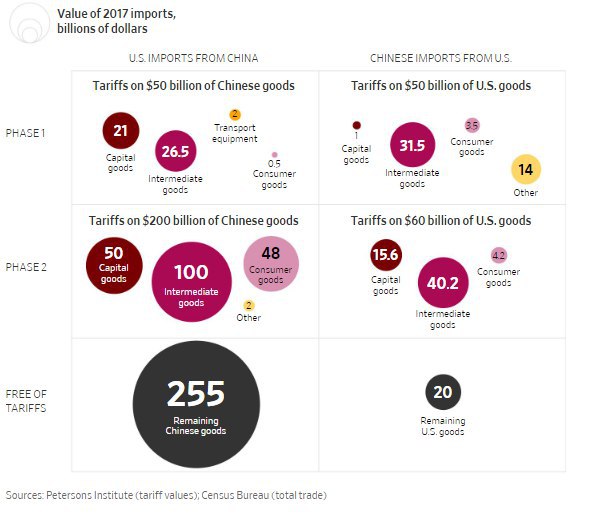
The U.S. and China have levied tariffs on hundreds of billions of dollars of imports so far. President Trump has threatened to impose tariffs on the rest of China's $505 billion in imports, which include mobile phones and laptop computers.
The U.S. and China have levied tariffs on hundreds of billions of dollars of imports so far. President Trump has threatened to impose tariffs on the rest of China's $505 billion in imports, which include mobile phones and laptop computers.
🔻 Oil Swoon Stirs Memory of 2014-16 Crash
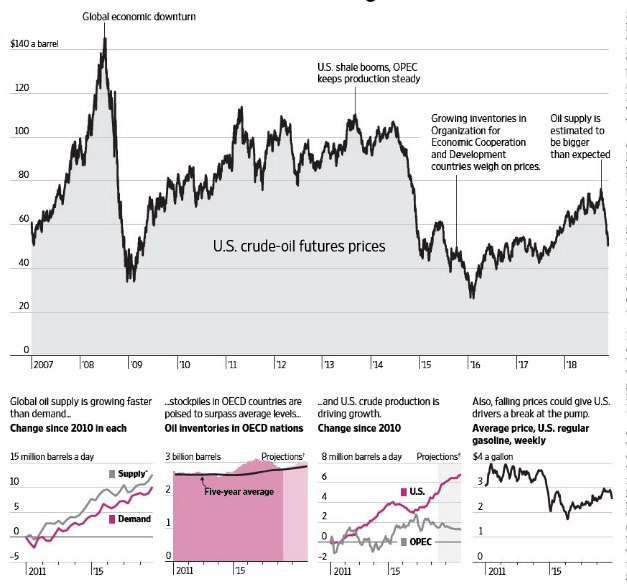
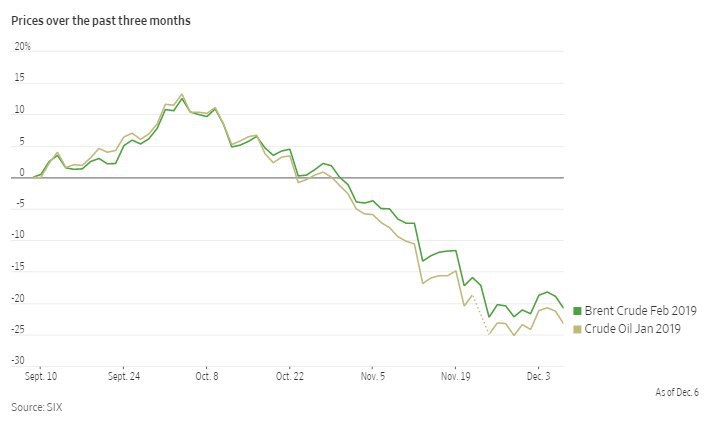
It was only at the start of October that analysts were wondering if oil would soon cost $100 a barrel. Then a trap door opened and oil prices have been in a rapid descent since, losing nearly a third of their value in about eight weeks, a wild slide that is reminding investors of the great oil-price collapse between 2014 and 2016
It was only at the start of October that analysts were wondering if oil would soon cost $100 a barrel. Then a trap door opened and oil prices have been in a rapid descent since, losing nearly a third of their value in about eight weeks, a wild slide that is reminding investors of the great oil-price collapse between 2014 and 2016
🔻 A New Kind of Lender Secretly Tracks Your Car to Make Sure You Pay Up
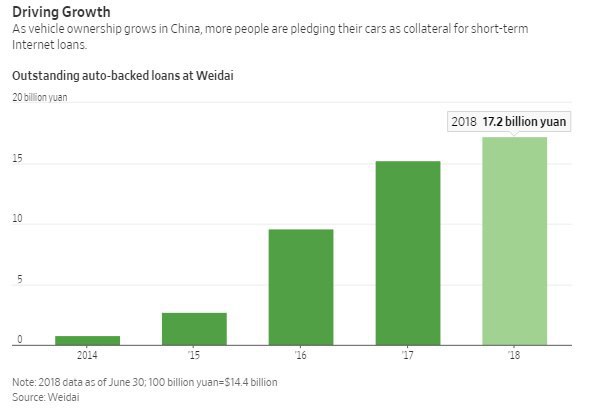
In China, a new type of internet loan comes with a catch: lenders can track your car’s whereabouts and can seize it if you fail to make payments. So-called auto-backed lenders—which charge annualized interest rates as high as 36%—install tracking devices in cars by hiding them. A New York-listed company that bills itself as China’s largest auto-backed loan platform by volume made 80.2 billion yuan ($11.5 billion) worth of such loans in 2017. The company, called Weidai Ltd. , said the loans had an average length of three months and it had a total outstanding balance of 17.2 billion yuan at the end of June, up from 12 billion yuan a year earlier. The total balance of outstanding peer-to-peer online loans in China peaked at 1.3 trillion yuan ($188 billion) in May before dropping to 832 billion yuan by October.
In China, a new type of internet loan comes with a catch: lenders can track your car’s whereabouts and can seize it if you fail to make payments. So-called auto-backed lenders—which charge annualized interest rates as high as 36%—install tracking devices in cars by hiding them. A New York-listed company that bills itself as China’s largest auto-backed loan platform by volume made 80.2 billion yuan ($11.5 billion) worth of such loans in 2017. The company, called Weidai Ltd. , said the loans had an average length of three months and it had a total outstanding balance of 17.2 billion yuan at the end of June, up from 12 billion yuan a year earlier. The total balance of outstanding peer-to-peer online loans in China peaked at 1.3 trillion yuan ($188 billion) in May before dropping to 832 billion yuan by October.
🔻 U.K., Bank of England Lay Out Economic Costs of Brexit Scenarios
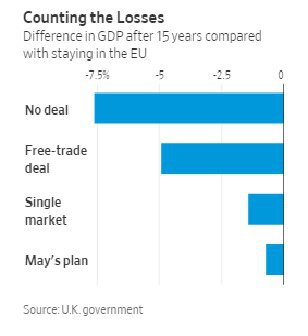
Analyses concluded that at the end of 2023, the economy would be between 1.25% and 3.75% smaller under Mrs. May’s plan than if the 2016 vote to leave had never happened, depending on the closeness of the economic ties finally negotiated.
Analyses show the cost of an abrupt and messy break with the EU would be much greater. If the U.K. crashes out of the bloc without a deal in March, the economy would be between 6.3% and 9% smaller after 15 years than if the U.K. remained an EU member, according to the government.
The Bank of England modeled what it described as a worst-case no-deal scenario, where ports freeze up, EU workers flee in the tens of thousands, tariffs and regulatory barriers shoot up, and interest rates ratchet higher to contain galloping inflation from a collapsing pound.
Such a doomsday scenario would lead to a 2019 recession deeper than that suffered during the financial crisis and leave the economy more than 10% smaller at the end of 2023 than it would have been had the U.K. never voted to leave.
🔻 U.S., China Reach a Truce on Trade
China and the U.S. agreed to a cease-fire in a trade battle that has shaken global markets, with the U.S. postponing plans to increase tariffs on $200 billion in Chinese goods and the two sides entering negotiations on other contentious issues.
According to the White House, the two nations will discuss thorny issues of Chinese economic policy, including forced technology transfer, intellectual-property protection, non-tariff barriers, cyberintrusions and cybertheft, services and agriculture. The two sides would “endeavor” to wrap up the talks in 90 days.
Should the talks fail, the White House said, the tariffs on the $200 billion of goods would increase to 25% from the current 10%.
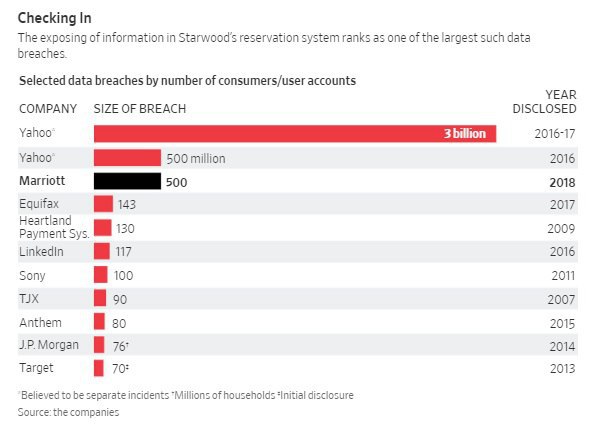
🔻 Marriott Says Starwood Data Breach Affects Up to 500 Million People
Marriott International Inc., which has more than 6,700 properties world-wide under 30 hotel brands, on Friday disclosed one of the biggest data breaches in history, a hack in the reservation database for its Starwood properties that may have exposed the personal information of up to 500 million guests.Hacked information includes passport numbers, payment-card numbers in addition to addresses, travel details.
Shares of Marriott fell 5.6% Friday and are down more than 9% over the past 12 months.
🔻 Crude Prices Rise After Russia, Saudi Arabia Agree to Extend Cuts
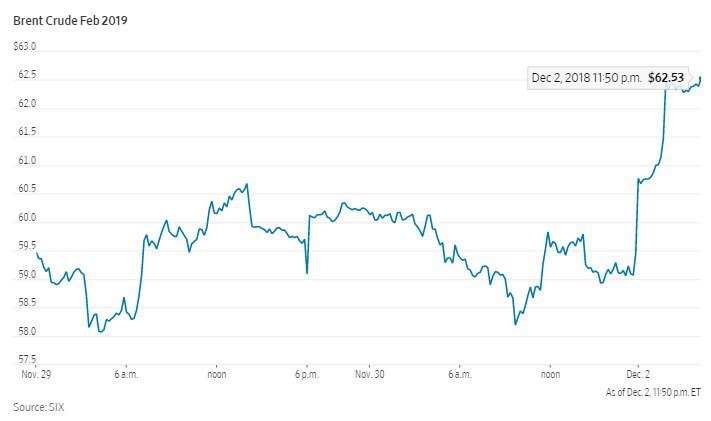
Oil prices climbed Monday after Russia said it would join Saudi Arabia in cutting crude output and the U.S. and China reached a truce over their trade dispute.
Speaking on the sidelines of the G-20 summit in Buenos Aires late Saturday, Russian President Vladimir Putin said he had agreed with the Saudis to extend a deal to cut oil production through next year, though he declined to specify volumes.
🔻 Economic Doubts Drag U.S. Treasury Benchmark Rate Further Below 3%
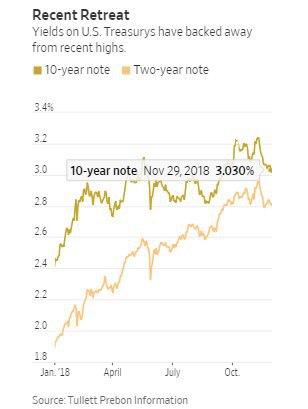
A weeks-long rally in government bonds pushed the yield on the benchmark 10-year Treasury note further below 3% Tuesday, signaling some investors are increasingly worried about the pace of U.S. growth.
Weighed down due to trade tensions, stock swings, falling oil prices and concerns that an economic slowdown outside the U.S. could weigh on the expansion here.
🔻 Chinese Dumped $1 Billion of U.S. Real Estate in Third Quarter
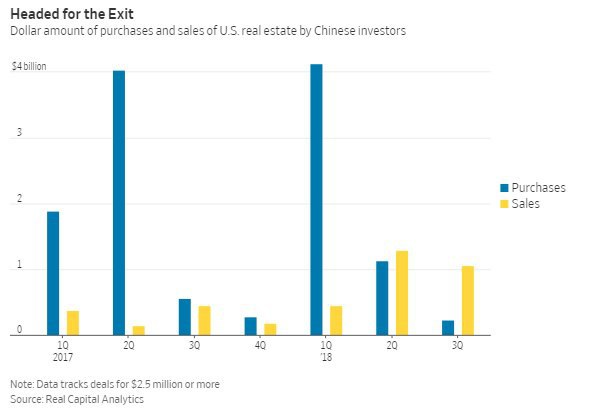
Chinese investors offloaded more than $1 billion in U.S. real estate in the third quarter, extending their recent retreat from hotels, office buildings and other foreign property under pressure from Beijing to reduce debt and curb money sent abroad.
Insurers, conglomerates and other big investors from China sold $1.05 billion worth of U.S. real estate in the third quarter, while purchasing $231 million of property, according to data firm Real Capital Analytics.
Chinese investors have spent tens of billions of dollars over the past five years to acquire U.S. real estate or land, favoring major metro areas like New York, Los Angeles, San Francisco and Chicago. Chinese buyers sometimes paid record prices to win trophy assets, punctuated by Anbang Insurance Group’s $1.95 billion acquisition of New York’s Waldorf Astoria in 2015—the highest price ever for a U.S. hotel.
🔻 Qatar to Withdraw From OPEC
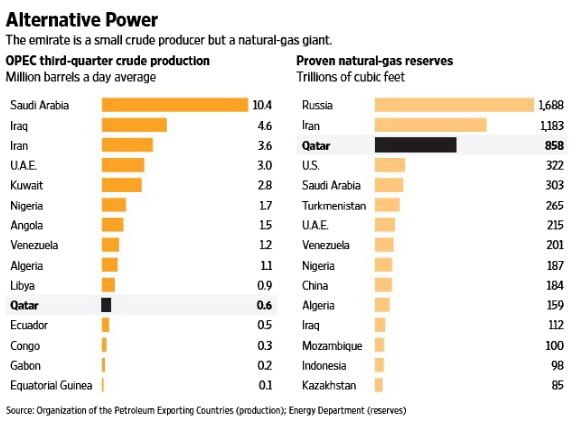
Everybody already knows that Qatar said it plans to leave OPEC after nearly six decades. But why Qatar decided to do so? The decision “will please Trump“as President Trump has criticized the group for increasing prices.
Qatar is one of the smaller oil producers in the Organization of the Petroleum Exporting Countries, but it is a powerhouse in the natural gas market.
Qatar’s absence is unlikely to have a material effect on OPEC’s goal of reducing output next year, However, it does come at a time when OPEC needs to hammer out a deal in the face of market skepticism in the cartel’s ability to control production
🔻 France as the Most Taxed Country
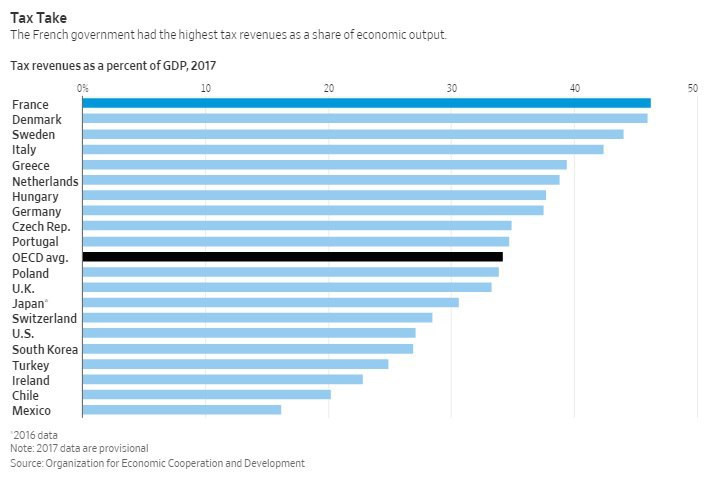
The Organization for Economic Cooperation and Development’s annual review of taxes in its 36 members published on Wednesday showed the French government’s tax revenues were the equivalent of 46.2% of economic output. Data comes a day after President Macron backed down from introducing a fuel tax increase following violent protests against the measure
The Organization for Economic Cooperation and Development’s annual review of taxes in its 36 members published on Wednesday showed the French government’s tax revenues were the equivalent of 46.2% of economic output. Data comes a day after President Macron backed down from introducing a fuel tax increase following violent protests against the measure
🔻 Palladium Challenges Gold as Top Metal
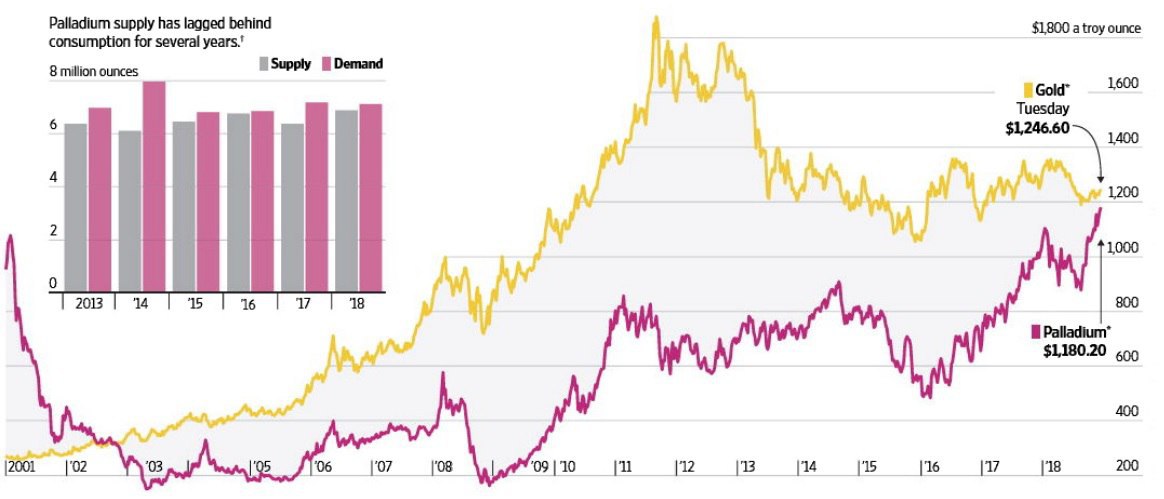
Prices are up more than 25% since the start of August and about 10% for the year, making the metal one of the market’s best-performing assets of 2018. Meanwhile, gold is down about 5% for the year.
Palladium has climbed to about $1,180.20 a troy ounce; gold has fallen to $1,246.60. The difference between the two is the narrowest since 2002.
Palladium got another boost over the weekend with the U.S. and China signaling progress on ending their monthslong trade dispute. Some analysts think a deal between the two countries could help stabilize demand from the auto sector, and many expect supply to decrease from producers including Russia and South Africa.
🔻 U.S.Postal Service plans to Hit Amazon
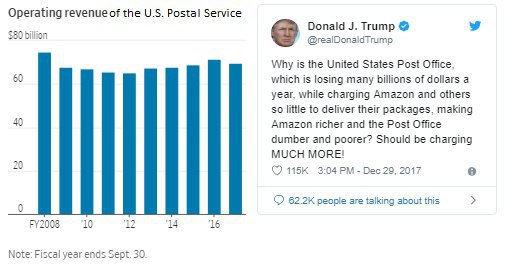
Mr. Trump has often claimed on Twitter that the Postal Service has given a sweetheart arrangement to Amazon, which he blames for unfairly hurting bricks-and-mortar retailing. Mr. Trump also has clashed with Amazon founder Jeff Bezos over coverage of his administration in the Washington Post, which is owned by Mr. Bezos
Prices for delivery will raise between 9.3% and 12.3%, starting early next year. Postal Service delivers up to 45% of Amazaon packages. FedEx and UPS would also be subject to the higher rates.
🔻 Banks May Be Safer in a Debt Crisis, But Investors Aren’t
U.S. and U.K. regulators last week sounded warnings about the knock-on effects for corporate debt markets when large institutional investors face demands for liquidity.
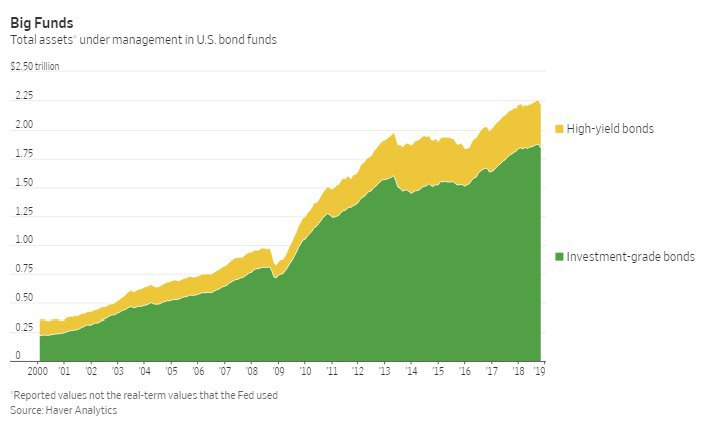
The Fed noted that lending commitments by large banks to nonbank financial firms rose to nearly $1 trillion by the middle of this year, from less than $600 billion five years ago. Most of the growth went to closed-end investment and mutual funds, real-estate investment trusts and special purpose vehicles.
Nonbanks have become much more important providers of credit to companies and individuals since the financial crisis as a result of stiffer regulations and higher capital requirements for banks. The Fed noted that mutual fund holdings of corporate debt had grown to about $2.3 trillion in September this year, from more than $500 billion at the end of 2009 in 2018 dollars.
🔻 Oil Prices Drop Sharply as OPEC Struggles to Agree on Cuts
Oil prices fell sharply Thursday after OPEC delayed a decision on cutting crude output, while a sliding stock market drove investors away from riskier assets across the board.
West Texas Intermediate futures dropped 3.3% to $51.17 a barrel on the New York Mercantile Exchange. The U.S. benchmark crude price briefly fell more than 5% to an intraday low of $50.08. Brent, the global benchmark, was 3.3% lower at $59.51 a barrel.
“Hopefully OPEC will be keeping oil flows as is, not restricted. The world does not want to see, or need, higher oil prices!” Mr. Trump tweeted Wednesday.
🔻 Arab Middle Class Tightens Belt
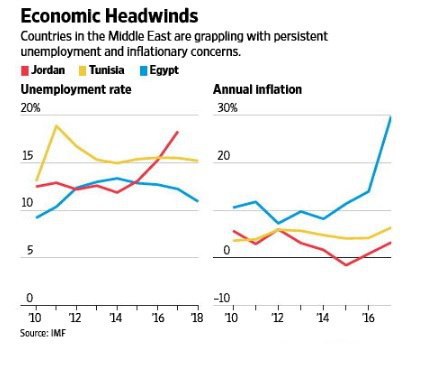
A wave of economic austerity is squeezing the Arab world’s middle class, pushing a segment of society that is key to growth and stability into making painful cutbacks and fueling discontent.
The Middle East faces an array of economic challenges, including from overhauls demanded by the IMF, which has granted $57 billion in rescue loans in recent years to stabilize and transform regional economies after the turmoil of the Arab Spring. The IMF required borrowers to reduce spending and balance budgets, which led to cuts in government payrolls and reduced subsidies for food, energy and other everyday goods.
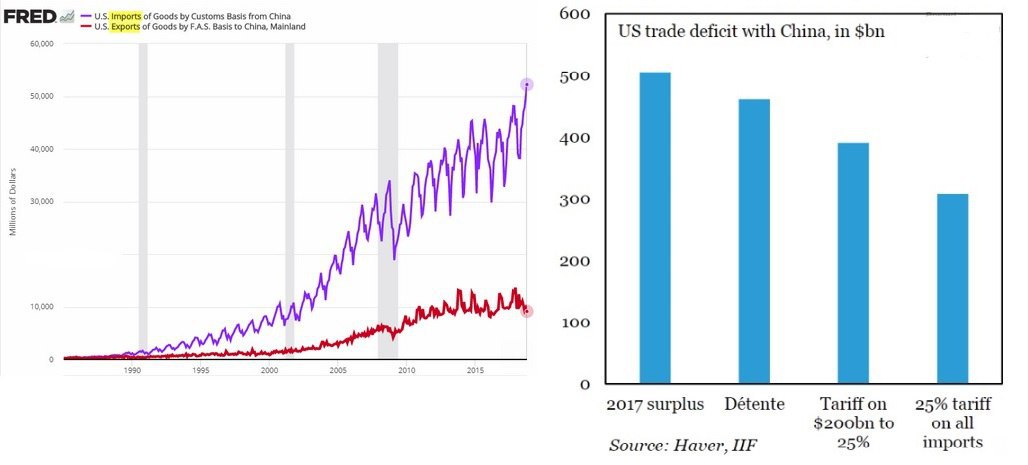
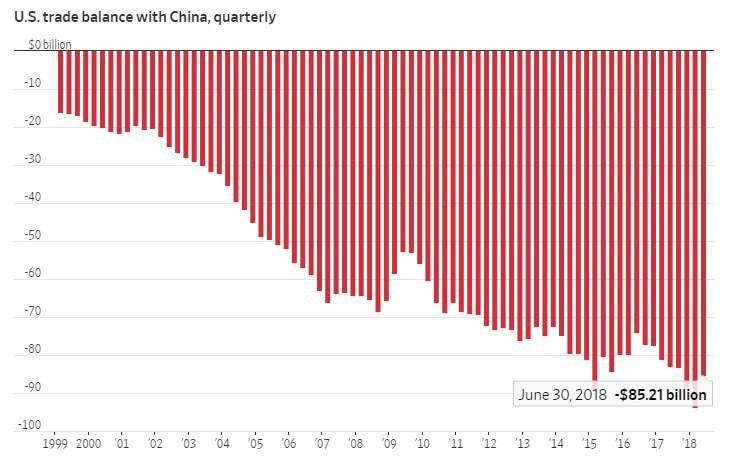
🔻 The US trade deficit hit the highest level in a decade as exports to China slump
Can tariffs against China lower the bilateral trade deficit? Yes, but it doesn't mean that the total US trade deficit will improve. In most cases, US importers will (over time) start sourcing from other countries.
Can tariffs against China lower the bilateral trade deficit? Yes, but it doesn't mean that the total US trade deficit will improve. In most cases, US importers will (over time) start sourcing from other countries.